Hazard & Risk
A concise Edexcel A Level Chemistry revision guide to the difference between hazards and risks in practical chemistry, including common laboratory hazards and how risk can be reduced during experiments.
- 5.16-a
- 5.16-b
- 5.16-c
What these spec points say
- 5.16-a understand risks in practical procedures
- 5.16-b understand hazards in practical procedures
- 5.16-c suggest appropriate precautions where necessary
Before You Start
This page builds on GCSE practical safety and hazard symbols.
- Hazard symbols warn that a substance is toxic, flammable, corrosive or oxidising.
- Eye protection is worn whenever chemicals are mixed or heated.
- Flammable liquids are kept away from naked flames.
- A fume cupboard removes toxic gases and vapours from the room.
GCSE Recap: Hazard Pictograms
Four quick GCSE questions on hazard pictograms and risk assessments before you meet the A Level definitions.
What Is a Hazard?
A hazard is a substance or procedure that has the potential to cause harm.
In chemistry, a hazard might be linked to a chemical substance, a piece of apparatus, a flame, a sharp object, a hot surface, pressure build-up or a practical procedure.
Definition: A hazard is something that could cause harm. It describes the possible danger before considering how likely that harm is to happen.
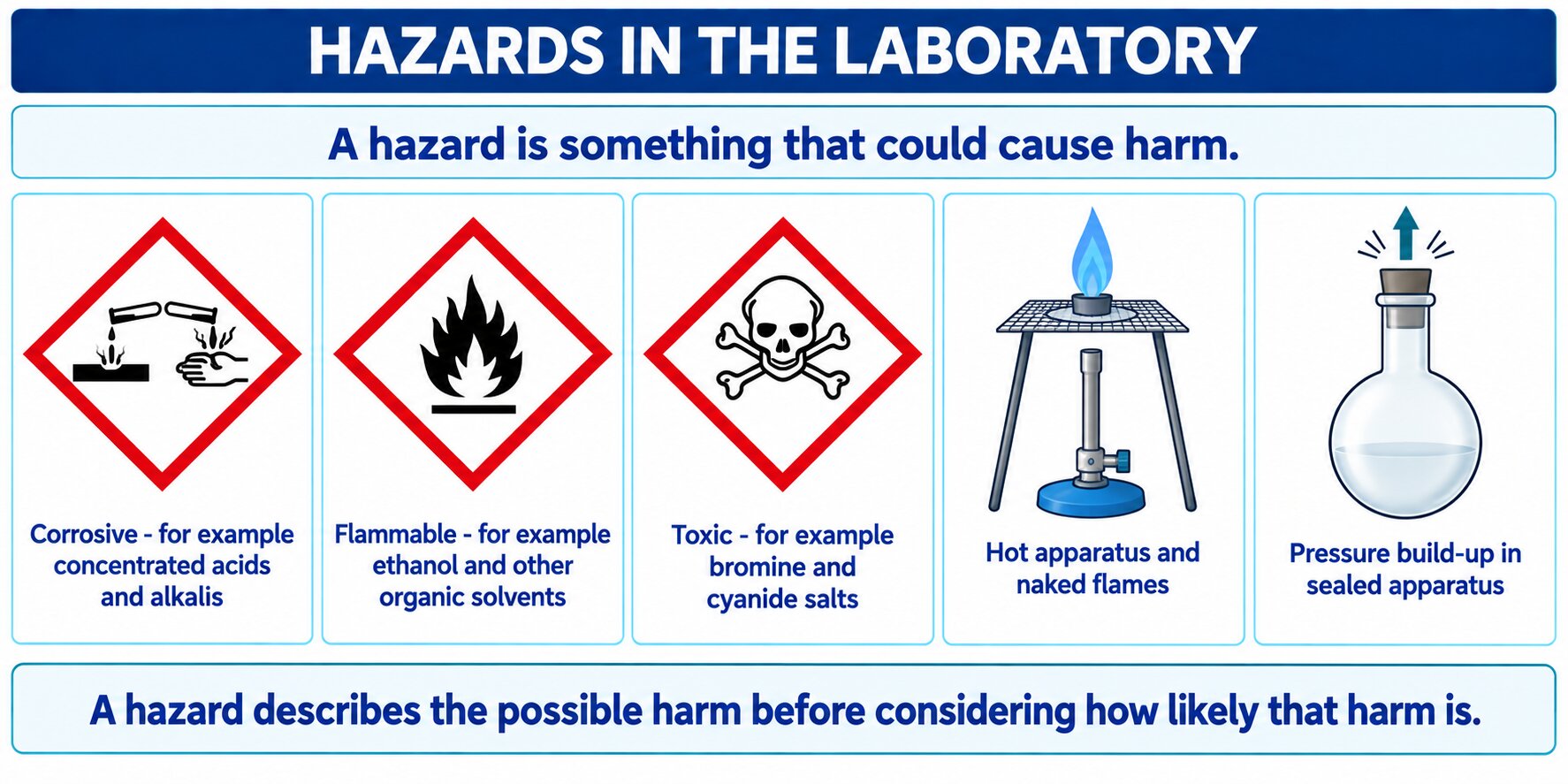
Hazards may come from the chemical itself, such as toxicity or flammability, or from how the substance or equipment is used.
Common Laboratory Hazards
Laboratory chemicals are often labelled according to the type of hazard they present. These labels help students and teachers decide what precautions are needed before practical work begins.
Labels also warn that a substance is explosive, a longer-term health hazard or dangerous for the environment. Harmful and irritant share one pictogram, so read the wording on the bottle as well as the symbol.
Important: The hazard describes the potential for harm. It does not automatically tell you how likely harm is under the exact practical conditions used.
Quick Check: Which Hazard Is It?
Read each description and choose the hazard label that fits.
What Is Risk?
Risk is the likelihood that harm will occur as a result of using a hazardous substance or carrying out a procedure, together with how severe that harm would be. A risk assessment judges both.
This means a hazardous substance can sometimes pose a lower risk if it is used in a low concentration, in a small amount, or with suitable safety precautions.
Definition: Risk describes how likely harm is to occur in a specific situation, and how serious that harm would be. It depends on the hazard, the quantity, the concentration, the method and the precautions used.
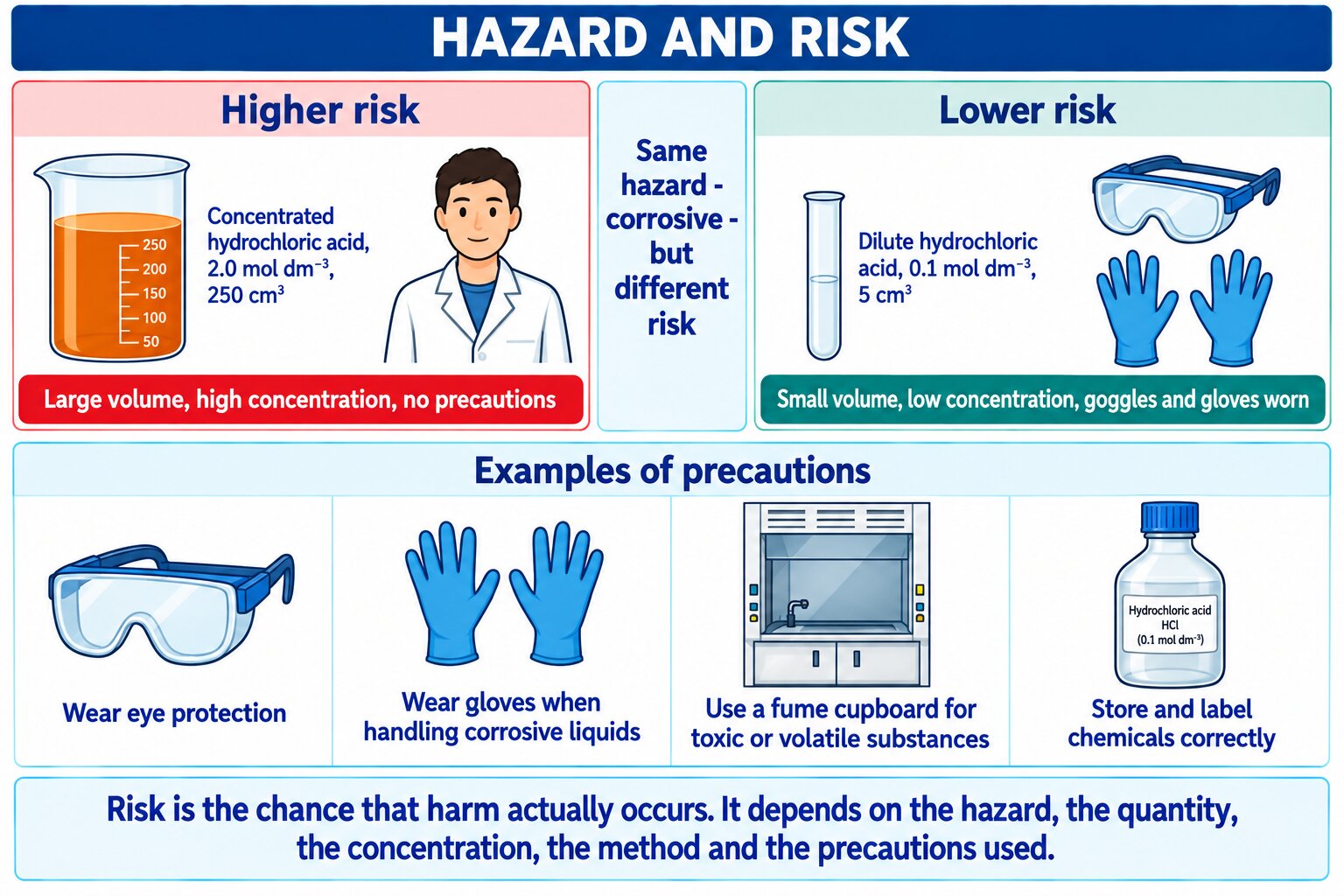
Risk is reduced by controlling how hazardous substances are handled, stored and used during practical work.
Quick Check: Same Chemical, Different Risk
Decide what is the same and what is different for the two students.
Hazard Compared with Risk
Students often confuse hazard and risk. A hazard is the possible source of harm. Risk is the chance that the harm will actually happen under the conditions used.
| Term | Meaning | Example in the laboratory |
|---|---|---|
| Hazard | A substance or procedure with the potential to cause harm. | Concentrated acid is corrosive because it can damage living tissue. |
| Risk | The likelihood that harm will occur in a particular situation. | The risk is lower if dilute acid is used in small amounts while wearing eye protection. |
Exam focus: If a question asks how to reduce risk, give a practical control measure, not just the name of the hazard.
Common mistake: Diluting the acid does lower the risk, but it also changes the hazard, because dilute acid is an irritant rather than corrosive.
To show the difference between hazard and risk, keep the same substance and change only the amount, the apparatus or the surroundings.
Quick Check: Explain Hazard and Risk
Write a short explanation, then compare it with the mark points and the model answer.
How Risks Can Be Reduced
Risks can be reduced by changing the scale of the experiment, changing the method or using precautions specific to the hazard.
| Method of reducing risk | What this means | Why it works |
|---|---|---|
| Work on a smaller scale | Use smaller amounts of the hazardous substance. | Less material is available to spill, burn, react or release harmful vapour. |
| Use specific precautions | Choose safety measures that match the hazard. | The control measure directly reduces the chance of harm from that particular hazard. |
| Use an alternative method | Use a safer procedure or less hazardous substance where possible. | Replacing the hazard, or reducing its severity, reduces the overall risk. |
| Hazard type | Suitable precaution |
|---|---|
| Irritant substances | Wear safety goggles, especially when using dilute acids and alkalis. |
| Corrosive substances | Wear goggles and gloves when handling concentrated acids and alkalis, use the lowest concentration that works and keep the volumes small. |
| Flammable substances | Keep away from naked flames. |
| Toxic substances | Wear gloves, avoid skin contact and wash hands after use. |
| Toxic or harmful gases and vapours | Work in a fume cupboard, or in a well-ventilated room, so the gas is drawn away and not breathed in. |
| Oxidising substances | Keep away from flammable or easily oxidised materials. |
Quick Check: Choose the Control Measure
For each practical situation, choose the control measure that matches the hazard.
Quick Check: Hazard or Risk?
In each round, choose the one statement that uses the words hazard and risk correctly.
Common Exam Mistakes
- Do not define hazard as the chance of harm. That is risk.
- Do not define risk as simply “danger”. Risk is the likelihood that harm will occur, and how severe that harm would be.
- Do not give vague precautions such as “be careful”. Give a specific safety measure linked to the hazard.
- Do not assume a hazardous chemical always has high risk. Concentration, amount and precautions affect risk.
FAQs
These questions secure the hazard and risk wording that examiners reward.
Is a hazard the same as a risk?
No. A hazard is anything with the potential to cause harm, such as a corrosive acid. Risk is how likely that harm is under the conditions used, and how severe it would be.
Do safety goggles reduce the hazard?
No. Goggles reduce the risk. The acid is just as corrosive; the precaution only makes harm to the eyes less likely.
Why is “be careful” not accepted as a precaution?
It names no action. Give a specific control linked to the hazard, such as a fume cupboard for a toxic gas or keeping a flammable liquid away from naked flames.
When must a fume cupboard be used?
Use one whenever a toxic or harmful gas or vapour is made or used, such as chlorine, sulfur dioxide or bromine. The fan draws the gas away from your breathing zone.
How does working on a smaller scale reduce risk?
Less of the hazardous substance is present, so a spill, fire or release of vapour is smaller and easier to control. The hazard itself is unchanged.

Copyright notice: This OLS revision content, including the explanations, layout, diagrams, tables and embedded learning structure, is authored for Online Learning System by Dr. Mohammed Al-Fatah. It may not be copied, reproduced, redistributed or adapted without written permission.
Keep this note — free
Save your progress across every Edexcel topic. A free account remembers which topics you have covered, saves your question scores, and syncs across your phone and laptop.
- Track every topic you have finished
- Keep your practice-question scores
- No payment, no card, free forever
Already registered? Log in