Atoms, Elements and Molecules
A concise revision guide to the meaning of atoms, elements, molecules, compounds and ions, including ionic charges, simple ionic formulae and monatomic, diatomic and polyatomic terminology.
- 3.10
What these spec points say
- 3.10 be able to write formulae given oxidation numbers
Before You Start
This page builds on GCSE work on atoms, elements, compounds and simple formulae.
- An element contains one type of atom; a compound contains two or more elements chemically combined.
- Atoms contain protons, neutrons and electrons, and an atom has no overall charge.
- Metal atoms lose electrons to form positive ions; non-metal atoms gain electrons to form negative ions.
- A formula such as H2O shows the number of atoms of each element in one particle.
GCSE Recap: Formulae, Compounds and Simple Ions
Before you read on, check the GCSE ideas about formulae, compounds and ions that this page builds on.
What Is an Element?
An element is a substance made from only one type of atom. Each element is represented by a chemical symbol, such as H for hydrogen, O for oxygen and Na for sodium.
Some element symbols have one capital letter. Others have two letters, where the first letter is capitalised and the second is lower case. For example, Cl represents chlorine, not C and l separately.
Key idea: an element cannot be broken down into simpler substances by chemical reactions.
What Is an Atom?
An atom is the smallest particle of an element that has the chemical properties of that element. For example, one oxygen atom still behaves as oxygen.
At this stage, you should remember that atoms contain smaller particles: protons, neutrons and electrons. You will study these in more detail in Topic 1: Atomic Structure and the Periodic Table.
Definition: an atom is the smallest particle of an element that can take part in chemical change while retaining the identity of that element.
Quick Check: Symbols and Formulae
Decide what is wrong with a formula that a student has written.
What Is a Molecule?
A molecule is a particle made from two or more atoms chemically bonded together.
If the atoms are all from the same element, the particle is a molecule of an element. For example, H2 is a molecule of hydrogen because it contains two hydrogen atoms bonded together.
If the atoms are from different elements, the particle is a molecule of a compound. For example, H2O contains hydrogen and oxygen atoms bonded together.
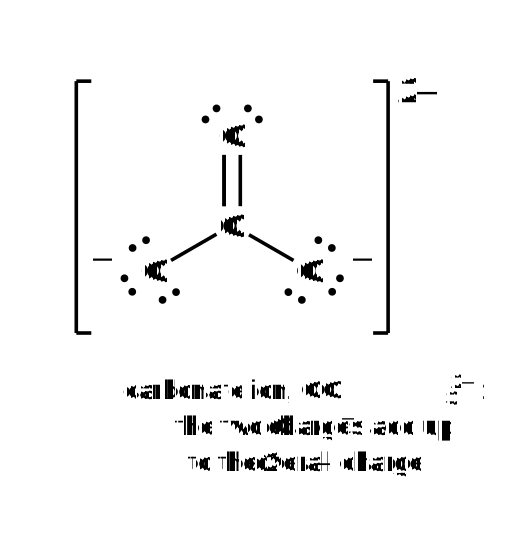
Educational chart showing atoms, elements, molecules, compounds and ions

This visual summary compares the key particle terms used in early chemistry, including atoms, elements, molecules and compounds.
What Is a Compound?
A compound is a substance containing atoms of two or more different elements chemically combined together.
Compounds have different properties from the elements that form them. For example, water, H2O, is a compound made from hydrogen and oxygen, but it does not behave like hydrogen gas or oxygen gas.
Exam focus: use the phrase chemically combined when defining a compound. A mixture is different because its substances are not chemically bonded together.
Quick Check: Which Particles Are Compounds
Click every formula that represents a molecule of a compound.
What Is an Ion?
An ion is a particle with an electric charge. It may be a single charged atom, such as Na+, or a group of atoms with an overall charge, such as SO42-.
A positively charged ion is called a cation. A negatively charged ion is called an anion.
Important: this page defines what an ion is and shows how ion charges are used in simple formulae. The formation of ions is covered in more detail when you study bonding and structure.
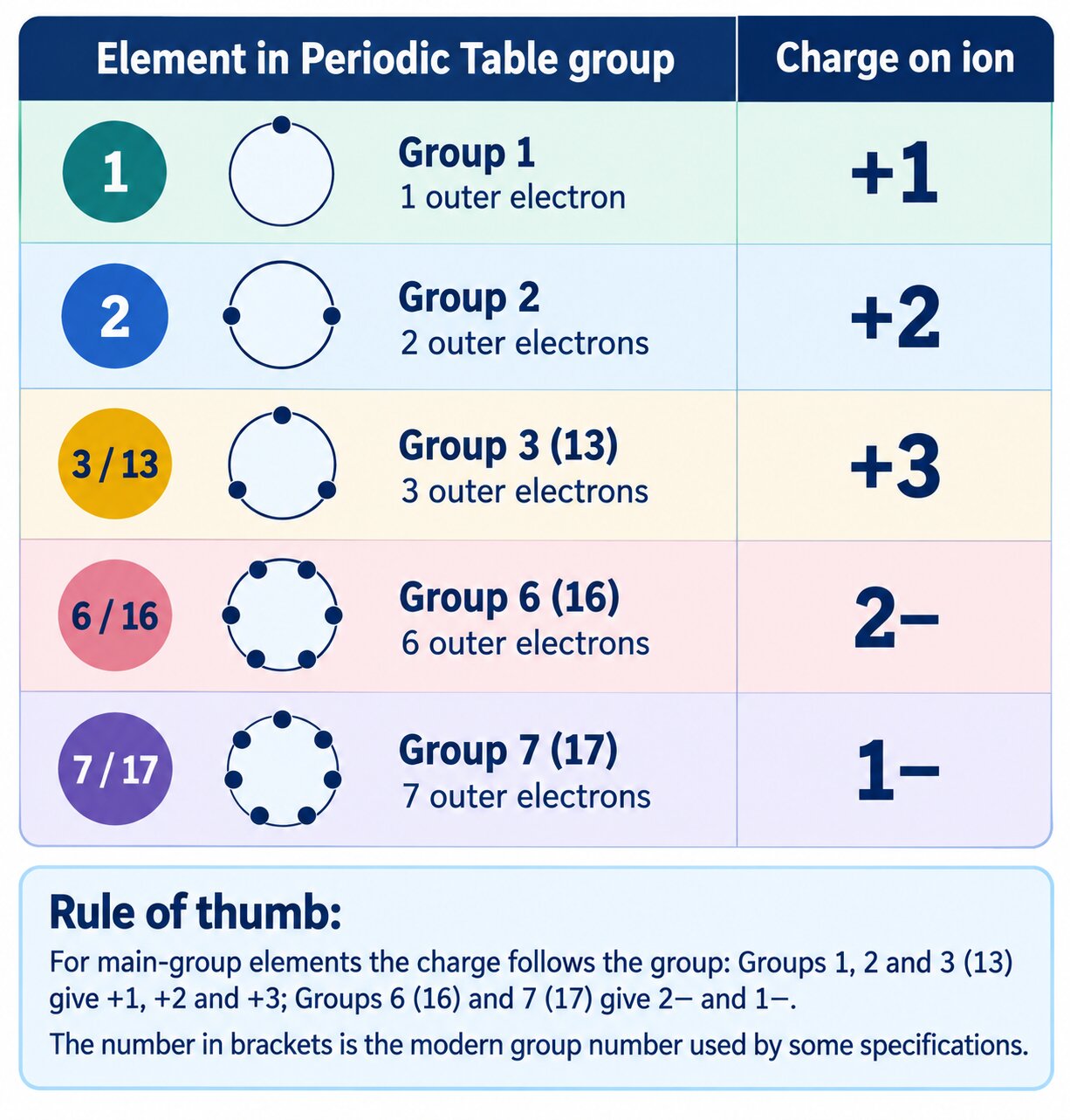
Ion charges linked to periodic table groups for common metal and non-metal ions
For many main-group ions, the group number helps predict the charge. Group 1 metals form +1 ions, Group 2 metals form +2 ions, Group 6 non-metals often form 2- ions and Group 7 non-metals often form 1- ions.
Quick Check: Reading an Ion
Answer each quick question about ions that are not on this page.
Working Out Formulae for Ionic Compounds
You cannot write balanced equations accurately until you can write formulae. For ionic compounds, the key rule is that the total positive charge and total negative charge must be equal, because the compound is electrically neutral overall.
Start by writing the ions with their charges. Then choose the smallest whole-number ratio of ions that makes the charges cancel out.
Sodium oxide
Sodium forms Na+ and oxygen forms O2-. Two sodium ions are needed for every oxide ion, so the formula is Na2O.
Barium nitrate
Barium forms Ba2+ and nitrate is NO3–. Two nitrate ions are needed for every barium ion, so the formula is Ba(NO3)2.
Iron(III) sulfate
Iron(III) tells you the ion is Fe3+. Sulfate is SO42-. The lowest common charge total is 6, so two Fe3+ ions and three SO42- ions are needed. The formula is Fe2(SO4)3.
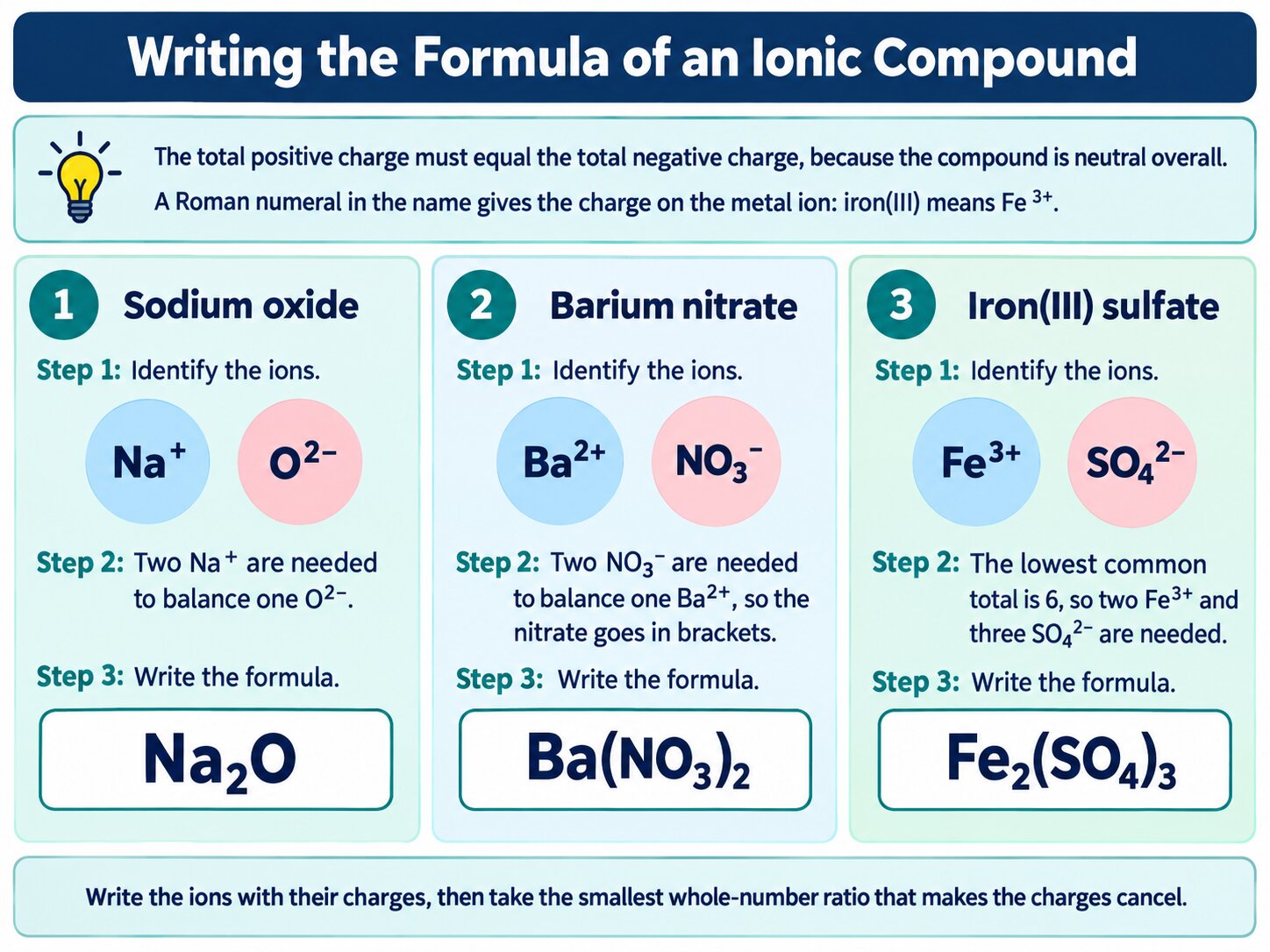
Step-by-step guide for determining ionic charges and writing ionic formulae
This step-by-step visual shows how ion charges are balanced to produce the correct formula for an ionic compound.
Bracket rule: use brackets when there is more than one polyatomic ion in the formula. For example, Ba(NO3)2 needs brackets because there are two nitrate ions.
Quick Check: Build Seven Formulae
Write each formula on paper, then flip the card to check.
Why Ion Charges Are Not Usually Written in Formulae
Ion charges can be shown when you are explaining how a formula is constructed, such as Na+ and Cl–. However, in the final formula of an ionic compound, the charges are normally omitted.
For example, sodium chloride is written as NaCl, not Na+Cl–, because the formula represents the electrically neutral compound. The charges are still there in the ions, but they are not shown in the final formula.
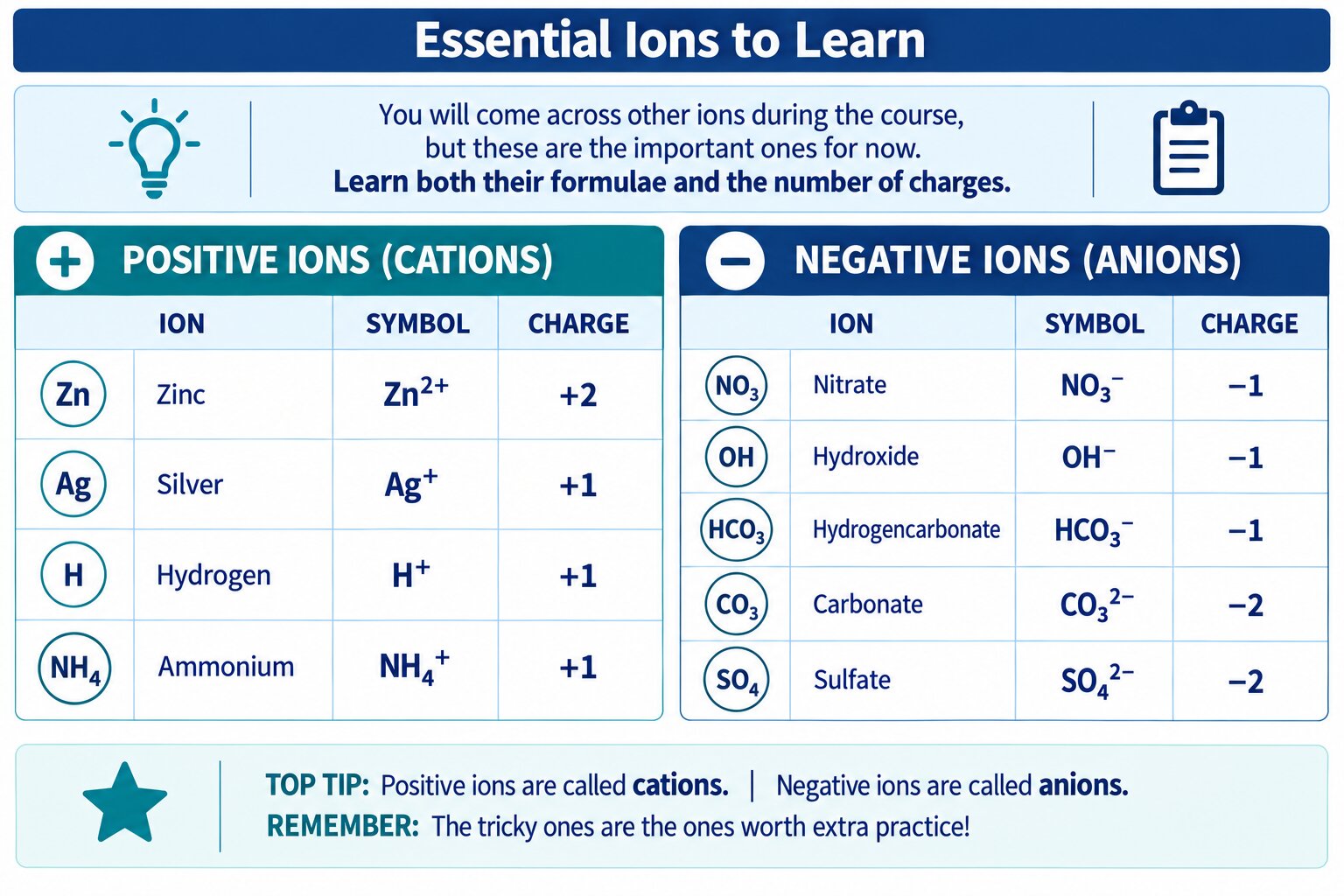
Use common ion charges carefully when constructing formulae. The final formula must be neutral overall, even though the individual ions are charged.
Quick Check: Spot the Accurate Statement
Pick the one accurate statement in each round.
Monatomic, Diatomic and Polyatomic Terms
These words describe how many atoms are present in a particle. They can be used for elements, molecules and ions.
| Term | Meaning | Examples |
|---|---|---|
| Monatomic | Made from single atoms or single-atom ions. | He, Ne, Cl– |
| Diatomic | Made from two atoms joined together, or an ion containing two atoms. | H2, N2, O2, OH– |
| Polyatomic | Made from several atoms joined together. | P4, CH4, SO42- |
Quick Check: The Words for Particles
Fit the word that describes each particle or substance into the grid.
Common Exam Points
- An element contains only one type of atom.
- A compound contains atoms of two or more different elements chemically combined.
- A molecule contains two or more atoms bonded together.
- H2 is a molecule of an element because it contains only hydrogen atoms.
- H2O is a molecule of a compound because it contains hydrogen and oxygen atoms.
- An ion has an overall positive or negative charge.
- A cation is positive. An anion is negative.
- Ionic compounds are neutral overall, so the total positive charge must equal the total negative charge.
- Use brackets when there is more than one polyatomic ion, such as Ba(NO3)2 or Fe2(SO4)3.
- Do not confuse chemical symbols with formulae. O is oxygen as an element symbol, while O2 is an oxygen molecule.
QuickSnap
This text summary condenses the page into the essential exam ideas.
- Element: a substance made from only one type of atom.
- Atom: the smallest particle of an element that retains that element’s chemical identity.
- Molecule: two or more atoms chemically bonded together.
- Compound: a substance containing atoms of different elements chemically combined.
- Ion: a charged particle. Positive ions are cations and negative ions are anions.
- Ionic formulae: total positive charge must equal total negative charge because ionic compounds are neutral overall.
- Brackets: use brackets when a formula contains more than one polyatomic ion, such as Ba(NO3)2.
- Formulae: H2 shows two hydrogen atoms in one hydrogen molecule, while H2O shows two hydrogen atoms and one oxygen atom in water.
FAQs
Use these questions to secure the wording needed for written definitions and short exam responses.
What is the difference between an atom and an element?
An atom is a single particle. An element is a substance made from only one type of atom. For example, oxygen is an element, and one oxygen atom is one particle of that element.
What is the difference between a molecule and a compound?
A molecule is two or more atoms bonded together. A compound contains atoms of two or more different elements chemically combined. Some molecules are compounds, such as H2O, but some molecules are elements, such as H2.
Is H2 an element or a compound?
H2 is a molecule of an element. It contains two hydrogen atoms bonded together, but both atoms are the same element.
Why is H2O a compound?
H2O is a compound because it contains atoms of two different elements, hydrogen and oxygen, chemically bonded together.
What is the difference between a cation and an anion?
A cation is a positively charged ion. An anion is a negatively charged ion. For example, Na+ is a cation and Cl– is an anion.
How do you work out the formula of an ionic compound?
Write the ions with their charges, then choose the smallest whole-number ratio that makes the total positive charge equal the total negative charge.
When do you use brackets in an ionic formula?
Use brackets when there is more than one polyatomic ion. For example, barium nitrate is Ba(NO3)2 because there are two nitrate ions.
Why are ion charges not usually shown in final formulae?
The final formula represents an electrically neutral compound, so the charges are not normally written even though the particles present are ions.
Copyright notice: This OLS revision content, including the explanations, layout, diagrams, tables and embedded learning structure, is authored for Online Learning System by Dr. Mohammed Al-Fatah. It may not be copied, reproduced, redistributed or adapted without written permission.
Keep this note — free
Save your progress across every Edexcel topic. A free account remembers which topics you have covered, saves your question scores, and syncs across your phone and laptop.
- Track every topic you have finished
- Keep your practice-question scores
- No payment, no card, free forever
Already registered? Log in