Comparing Masses of Substances
A focused revision guide to relative atomic mass, relative formula mass, percentage composition and hydrated salts. These ideas allow chemists to compare masses of atoms, compounds and water of crystallisation using the carbon-12 scale.
Relative Atomic Mass
Atoms are far too small to measure conveniently in grams during ordinary chemical calculations. Instead, atomic masses are compared with the mass of an atom of the carbon-12 isotope.
The carbon-12 scale defines one atomic mass unit as 1/12 of the mass of one carbon-12 atom. On this scale, a carbon-12 atom has a mass of exactly 12 units.
Relative atomic mass, Ar: the weighted mean mass of the atoms of an element compared with 1/12 of the mass of a carbon-12 atom.
The word weighted matters. Most elements exist as a mixture of isotopes, so the relative atomic mass takes account of both the mass of each isotope and its relative abundance.
Key idea: relative atomic mass has no unit because it is a comparison with the carbon-12 standard.
Relative Formula Mass
The relative formula mass, Mr, is found by adding together the relative atomic masses of all the atoms shown in a formula.
The term relative molecular mass, sometimes written RMM, should only be used for substances that exist as molecules. Relative formula mass is safer because it applies to molecular substances, ionic compounds and giant structures.
Relative formula mass, Mr: the sum of the relative atomic masses of all atoms in the formula of a substance.
| Substance | Formula | Calculation | Mr |
|---|---|---|---|
| Carbon dioxide | CO2 | 12.0 + (2 × 16.0) | 44.0 |
| Calcium carbonate | CaCO3 | 40.1 + 12.0 + (3 × 16.0) | 100.1 |
| Magnesium nitrate | Mg(NO3)2 | 24.3 + 2(14.0 + 3 × 16.0) | 148.3 |
Exam focus: brackets multiply everything inside them. In Mg(NO3)2, there are two nitrogen atoms and six oxygen atoms.
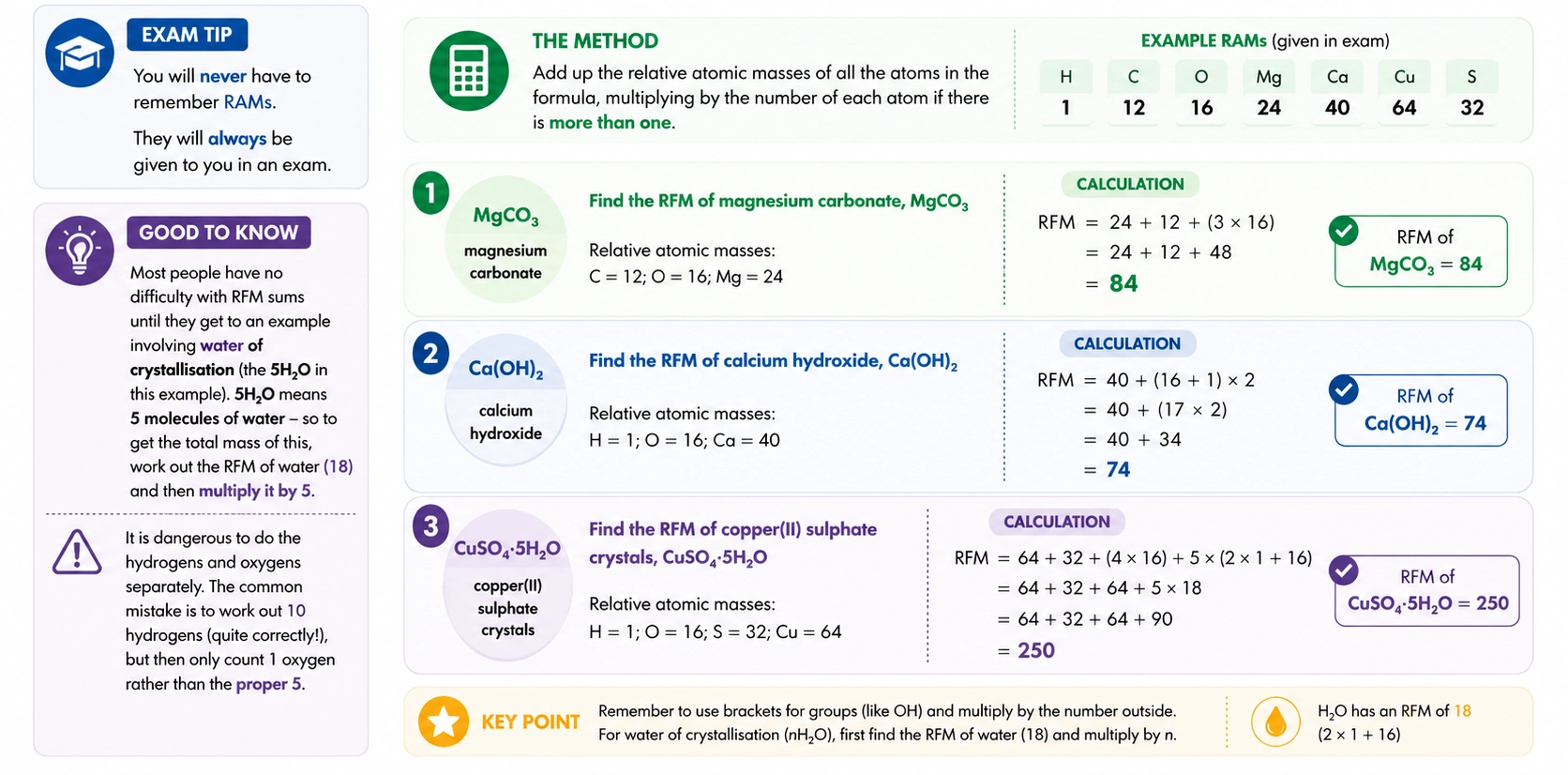
Relative formula mass is calculated by counting each atom in the formula and adding the correct relative atomic masses.
Check Your Understanding
Use this short activity to practise relative atomic mass and relative formula mass.
Using Mr to Find Percentage Composition
Percentage composition tells you what percentage of the mass of a compound comes from a particular element.
First calculate the Mr of the compound. Then work out the total mass contribution from the element being considered.
Percentage by mass of an element: (total Ar of that element in the formula ÷ Mr of the compound) × 100
Example: urea, CO(NH2)2
Mr = 12.0 + 16.0 + (2 × 14.0) + (4 × 1.0) = 60.0
Percentage of nitrogen in urea
Nitrogen contributes 28.0 out of 60.0, so percentage nitrogen = (28.0 ÷ 60.0) × 100 = 46.7%.
Common mistake: do not use the Ar of a single atom if the formula contains more than one atom of that element.
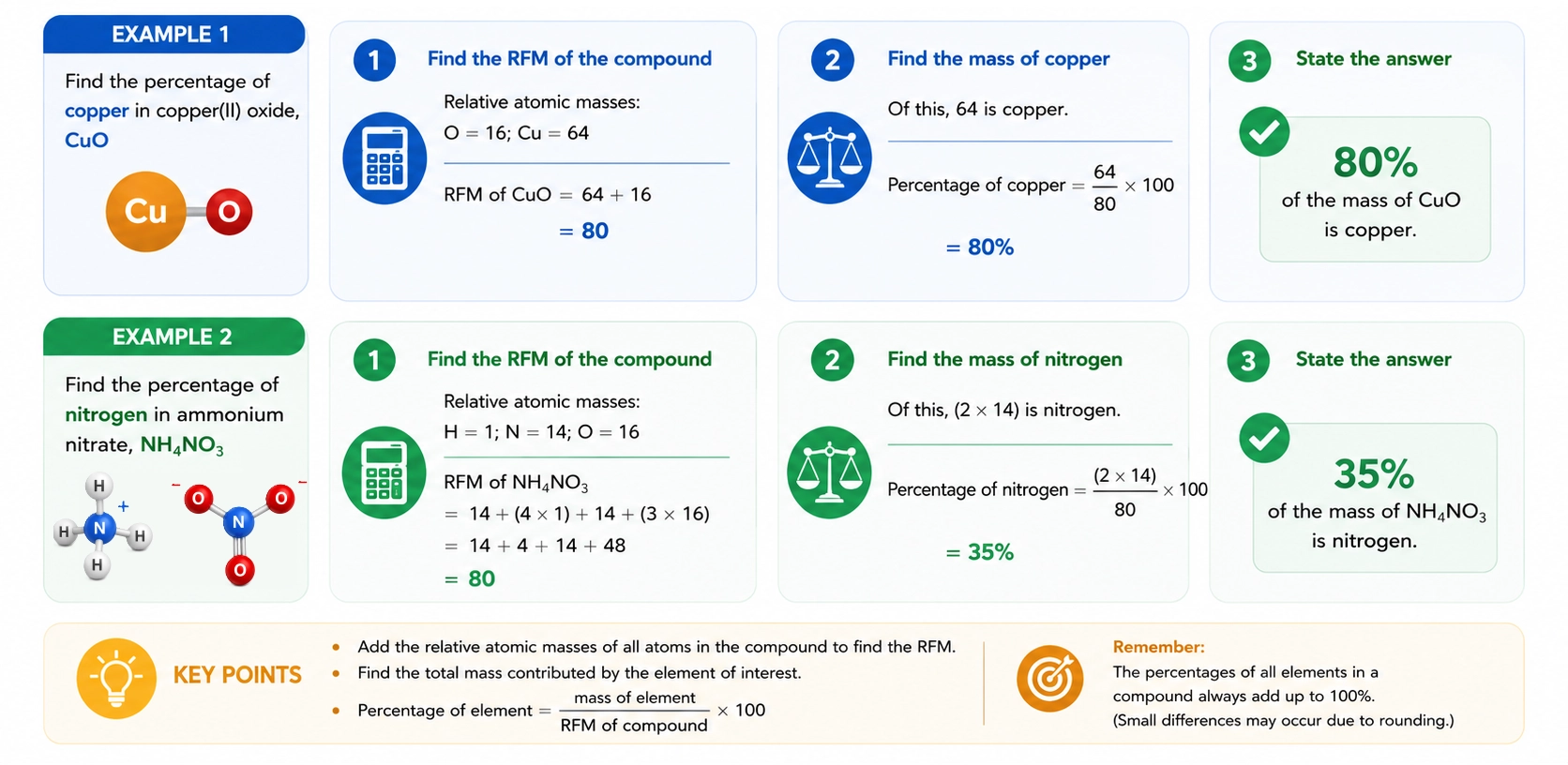
Percentage composition compares the mass contribution of one element with the total relative formula mass of the compound.
Check Your Understanding
Use this short activity to practise using Mr to find percentage composition.
Hydrated Salts
A hydrated salt is an ionic compound that contains water of crystallisation in its solid crystal structure. This water is shown using a dot in the formula, such as CuSO4·5H2O.
When a hydrated salt is heated strongly, the water of crystallisation can be driven off. The remaining solid is called the anhydrous salt.
Hydrated salt: a crystalline salt that contains a fixed number of water molecules chemically incorporated into its crystal structure.
| Term | Meaning | Example |
|---|---|---|
| Hydrated | Contains water of crystallisation. | CuSO4·5H2O |
| Anhydrous | Contains no water of crystallisation. | CuSO4 |
| Dot formula | Shows the ratio of salt formula units to water molecules. | ZnSO4·7H2O |
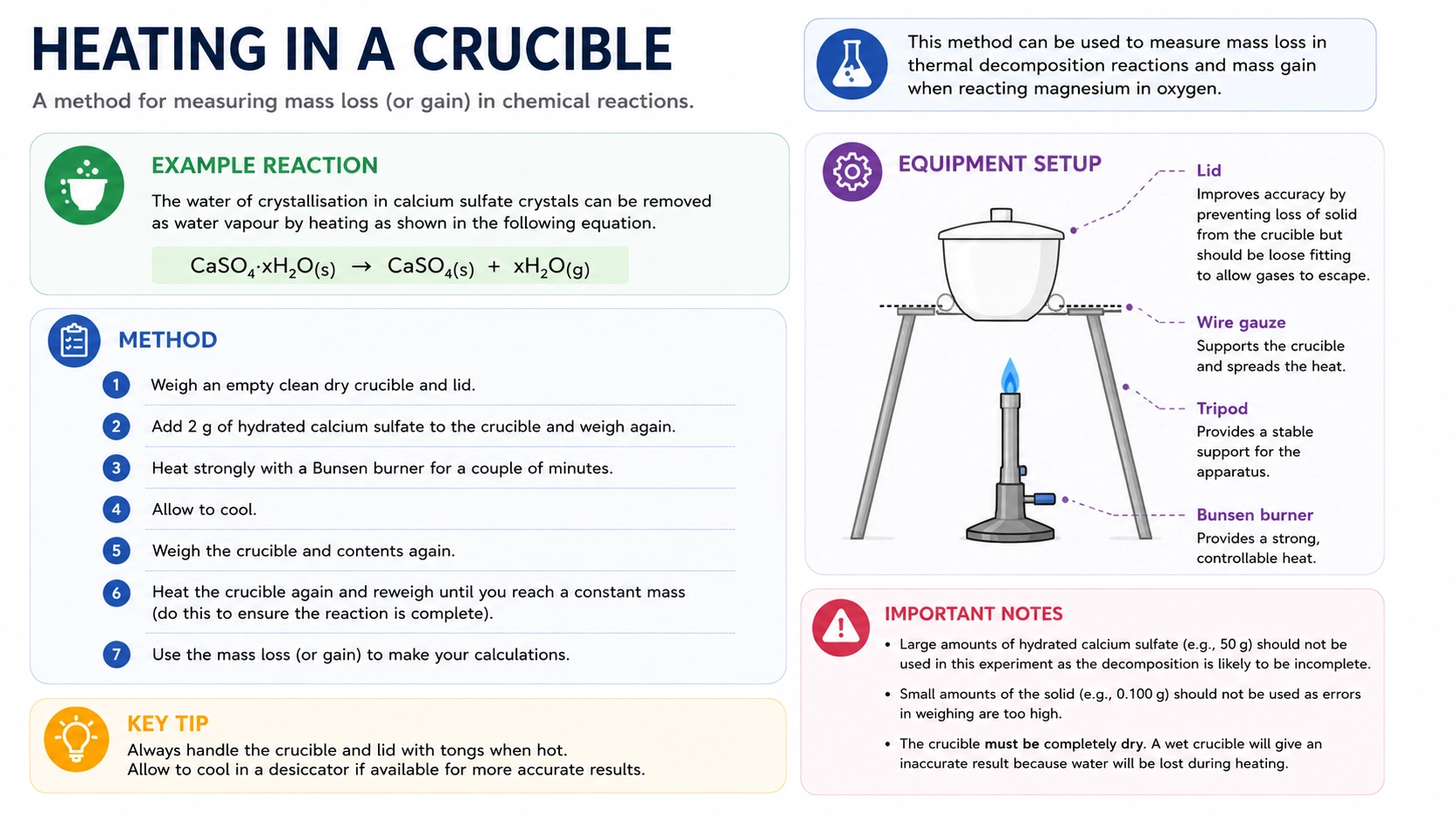
Heating a hydrated salt in a crucible allows the mass of water lost to be compared with the mass of anhydrous salt remaining.
Finding x in a Hydrated Salt Formula
To find the value of x in a formula such as ZnSO4·xH2O, compare the number of moles of anhydrous salt with the number of moles of water lost.
- Find the mass of water lost: hydrated salt mass minus anhydrous salt mass.
- Calculate moles of anhydrous salt using mass ÷ Mr.
- Calculate moles of water using mass ÷ 18.0.
- Divide both mole values by the smaller value to find the simplest ratio.
Worked pattern
If 3.51 g of hydrated zinc sulfate gives 1.97 g of anhydrous ZnSO4, then mass of water lost = 3.51 − 1.97 = 1.54 g.
Mole ratio
Moles of ZnSO4 = 1.97 ÷ 161.5 = 0.0122. Moles of H2O = 1.54 ÷ 18.0 = 0.0856. The ratio is approximately 1:7, so x = 7.
Final formula: ZnSO4·7H2O.
Common Exam Points
- Relative atomic mass, Ar, is measured relative to 1/12 of the mass of a carbon-12 atom.
- Ar is a weighted mean when an element has naturally occurring isotopes.
- Relative formula mass, Mr, is found by adding the Ar values of all atoms in the formula.
- Use brackets carefully. A subscript outside a bracket multiplies every atom inside the bracket.
- Percentage composition uses the mass contribution of one element divided by the total Mr, multiplied by 100.
- Hydrated salts contain water of crystallisation.
- Anhydrous salts contain no water of crystallisation.
- In hydrated salt calculations, the mass of water lost is found by subtracting the anhydrous mass from the hydrated mass.
- To find x in a hydrate, compare the mole ratio of anhydrous salt to water.
Check Your Understanding
Use this short activity to practise hydrated salt calculations.
QuickSnap
This text summary condenses the page into the essential exam ideas.
- Ar: weighted mean mass of atoms compared with 1/12 of carbon-12.
- Mr: sum of all relative atomic masses in the formula.
- Percentage composition: mass of the element in the formula ÷ total Mr × 100.
- Hydrated salt: a crystalline salt containing water of crystallisation.
- Anhydrous salt: the salt after water of crystallisation has been removed.
- Hydrate ratio: calculate moles of salt and water, then divide by the smaller value.
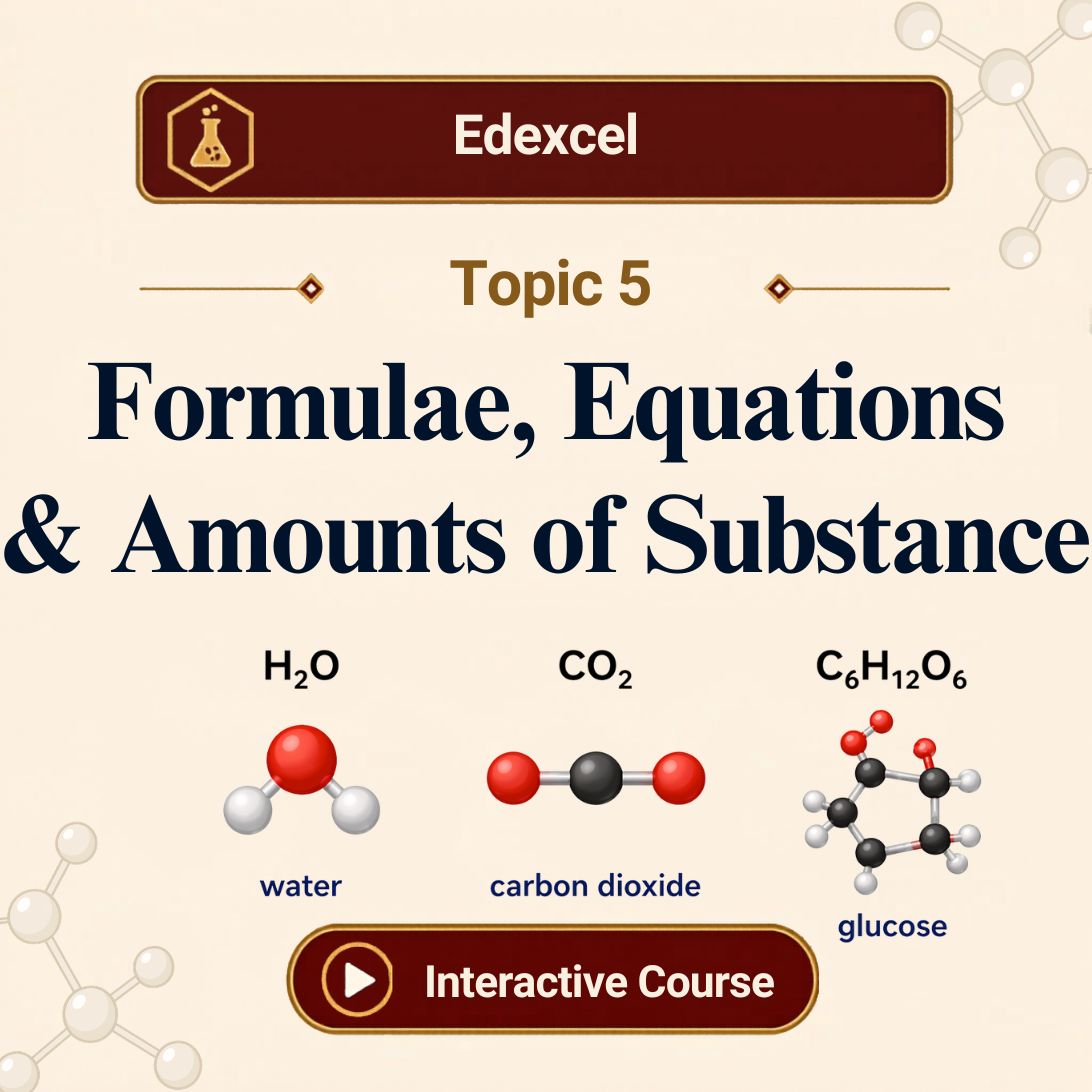
Master Formulae, Equations and Amounts of Substance for Edexcel A Level Chemistry
Continue from these free revision notes into the full Topic 5 Formulae, Equations and Amounts of Substance course, with guided video teaching, diagnostic MCQ practice, teacher-marked short-answer questions and a specification assignment with a personalised progress report.
Guided video teaching
Learn formulae, balanced equations, ionic equations, relative masses, mole calculations, empirical formulae, reacting masses, gas volumes, percentage yield and atom economy through structured video lessons with worked examples and walkthroughs.
Instant MCQ feedback
Auto-marked MCQ quizzes provide immediate diagnostic feedback for every answer choice.
Teacher-marked SAQs
Submit written exam responses and receive chemistry specialist feedback with improvement guidance.
Progress tracking
Identify strengths and weaknesses across formulae, equations, mole calculations, concentration, empirical formulae, percentage yield, atom economy and test-tube reactions with targeted reporting.
See how the course works
Click play to start the course preview animation.
A compound contains carbon, hydrogen and oxygen only. Its percentage composition by mass is shown.
| Element | Percentage by mass |
|---|---|
| C | 40.0% |
| H | 6.7% |
| O | 53.3% |
What is the empirical formula of the compound?
Explain how the volume of hydrogen can be used to calculate the amount of magnesium that reacted.
FAQs
These questions address common misconceptions students have when comparing masses of substances.
What is relative atomic mass?
Relative atomic mass is the weighted mean mass of atoms of an element compared with 1/12 of the mass of a carbon-12 atom.
What is the difference between Ar and Mr?
Ar is used for an element. Mr is used for a formula and is found by adding together the Ar values for all atoms in that formula.
Why is relative formula mass better than relative molecular mass?
Relative molecular mass applies properly to molecular substances. Relative formula mass is more general because it can be used for ionic compounds, molecules and giant structures.
How do I calculate percentage composition?
Find the total mass contribution from the element in the formula, divide by the Mr of the compound, then multiply by 100.
What is water of crystallisation?
Water of crystallisation is water chemically incorporated into the crystal structure of a hydrated salt in a fixed ratio.
How do I find x in a hydrated salt formula?
Calculate moles of anhydrous salt and moles of water lost, then divide both values by the smaller mole value to obtain the simplest ratio.
Copyright notice: This OLS revision content, including the explanations, layout, diagrams, tables and embedded learning structure, is authored for Online Learning System by Dr. Mohammed Al-Fatah. It may not be copied, reproduced, redistributed or adapted without written permission.