The Yield of a Reaction
A focused revision guide to percentage yield, actual yield and theoretical yield. This page links mole calculations to practical chemistry, where reactions rarely give the maximum possible amount of product.
Why Yield Matters
In ideal mole calculations, the balanced equation predicts the maximum mass of product that could be formed. In real practical chemistry, the amount collected is often lower than this maximum.
This is especially common in organic chemistry, where side reactions, transfers between containers, purification steps and incomplete reactions can reduce the final mass of pure product.
Key idea: yield calculations connect theoretical chemistry to the practical reality of making and isolating a product.
Actual Yield and Theoretical Yield
To calculate percentage yield, you need to compare two quantities: the mass of product that was actually obtained and the maximum mass that could have been obtained from the reactants.
| Term | Meaning | How it is found |
|---|---|---|
| Actual yield | The amount of product collected in the experiment. | Measured directly in the practical or stated in the question. |
| Theoretical yield | The maximum amount of product that could be made if the reaction went perfectly. | Calculated from the balanced equation using mole ratios. |
| Percentage yield | The actual yield expressed as a percentage of the theoretical yield. | Use actual yield ÷ theoretical yield × 100. |
The Percentage Yield Formula
The percentage yield formula compares what you obtained with what you could theoretically have obtained.
Percentage yield = actual yield ÷ theoretical yield × 100
Both yields must use the same unit. If the actual yield is in grams, the theoretical yield must also be in grams. If the actual yield is in moles, the theoretical yield must also be in moles.
Exam focus: the theoretical yield is not measured in the lab. It is calculated from the balanced equation.
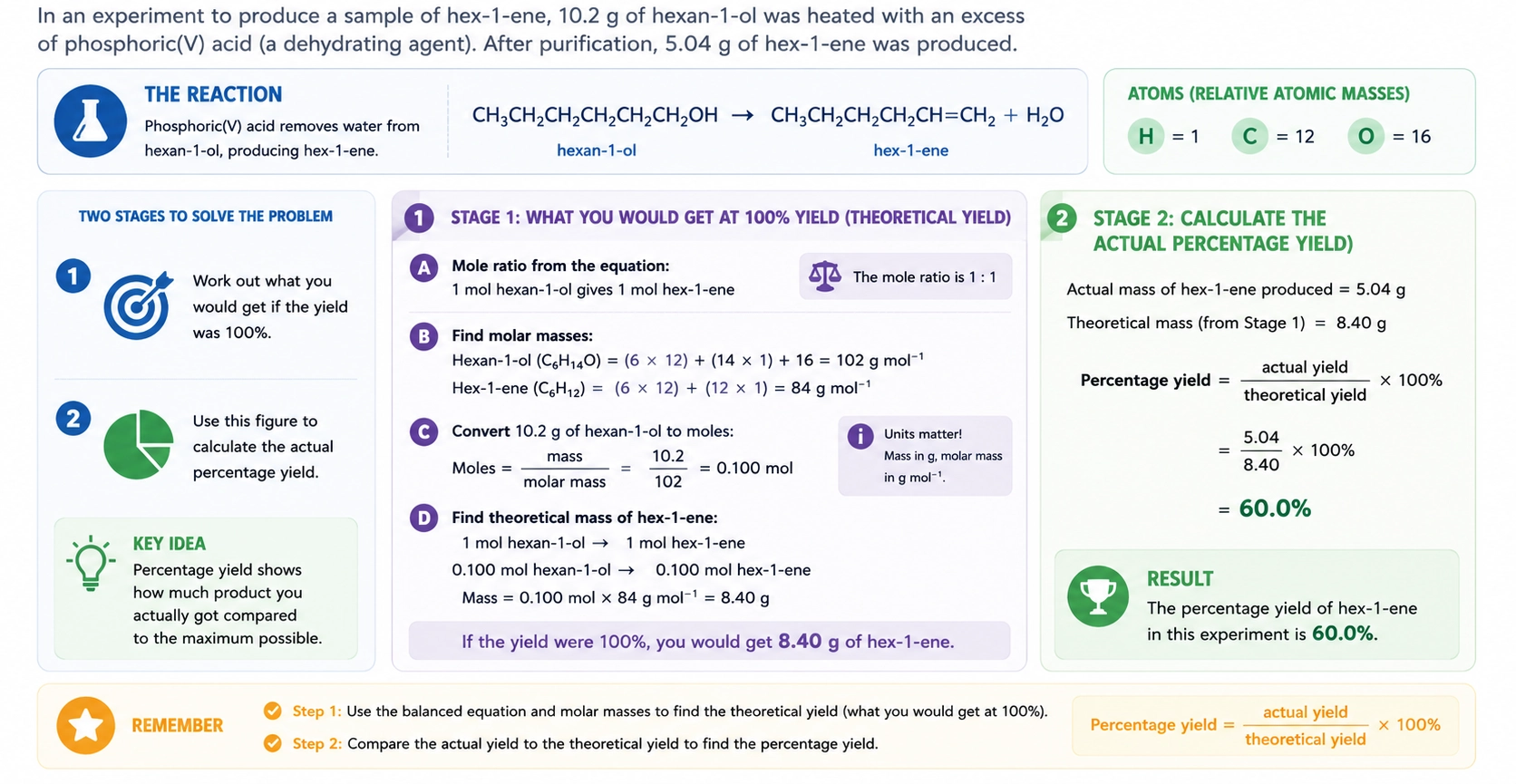
Use the formula only after the theoretical yield has been calculated from the balanced equation.
Calculating Theoretical Yield First
Most exam questions do not give the theoretical yield directly. You usually calculate it first using moles, the balanced equation and relative formula mass.
Step 1: calculate the amount of reactant
Use amount = mass ÷ molar mass.
Step 2: use the mole ratio
Use the coefficients in the balanced equation to convert from reactant moles to product moles.
Step 3: calculate the theoretical mass
Use mass = amount × molar mass.
Step 4: calculate percentage yield
Compare the actual yield with the theoretical yield, then multiply by 100.
Worked Example: Iron from Iron(III) Oxide
Question: 25.0 g of Fe2O3 reacts with carbon monoxide and 10.0 g of Fe is produced. Calculate the percentage yield.
Balanced equation: Fe2O3 + 3CO → 2Fe + 3CO2
| Stage | Working | Result |
|---|---|---|
| Amount of Fe2O3 | Mr of Fe2O3 = 159.6 amount = 25.0 ÷ 159.6 |
0.1566 mol |
| Mole ratio | 1 mol Fe2O3 produces 2 mol Fe | 0.3132 mol Fe |
| Theoretical mass of Fe | mass = amount × Mr mass = 0.3132 × 55.8 |
17.5 g Fe |
| Percentage yield | percentage yield = 10.0 ÷ 17.5 × 100 | 57.1% |
Answer: the percentage yield is 57.1%, because only 10.0 g of iron was obtained from a possible 17.5 g.
Practice the Core Method
Use this short task to check that you can connect actual yield, theoretical yield and percentage yield.
Using Density in Yield Calculations
Sometimes a practical gives a product volume rather than a product mass. If the product is a liquid and its density is given, calculate the mass before calculating the yield.
mass = density × volume
Check the units carefully. If density is given in g cm-3, volume should be in cm3, giving mass in grams.
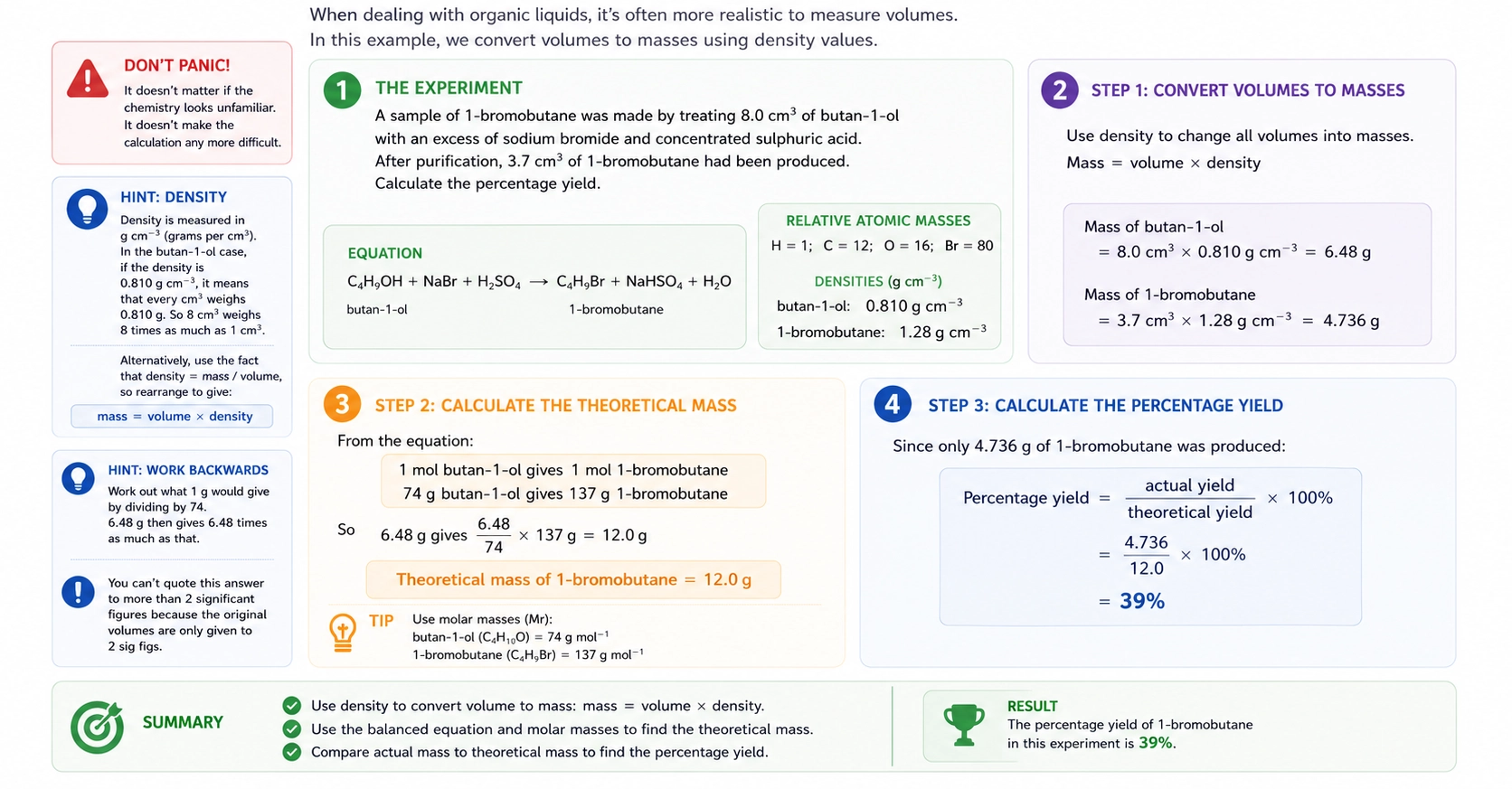
When a liquid product is measured by volume, density converts the volume into the mass needed for the percentage yield calculation.
Why Yield Is Less Than 100%
A reaction often has a percentage yield below 100% because the theoretical yield assumes perfect conditions. Practical chemistry involves losses and limitations.
| Reason | How it lowers yield | Example wording |
|---|---|---|
| Incomplete reaction | Not all reactant particles are converted into product. | The reaction may not go to completion. |
| Side reactions | Some reactant forms unwanted products instead of the desired product. | A competing reaction uses some starting material. |
| Transfer losses | Product may be left on glassware, filter paper or inside apparatus. | Some product is lost during transfer. |
| Purification losses | Recrystallisation, filtration, washing or drying may remove some product. | Some product is lost during purification. |
Percentage Yield Study Guide
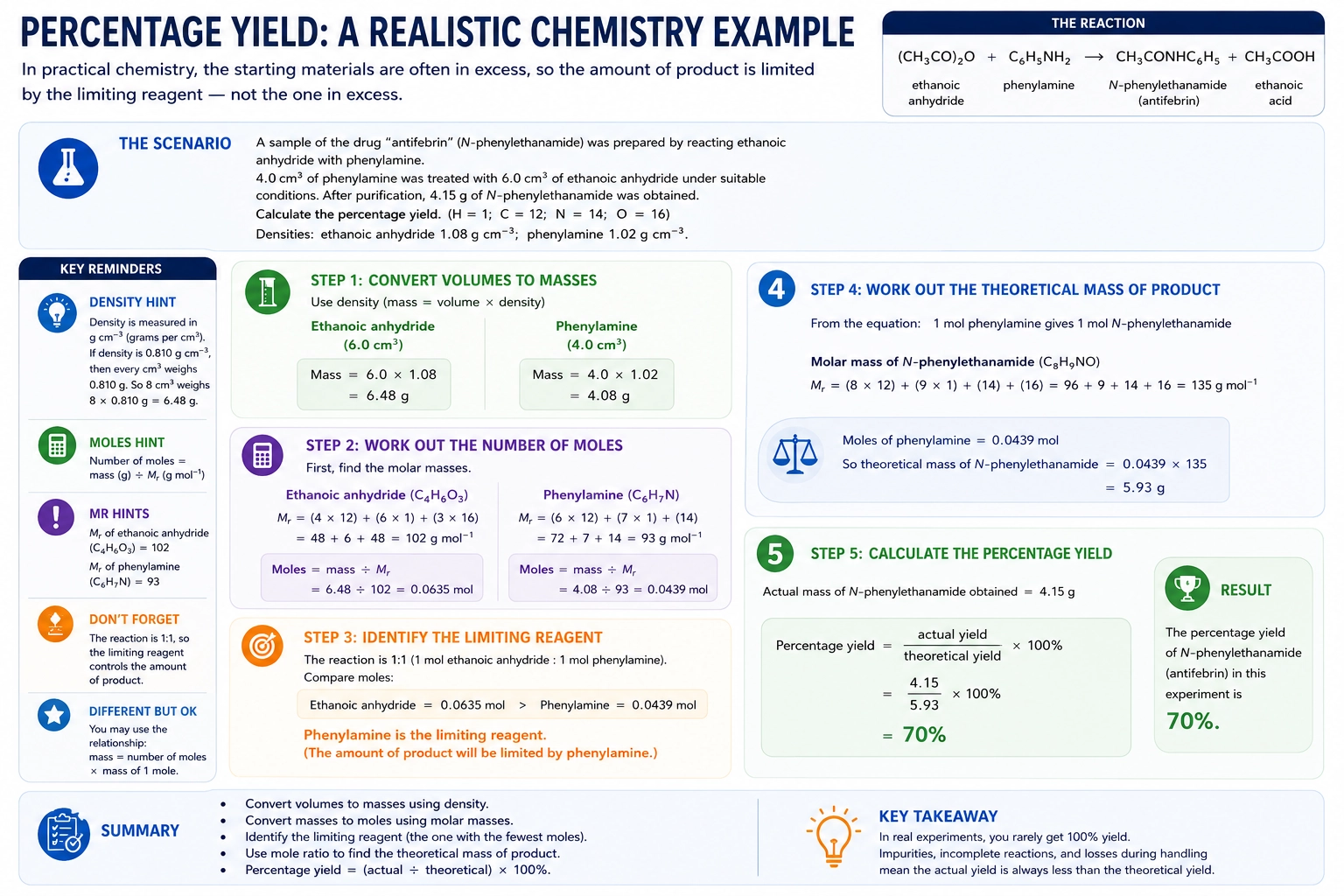
A compact visual summary linking actual yield, theoretical yield and the practical reasons why yields are often below 100%.
Common Exam Points
- Actual yield is the mass of product obtained in the experiment.
- Theoretical yield is the maximum mass predicted by the balanced equation.
- Percentage yield is calculated using actual yield ÷ theoretical yield × 100.
- Use the balanced equation to work out the theoretical yield before using the percentage yield formula.
- The actual yield and theoretical yield must be in the same units.
- Percentage yield below 100% can be caused by incomplete reactions, side reactions and product loss.
- A result above 100% usually indicates impurity, wet product or experimental error.
Check Your Understanding
Use this final short task to consolidate the relationship between theoretical yield, actual yield and practical losses.
QuickSnap
This text summary condenses the page into the essential exam ideas.
- Actual yield: the amount of product collected in the experiment.
- Theoretical yield: the maximum amount predicted by the balanced equation.
- Percentage yield: actual yield ÷ theoretical yield × 100.
- Main method: calculate theoretical yield first, then compare it with the actual yield.
- Low yield: usually caused by incomplete reaction, side reaction, transfer loss or purification loss.
- Exam warning: a yield greater than 100% suggests a problem such as wet or impure product.
Master Formulae, Equations and Amounts of Substance for Edexcel A Level Chemistry
Continue from these free revision notes into the full Topic 5 Formulae, Equations and Amounts of Substance course, with guided video teaching, diagnostic MCQ practice, teacher-marked short-answer questions and a specification assignment with a personalised progress report.
Guided video teaching
Learn formulae, balanced equations, ionic equations, relative masses, mole calculations, empirical formulae, reacting masses, gas volumes, percentage yield and atom economy through structured video lessons with worked examples and walkthroughs.
Instant MCQ feedback
Auto-marked MCQ quizzes provide immediate diagnostic feedback for every answer choice.
Teacher-marked SAQs
Submit written exam responses and receive chemistry specialist feedback with improvement guidance.
Progress tracking
Identify strengths and weaknesses across formulae, equations, mole calculations, concentration, empirical formulae, percentage yield, atom economy and test-tube reactions with targeted reporting.
See how the course works
Click play to start the course preview animation.
A compound contains carbon, hydrogen and oxygen only. Its percentage composition by mass is shown.
| Element | Percentage by mass |
|---|---|
| C | 40.0% |
| H | 6.7% |
| O | 53.3% |
What is the empirical formula of the compound?
Explain how the volume of hydrogen can be used to calculate the amount of magnesium that reacted.
FAQs
These questions address common misconceptions students have when learning percentage yield calculations.
What is percentage yield?
Percentage yield compares the actual amount of product obtained with the theoretical maximum amount predicted by the balanced equation. It is calculated using actual yield ÷ theoretical yield × 100.
What is the difference between actual yield and theoretical yield?
Actual yield is the amount collected in the experiment. Theoretical yield is the maximum possible amount calculated from the balanced equation, assuming no losses and complete reaction.
Why is percentage yield often less than 100%?
Yield is often less than 100% because reactions may be incomplete, side reactions may occur, and product may be lost during transfer, filtration, washing, drying or purification.
Can percentage yield be more than 100%?
A value above 100% usually indicates an experimental or calculation problem. Common causes include wet product, impurities, weighing errors or using the wrong theoretical yield.
Why do I need the balanced equation for yield calculations?
The balanced equation gives the mole ratio between the reactant and product. This ratio is needed to calculate the theoretical yield before the percentage yield can be found.
Copyright notice: This OLS revision content, including the explanations, layout, diagrams, tables and embedded learning structure, is authored for Online Learning System by Dr. Mohammed Al-Fatah. It may not be copied, reproduced, redistributed or adapted without written permission.