CP3: Finding the Concentration of Hydrochloric Acid
A guided walkthrough of Core Practical 3 for Edexcel International A Level Chemistry. This page takes you through the dilution step, the titration method, the end point, concordant titres, and the full concentration calculation using sample data.
What This Practical Measures
In this practical, you are finding the concentration of an original hydrochloric acid solution. You do this by first diluting an accurately measured sample of hydrochloric acid, then titrating aliquots of the diluted acid against a previously standardised sodium hydroxide solution.
The chemical reaction is:
HCl + NaOH → NaCl + H2O
This is a 1:1 reaction, so the moles of sodium hydroxide in the titre equal the moles of hydrochloric acid in the aliquot at the end point.
Measure
Use a pipette to transfer 25.0 cm3 of hydrochloric acid accurately.
Dilute
Make it up to 250 cm3 in a volumetric flask with distilled water.
Titrate
Titrate 25.0 cm3 aliquots of the diluted acid with standardised NaOH.
Calculate
Use the mean titre to calculate the concentration of the original acid.
Key idea: this practical is really about linking accurate measurements to stoichiometry. If your technique is sound, the calculation becomes straightforward.
Apparatus and Safety
You need a burette, clamp and stand, conical flask, 25 cm3 volumetric pipette and safety filler, 250 cm3 volumetric flask, beakers, sodium hydroxide solution, hydrochloric acid solution, phenolphthalein, and distilled water.
Safety matters because both the acid and the alkali can irritate skin and eyes. Sodium hydroxide is especially hazardous to the eyes, so eye protection is essential. You must also use a pipette filler rather than mouth pipetting.
Essential safety
Wear goggles, avoid skin contact with the acid, alkali and indicator, and take care when clamping and filling the burette so it does not crack or topple over.
Technique reminder
Record burette readings to the nearest 0.05 cm3. Do not include the rough titre when calculating the mean.
Step 1: Dilute the Hydrochloric Acid Accurately
Wash out the 250 cm3 volumetric flask with distilled water. Then use a volumetric pipette to transfer 25.0 cm3 of the original hydrochloric acid into the flask. Add distilled water until the bottom of the meniscus sits exactly on the mark.
This dilution stage matters because the full 250 cm3 flask now contains all the moles that were originally present in the 25.0 cm3 sample. Later, you will titrate just a 25.0 cm3 aliquot of this diluted solution, so you must scale back up in the final calculation.
Remember: do not force out the final drop from the volumetric pipette. The pipette is calibrated so that a small amount remains inside after delivery.
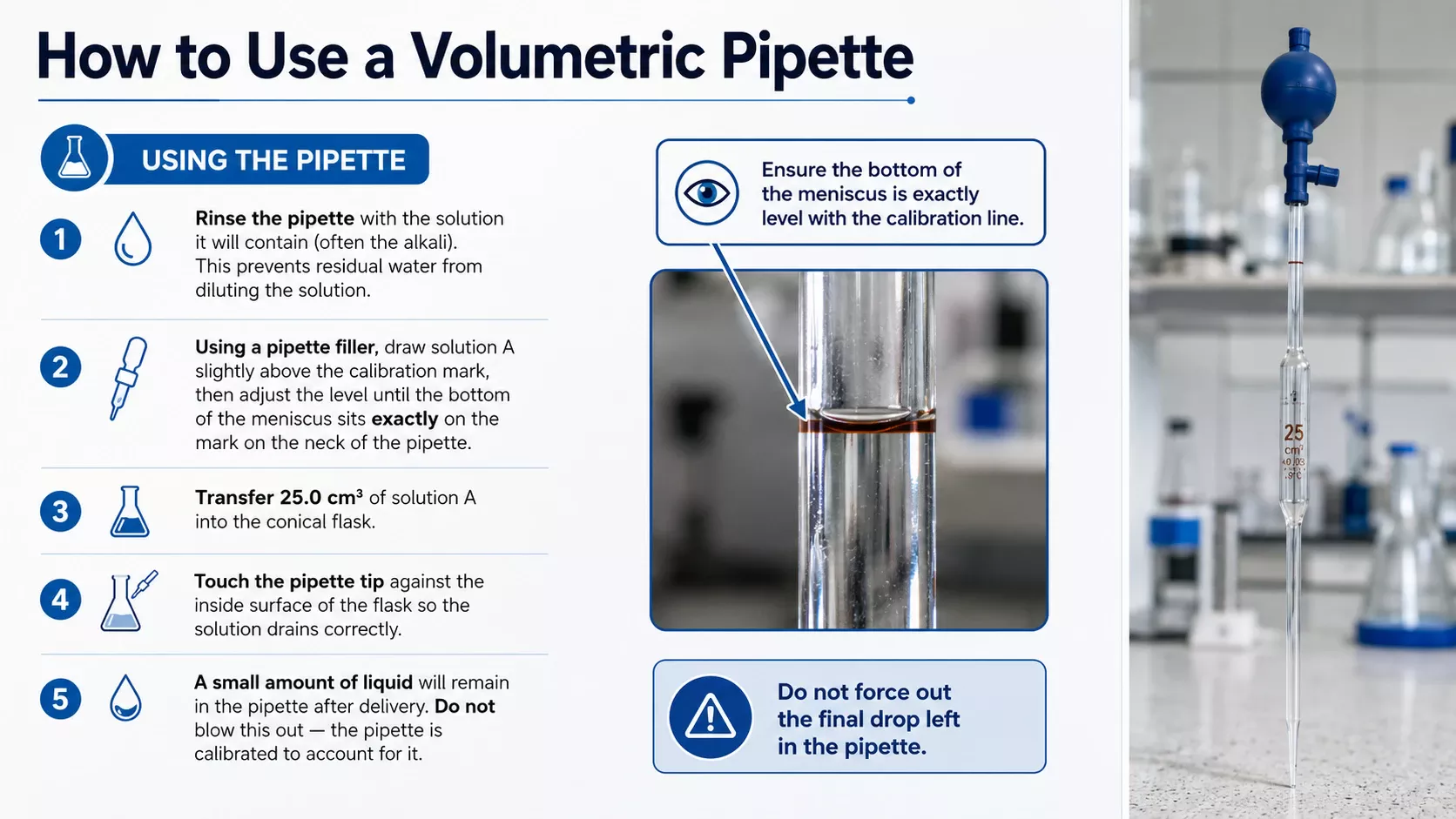
Using the volumetric pipette
Rinse the pipette with the solution it will contain, set the meniscus at the calibration line, deliver 25.0 cm3, and do not blow out the final drop.
Step 2: Set Up and Run the Titration
Prepare the titration apparatus carefully. The burette should contain the standardised sodium hydroxide solution, and the conical flask should contain 25.0 cm3 of the diluted hydrochloric acid.
Rinse the burette with the sodium hydroxide solution before filling it. Make sure the jet tip is completely filled and contains no air bubbles. Then pipette a 25.0 cm3 aliquot of the diluted acid into the conical flask and add a few drops of phenolphthalein indicator.
During the titration, swirl the flask continuously. As you approach the end point, add the sodium hydroxide dropwise.
Exam focus: always explain that air in the burette jet makes the delivered volume seem larger than the true reacting volume, giving a titre that is too large.
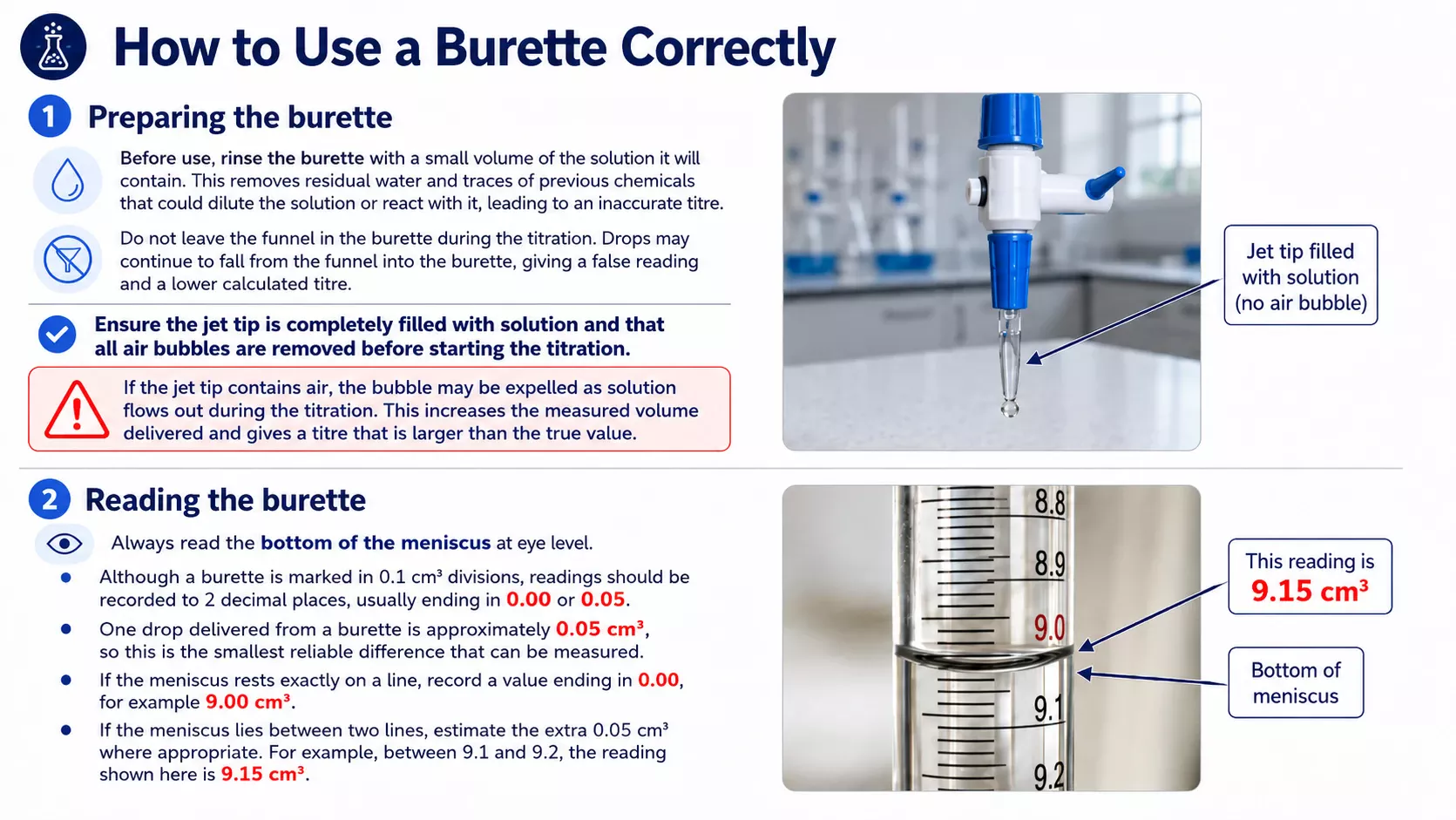
Using the burette correctly
Rinse with solution, remove bubbles from the jet, read the bottom of the meniscus at eye level, and record readings to the nearest 0.05 cm3.
Step 3: Spot the End Point with Phenolphthalein
Phenolphthalein is the correct indicator here. The diluted hydrochloric acid in the conical flask starts acidic, so the indicator is colourless. As sodium hydroxide is added, the pH rises.
The end point is reached when the solution becomes pale pink and the colour persists for about 5 seconds. If the pink disappears quickly while swirling, you have not quite reached the end point yet.
Before the end point
The flask remains colourless. Any pink flashes disappear on swirling.
At the end point
The solution becomes a very faint pink. If the pink is strong, you have probably overshot the end point.
Technique tip: place the conical flask on a white tile or white paper so the faint pink colour change is easier to see.
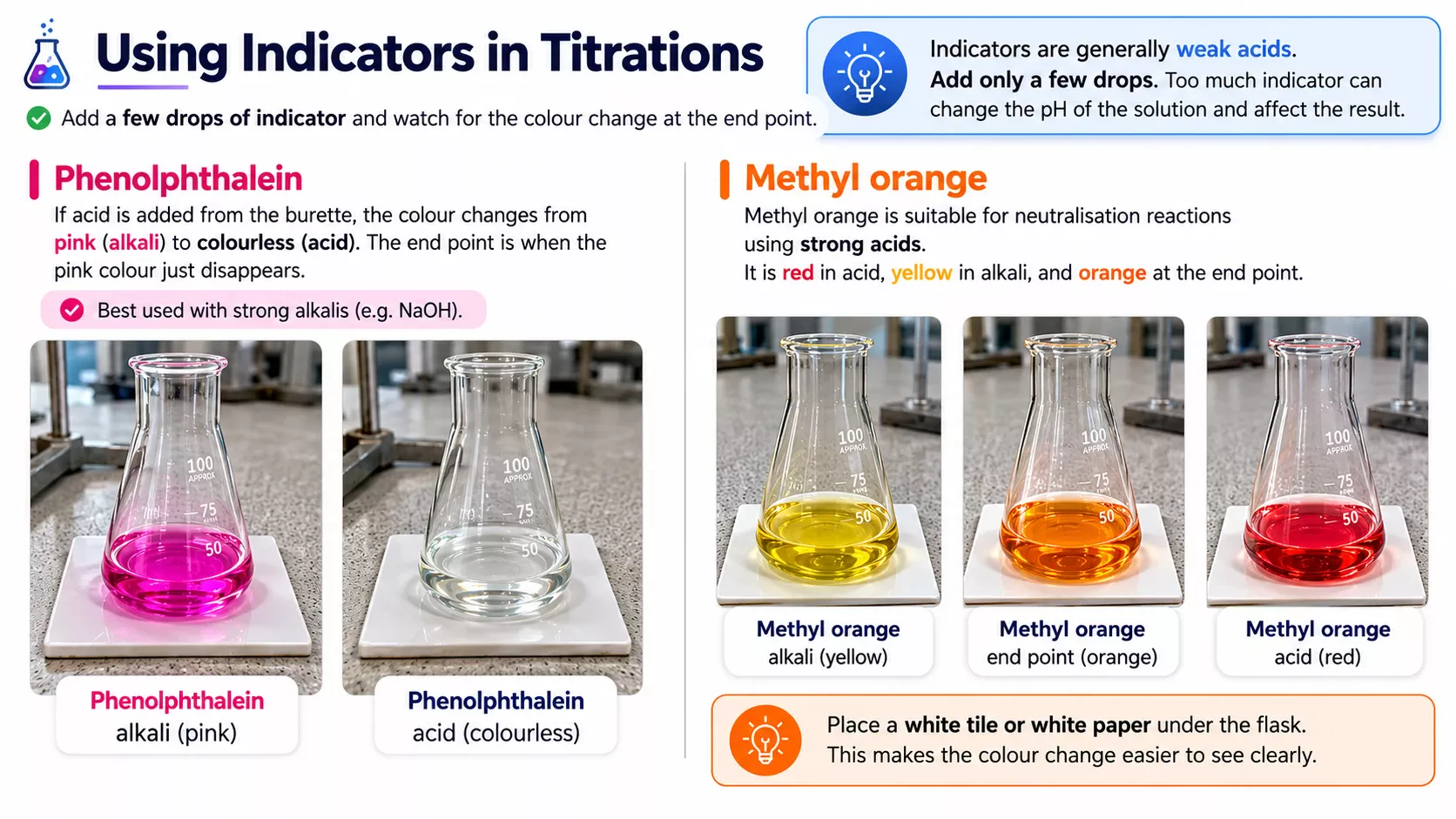
Phenolphthalein in this practical
Phenolphthalein is pink in alkali and colourless in acid. In this titration, the correct end point is the first faint pink that remains for a few seconds.
Step 4: Record Titres and Choose Concordant Results
You should carry out one rough titration first, then repeat the titration until you obtain at least two concordant titres. Concordant titres are usually within 0.10 cm3 of each other.
Use the sample data below. Trial 1 and Trial 3 are a good concordant pair because 30.10 cm3 and 30.05 cm3 differ by only 0.05 cm3.
| Trial | Final burette reading / cm3 | Initial burette reading / cm3 | Titre / cm3 |
|---|---|---|---|
| Trial 1 | 30.55 | 0.45 | 30.10 |
| Trial 2 | 32.10 | 2.15 | 29.85 |
| Trial 3 | 30.65 | 0.60 | 30.05 |
| Trial 4 | 33.40 | 3.15 | 30.25 |
Mean titre = (30.10 + 30.05) ÷ 2
Mean titre = 30.08 cm3 (to 2 d.p.)
Important: do not average all the values automatically. Choose only the concordant titres and exclude the rough titration.
Step 5: Worked Calculation from the Mean Titre
Now use the mean titre to calculate the concentration of the original hydrochloric acid. The sodium hydroxide concentration is 0.0800 mol dm-3, and the mean titre is 30.08 cm3.
1. Convert volume to dm3
30.08 cm3 = 0.03008 dm3
2. Calculate moles of NaOH in the mean titre
n = c × V = 0.0800 × 0.03008 = 0.0024064 mol
3. Use the 1:1 equation
Moles of HCl in the 25.0 cm3 aliquot of diluted acid = 0.0024064 mol
4. Scale up from the 25.0 cm3 aliquot to the full 250 cm3 volumetric flask
moles in full 250 cm3 = 0.0024064 × (250 ÷ 25.0)
= 0.024064 mol
5. Calculate the concentration of the original hydrochloric acid
The original 25.0 cm3 sample contained 0.024064 mol.
c = n ÷ V = 0.024064 ÷ 0.0250 = 0.963 mol dm-3
General scaling rule
number of moles in full volume = (full volume × number of moles in aliquot) ÷ aliquot volume
Common slip
Students often forget the dilution factor of 10 when going from the 25.0 cm3 aliquot to the full 250 cm3 flask.
Evaluation, Uncertainty and Common Errors
A single burette reading has an uncertainty of about ±0.05 cm3. Because a titre uses two readings, the uncertainty in the titre is about ±0.10 cm3.
Percentage burette uncertainty
% uncertainty = (0.10 ÷ mean titre) × 100
For a mean titre of 30.08 cm3:
% uncertainty = (0.10 ÷ 30.08) × 100 = 0.33%
Larger titres reduce percentage uncertainty, which is why a titre around 25 cm3 or more is generally better than a much smaller one.
- Rinse the burette with the sodium hydroxide solution, not water.
- Rinse the conical flask only with distilled water between titrations.
- Read the bottom of the meniscus at eye level.
- Near the end point, add the alkali dropwise.
- If the flask turns deep pink, you have overshot and should repeat.
Exam focus: if a pipette is blown out, too much acid is transferred, the diluted solution is more concentrated, the titre becomes smaller, and the calculated acid concentration is too high.
Interactive End Point and Titration Curve
This simplified model shows a strong acid and strong alkali titration. Press Begin titration once and the model will automatically add sodium hydroxide, slow down near the end point, move the marker along the pH curve, and change the conical flask colour.
Run the model
The animation deliberately slows near 30.05 cm3, where the end point is reached and sodium hydroxide should be added dropwise.
Live result
Phenolphthalein is colourless in acid.