Alkene
A concise revision guide to alkene functional groups, carbon-carbon double bonds, the -ene suffix, E-Z naming, diene and triene suffixes, and functional group priority in IUPAC names.
What Is an Alkene?
An alkene is an unsaturated hydrocarbon containing at least one carbon-carbon double bond, written as C=C. The double bond is always between two carbon atoms.
The C=C double bond is the functional group of alkenes. It is the part of the molecule responsible for the characteristic reactions of the homologous series.
For open-chain alkenes with one double bond, the general formula is CnH2n.
Key idea: A molecule is not an alkene unless it contains a C=C double bond between two carbon atoms.
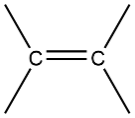
The C=C double bond is shown explicitly because it is the functional group that defines the alkene homologous series.
Naming Alkenes Using the -ene Suffix
Alkenes are named using the suffix -ene. The parent carbon chain is chosen by identifying the longest chain that contains the C=C double bond.
When numbering the carbon chain, use the lower of the two possible numbers to show the position of the double bond. The number gives the first carbon of the C=C bond.
| Homologous series | Functional group | Suffix | Example |
|---|---|---|---|
| Alkenes | C=C | -ene | propene |
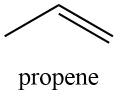
Propene contains three carbon atoms and one C=C double bond, so the parent name uses prop- and the alkene suffix -ene.
E-Z Prefixes in Alkene Names
Some alkene names begin with E or Z. These prefixes show the type of stereoisomer present.
This is needed because rotation around a C=C double bond is restricted. If the groups attached to the double bond are arranged differently in space, different stereoisomers can exist.
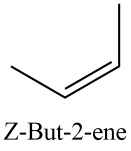
The Z prefix identifies the spatial arrangement of the groups around the C=C bond.
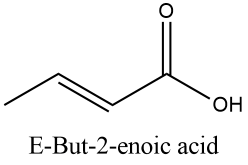
The E prefix can still be used when the molecule also contains a higher-priority functional group.
Exam focus: E and Z are stereochemical prefixes, not part of the carbon chain length. They describe the arrangement around the C=C double bond.
More Than One Double Bond
If a molecule contains more than one C=C double bond, the alkene suffix changes.
Two double bonds use the suffix -diene, while three double bonds use -triene. The positions of the double bonds are shown with numbers.
One C=C bond
Use -ene, such as but-2-ene.
Two C=C bonds
Use -diene, such as penta-1,3-diene.
Three C=C bonds
Use -triene, with numbers showing the positions of the three double bonds.
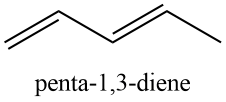
The name penta-1,3-diene shows a five-carbon chain with double bonds beginning at carbon 1 and carbon 3.
Alkenes with Other Functional Groups
The -en part used for alkenes can appear before other functional group suffixes, such as -ol or -oic acid.
However, alcohol and carboxylic acid groups have higher priority than alkenes. This means they take precedence when numbering the carbon chain.
For example, in 2-bromobut-3-en-1-ol, the alcohol group receives the lowest possible number because the OH group has higher priority than the C=C double bond.
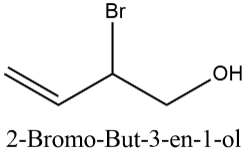
The -en part shows the C=C bond, while -ol is the higher-priority suffix used for the alcohol group.
The carboxylic acid group takes priority, so the compound is named as an enoic acid rather than only as an alkene.
Remember: The C=C bond still needs to be included in the name, but higher-priority functional groups control the main suffix and numbering direction.
Check Your Understanding
Use these short activities to check alkene naming, suffixes, stereochemical prefixes and functional group priority before moving on.
Master Topic 6A/6B Organic Chemistry and Alkanes for Edexcel A Level Chemistry
Continue from these free revision notes into the full Topic 6A/6B Organic Chemistry and Alkanes course for Edexcel A Level Chemistry Paper 2 (9CH0/02), with guided video teaching, diagnostic MCQ practice, teacher-marked short-answer questions and a specification assignment with a personalised progress report.
Guided video teaching
Learn the chemistry and exam technique through structured video lessons with worked examples and walkthroughs.
Instant MCQ feedback
Auto-marked MCQ quizzes provide immediate diagnostic feedback for every answer choice.
Teacher-marked SAQs
Submit written exam responses and receive chemistry specialist feedback with improvement guidance.
Progress tracking
Identify strengths and weaknesses across the full Topic 6A/6B specification with targeted reporting.
See how the course works
Click play to start the course preview animation.
Some ionic radii are shown.
| Ion | Ionic radius / nm |
|---|---|
| Na+ | 0.102 |
| K+ | 0.138 |
| F− | 0.133 |
| Cl− | 0.180 |
Which compound has the strongest ionic bonding?
Explain why the metallic bonding in magnesium is much stronger than that in sodium.
Copyright notice: This OLS revision content, including the explanations, layout, diagrams, tables and embedded learning structure, is authored for Online Learning System by Dr. Mohammed Al-Fatah. It may not be copied, reproduced, redistributed or adapted without written permission.