Combustion of Alkanes
A concise revision guide to alkanes as fuels, complete combustion, incomplete combustion, carbon monoxide, soot, energy release and environmental impact.
- 6B.11-a
- 6B.11-d
- 6B.12-a
- 6B.16i
What these spec points say
- 6B.11-a know carbon monoxide is formed during combustion of alkane fuels
- 6B.11-d know carbon particulates are formed during combustion of alkane fuels
- 6B.12-a understand problems arising from carbon monoxide toxicity
- 6B.16i understand the reactions of alkanes with: oxygen in air (combustion)
Burning Methane: Complete, Incomplete and Toxic CO
Choose a step to follow every atom as methane burns in plenty of oxygen, in too little, and in very little, then see why carbon monoxide is toxic.
© Dr. Mohammed Al-Fatah – onlinelearningsystem.net
GCSE Recap: Hydrocarbons and Energy Changes
Before you start, check what you remember from GCSE about hydrocarbons, bond energies and burning.
Alkanes as Fuels
A fuel is a substance that releases energy as heat when it undergoes combustion. Alkanes are useful fuels because they burn readily in oxygen and release large amounts of energy.
Combustion of alkanes is highly exothermic. More energy is released when new bonds are formed in the products than is absorbed to break bonds in the reactants.
This explains why alkanes are widely used in heating, cooking and transport, where a reliable and controllable energy source is required.
Key idea: Alkanes are suitable fuels because their combustion releases significant energy in a controllable way.
Quick Check: Why Combustion Is Exothermic
Use the two energy totals to work out the overall energy change when propane burns.
Complete Combustion
When an alkane burns in the presence of excess oxygen, it undergoes complete combustion.
In complete combustion, the hydrocarbon is fully oxidised. The only products are carbon dioxide, CO2, and water, H2O.
Because all carbon atoms form carbon dioxide and all hydrogen atoms form water, complete combustion releases the maximum amount of energy from the fuel.
Complete combustion: Combustion in excess oxygen where a hydrocarbon is fully oxidised to carbon dioxide and water only.
| Combustion type | Oxygen supply | Products | Energy released |
|---|---|---|---|
| Complete combustion | Excess oxygen | CO2 and H2O only | Maximum energy from the fuel |
Example: The complete combustion of octane is C8H18(l) + 12½O2(g) → 8CO2(g) + 9H2O(l). Octane is a liquid under standard conditions, so it is written (l), like the water formed.
Remember: If a question tells you not to use fractions, double every number: 2C8H18(l) + 25O2(g) → 16CO2(g) + 18H2O(l).
Quick Check: Balance Complete Combustion
Type the missing balancing numbers for three alkanes burning in excess oxygen.
Watch: what changes when oxygen runs short
Complete combustion gives carbon dioxide and water. What happens when there is not enough oxygen?
Incomplete Combustion
When the oxygen supply is limited, alkanes undergo incomplete combustion rather than complete combustion.
In incomplete combustion, the fuel is only partially oxidised. This can produce carbon monoxide, CO, which is highly toxic, and/or solid carbon, C, also known as soot.
The oxygen supply is rarely even, so the products are usually a mixture: some carbon is oxidised to carbon dioxide, some only to carbon monoxide and some not at all.
In an engine a little fuel also leaves the cylinder without burning, so the exhaust contains unburned hydrocarbons as well.
Incomplete combustion releases less energy per mole than complete combustion because the fuel is not fully oxidised.
| Reaction | Balanced equation | Main concern |
|---|---|---|
| Methane forms carbon monoxide | CH4(g) + 1½O2(g) → CO(g) + 2H2O(l) | CO is toxic and difficult to detect. |
| Methane forms soot | CH4(g) + O2(g) → C(s) + 2H2O(l) | Carbon particles cause smoky flames and air pollution. |
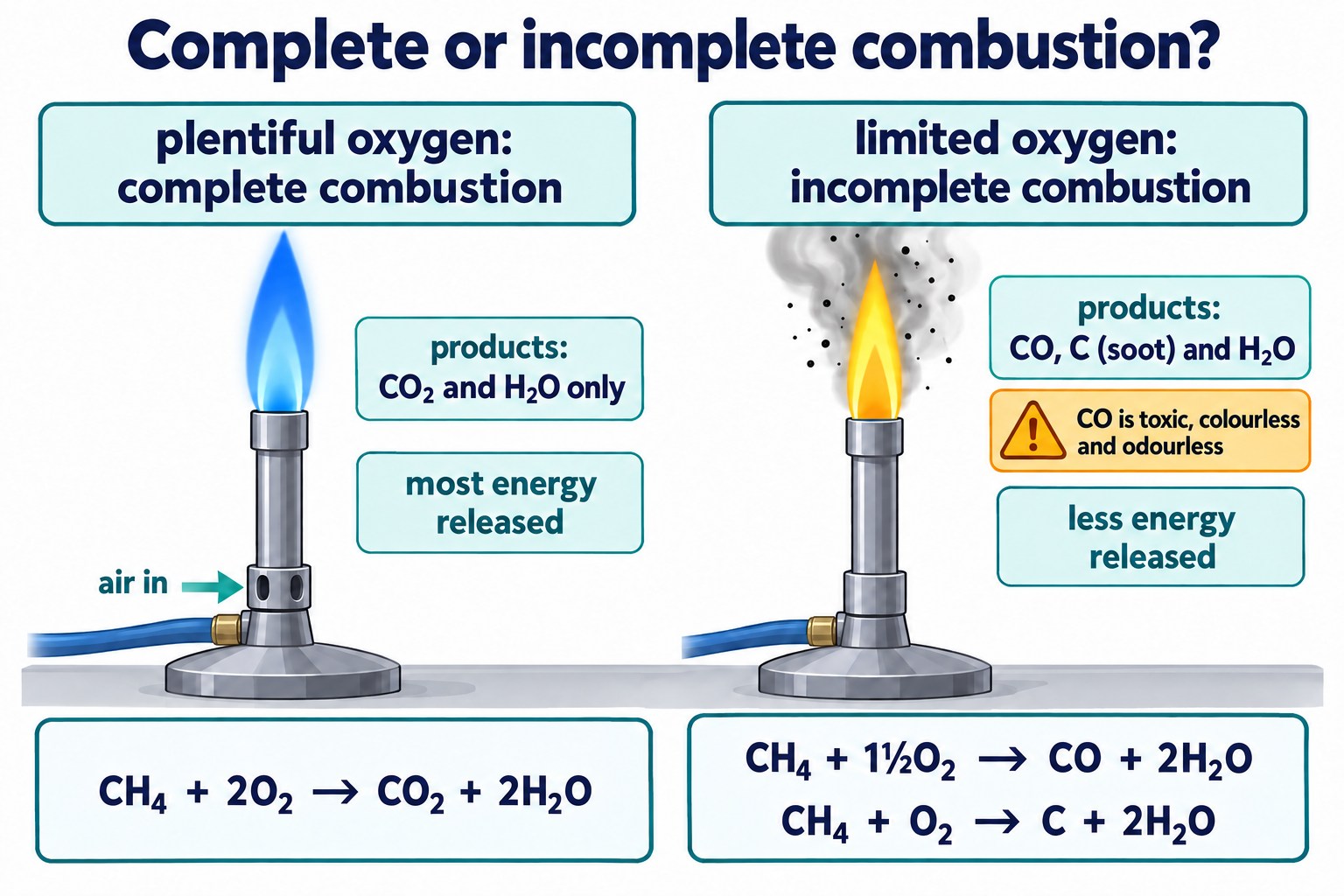
Limited oxygen causes partial oxidation, producing soot and carbon monoxide instead of only carbon dioxide and water.
Quick Check: Complete or Incomplete?
Read each balanced equation and decide quickly what it shows.
Carbon Monoxide and Health Risks
Carbon monoxide is a colourless and odourless gas. This makes it extremely dangerous because it can build up without being noticed.
If carbon monoxide accumulates in an enclosed space, such as a room with a faulty heater, it can be fatal.
Carbon monoxide is toxic because it forms a strong bond with haemoglobin in red blood cells. This bond is stronger than the bond between haemoglobin and oxygen, so oxygen is prevented from being transported around the body.
Exam focus: A strong answer links carbon monoxide poisoning to haemoglobin and reduced oxygen transport, not just to “toxic fumes”.
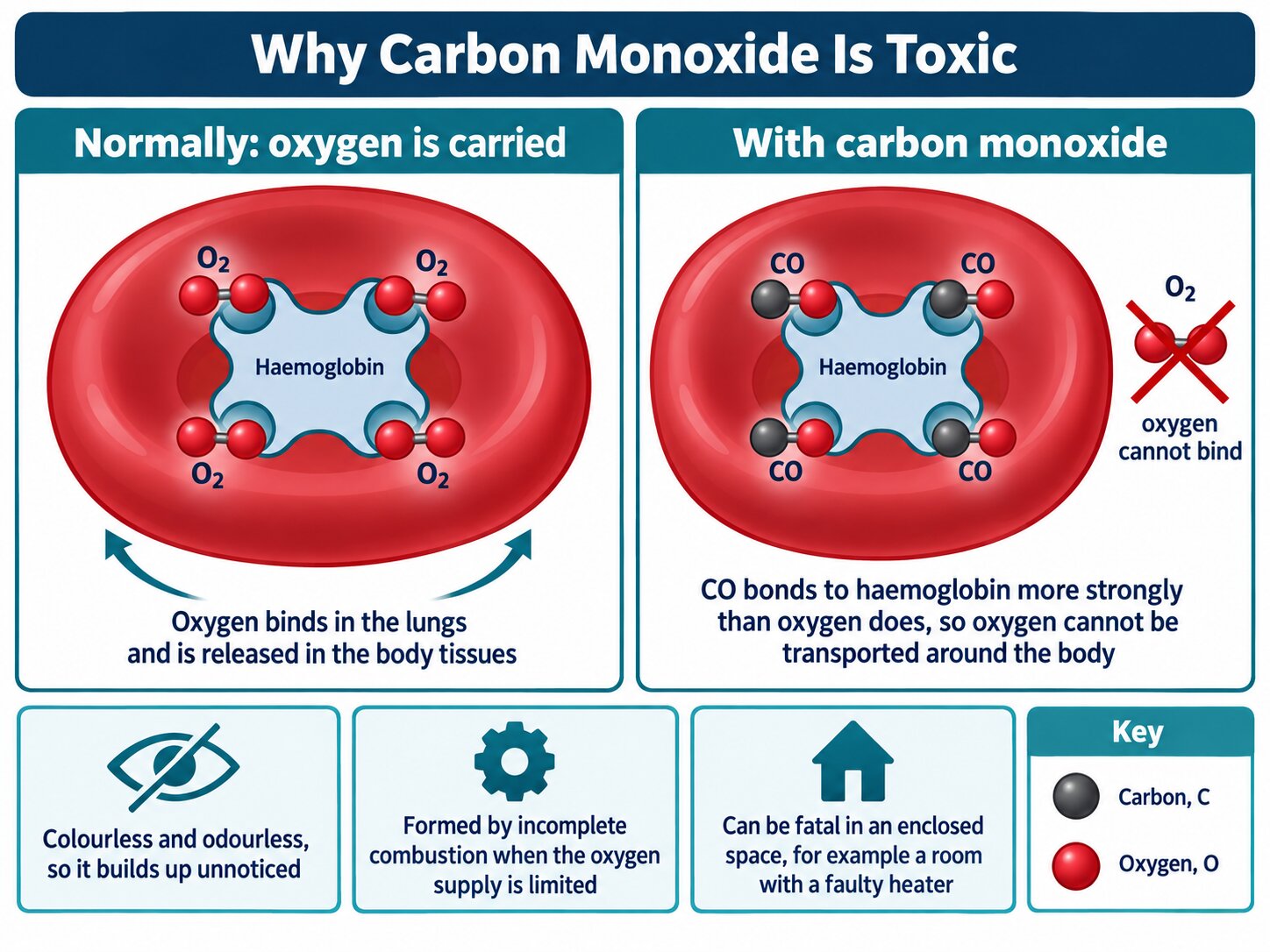
Carbon monoxide is dangerous because it binds strongly to haemoglobin, reducing the blood’s ability to transport oxygen.
Quick Check: Explain the Danger
Write a short explanation, then compare it with the mark points and the model answer.
Energy and Environmental Impact
Incomplete combustion releases less energy per mole than complete combustion because the carbon atoms are not fully oxidised to carbon dioxide.
The formation of carbon particles contributes to air pollution. These particles can produce a smoky or sooty flame.
Carbon particles can also contribute to global dimming, because the particles reflect or absorb some of the Sun’s incoming radiation, so less of it reaches the ground.
| Issue | Cause | Effect |
|---|---|---|
| Lower energy release | Fuel is only partially oxidised | Less energy released per mole than complete combustion |
| Air pollution | Carbon particles are produced | Smoky flame and particulate pollution |
| Global dimming | Soot particles reflect or absorb sunlight | Less sunlight reaches the ground |
Quick Check: Pick the Accurate Statement
In each round, choose the one statement that is accurate.
Combustion of Alkanes
Alkanes as fuels
Alkanes burn in oxygen and release heat energy, making them useful fuels for heating, cooking and transport.
Complete combustion
With excess oxygen, alkanes form carbon dioxide and water only, releasing the maximum energy from the fuel.
Incomplete combustion
With limited oxygen, alkanes may form carbon monoxide and soot, releasing less energy per mole.
Carbon monoxide risk
Carbon monoxide binds strongly to haemoglobin, preventing oxygen transport and making it highly dangerous.
Combustion FAQs
These questions cover the main exam points on alkane combustion.
What is complete combustion of an alkane?
Complete combustion occurs when an alkane burns in excess oxygen, producing carbon dioxide and water only.
What is incomplete combustion of an alkane?
Incomplete combustion occurs when the oxygen supply is limited, producing carbon monoxide and/or solid carbon as well as water.
Why is carbon monoxide dangerous?
Carbon monoxide binds strongly to haemoglobin in red blood cells, preventing oxygen from being transported around the body.
Why does incomplete combustion release less energy?
Incomplete combustion releases less energy because the fuel is only partially oxidised, so less energy is released per mole than in complete combustion.
How do I balance the combustion equation of an alkane?
Balance carbon first to give CO₂, then hydrogen to give H₂O. Count the oxygen atoms on the right and halve that number for O₂. A half is allowed, as in 12½O₂ for octane.

Copyright notice: This OLS revision content, including the explanations, layout, diagrams, tables and embedded learning structure, is authored for Online Learning System by Dr. Mohammed Al-Fatah. It may not be copied, reproduced, redistributed or adapted without written permission.
Keep this note — free
Save your progress across every Edexcel topic. A free account remembers which topics you have covered, saves your question scores, and syncs across your phone and laptop.
- Track every topic you have finished
- Keep your practice-question scores
- No payment, no card, free forever
Already registered? Log in