Oxides of Nitrogen
A concise revision guide to nitrogen oxides, NOx, how they form in high-temperature combustion, why engines and power stations produce them, and why they matter in air pollution.
- 6B.11-b
- 6B.12-b
What these spec points say
- 6B.11-b know oxides of nitrogen are formed during combustion of alkane fuels
- 6B.12-b understand problems arising from acidity of oxides of nitrogen
GCSE Recap: Air and the Nitrogen Molecule
Before you start, check what you remember from GCSE about the gases in air and the bond in N₂.
What Are Oxides of Nitrogen?
Oxides of nitrogen are commonly written as NOx. This is a general term for nitrogen oxide gases formed when nitrogen and oxygen react together during high-temperature combustion.
The two main examples at this level are nitrogen monoxide, NO, also called nitric oxide, and nitrogen dioxide, NO2. Exam papers use nitrogen monoxide, so that name is used from here on.
Although nitrogen gas, N2, makes up a large proportion of the air, it is usually quite unreactive because it contains a very strong N≡N triple bond.
Key idea: Nitrogen oxides form from nitrogen and oxygen in air when combustion temperatures are high enough to overcome the stability of nitrogen molecules.
Watch: the bond only a hot engine can break
Nitrogen in the air has a triple bond that almost nothing can break. Inside an engine, it does.
Why High Temperature Is Needed
Inside a car engine, the temperature during combustion is extremely high. The spark only ignites the fuel.
It is the heat released by the burning fuel that raises the temperature far enough for nitrogen to react, which is why diesel engines, which have no spark plugs, still produce a great deal of NOx.
At these high temperatures, enough energy is available to break bonds in nitrogen and oxygen molecules. Once nitrogen atoms are available to react, they can combine with oxygen to form nitrogen oxides.
High-temperature formation: Nitrogen oxides are mainly produced when the high temperatures in engines or power stations allow nitrogen and oxygen from the air to react.
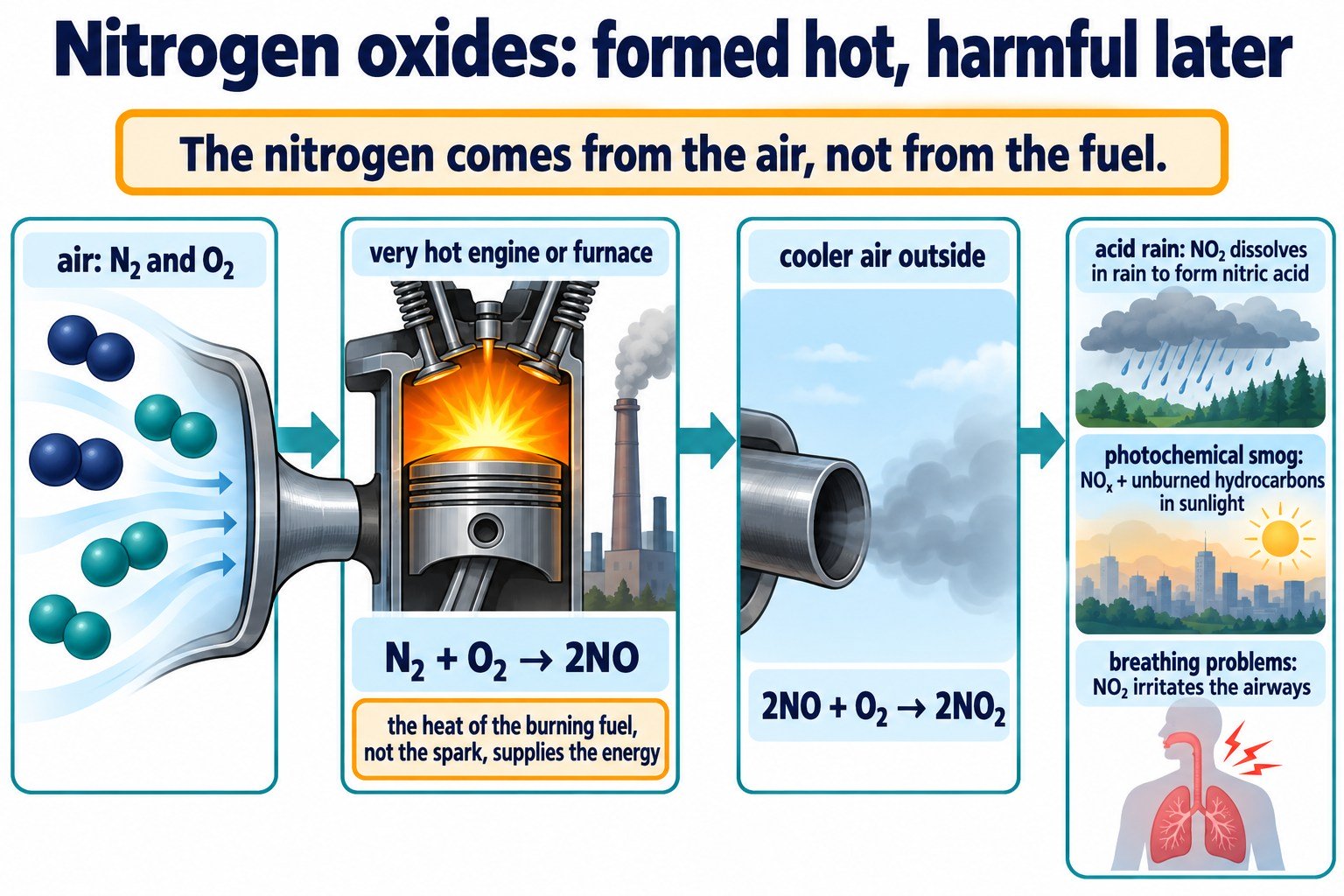
High-temperature combustion in engines and power stations provides the conditions needed for nitrogen and oxygen in air to react.
Quick Check: Will NO Form Here?
Decide quickly whether nitrogen and oxygen will react in each situation.
Equations for Nitrogen Oxide Formation
The first important product is often nitrogen monoxide, NO. This can form when nitrogen and oxygen react at high temperature:
N2 + O2 → 2NO
Nitrogen monoxide can then react further with oxygen in the air to form nitrogen dioxide, NO2:
2NO + O2 → 2NO2
The two steps happen in different places. NO forms in the very hot engine, and it is oxidised to NO2 in the cooler air outside. Adding the two equations together gives the overall change:
N2 + 2O2 → 2NO2
Quick Check: Use the Equations
Use the two equations to work out the amounts, and type a number in each gap.
Quick Check: From Air Intake to NO₂
Drag the events into the order in which they happen.
Where Oxides of Nitrogen Are Produced
Nitrogen oxides are produced mainly where combustion temperatures are very high. This explains why they are associated with car engines and power stations.
In a car engine, fuel burns in air. Air contains both nitrogen and oxygen, so the engine provides both the reactants and the high-temperature conditions needed for NOx formation.
| Source | Why NOx forms | Key exam point |
|---|---|---|
| Car engines | Fuel burns at very high temperature in air. | Nitrogen and oxygen from air react together. |
| Power stations | Combustion occurs at high temperature on a large scale. | High temperature makes normally unreactive nitrogen able to react. |
Exam focus: Do not say nitrogen oxides come directly from the fuel. The nitrogen and oxygen are mainly from the air, and the high temperature allows them to react.
Quick Check: Explain the Hydrogen Engine
Write a short explanation, then compare it with the mark points and the model answer.
Why Nitrogen Oxides Matter
Nitrogen oxides are air pollutants. They are important because they contribute to poor air quality and are linked with environmental problems.
Three problems are worth naming. NO2 dissolves in rainwater and forms nitric acid, so nitrogen oxides contribute to acid rain.
NOx reacts with unburned hydrocarbons in sunlight to form photochemical smog and ground-level ozone.
Breathing NO2 irritates the airways and makes asthma worse, so it also causes respiratory problems.
At this stage, the key chemical point is to understand how they form: nitrogen and oxygen from the air react during very high-temperature combustion.
Reducing NOx emissions is one reason vehicles use catalytic converters, which are covered in the next connected part of this topic.
Quick Check: Pick the Accurate Statement
In each round, choose the one statement that is accurate.
Oxides of Nitrogen FAQs
These questions cover the main exam points on nitrogen oxides formed during combustion.
What are oxides of nitrogen?
Oxides of nitrogen, commonly written as NOx, are nitrogen oxide gases such as NO and NO2.
How are nitrogen oxides formed in car engines?
Nitrogen oxides form when nitrogen and oxygen from the air react together at the very high temperatures produced inside a car engine.
Why is nitrogen usually unreactive?
Nitrogen is usually unreactive because N2 contains a strong N≡N triple bond, which requires a large amount of energy to break.
What equation shows nitrogen monoxide formation?
Nitrogen monoxide forms from nitrogen and oxygen at high temperature: N2 + O2 → 2NO.
Why do power stations produce nitrogen oxides?
Power stations involve high-temperature combustion, so nitrogen and oxygen from the air can react to form nitrogen oxides.
Copyright notice: This OLS revision content, including the explanations, layout, diagrams, tables and embedded learning structure, is authored for Online Learning System by Dr. Mohammed Al-Fatah. It may not be copied, reproduced, redistributed or adapted without written permission.
Keep this note — free
Save your progress across every Edexcel topic. A free account remembers which topics you have covered, saves your question scores, and syncs across your phone and laptop.
- Track every topic you have finished
- Keep your practice-question scores
- No payment, no card, free forever
Already registered? Log in