Further Substitution
A concise Edexcel A Level Chemistry revision guide to further substitution in the free-radical substitution of methane, including excess chlorine, formation of CH2Cl2, CHCl3 and CCl4, and the overall equation for complete chlorination.
- 6B.17-a
- 6B.17-b
What these spec points say
- 6B.17-a understand limitations of radical substitution in synthesis due to further substitution reactions
- 6B.17-b understand limitations of radical substitution in synthesis due to formation of a mixture of products
Further Substitution: Why Chlorination Gives a Mixture
Choose a step to watch chlorine radicals keep replacing hydrogen atoms, then see the isomers from propane and the mixture that results.
© Dr. Mohammed Al-Fatah – onlinelearningsystem.net
What Is Further Substitution?
Further substitution occurs when the halogenoalkane product from an earlier free-radical substitution step reacts again with chlorine. This means additional hydrogen atoms are replaced by chlorine atoms.
In the chlorination of methane, the first substitution forms chloromethane, CH3Cl. If chlorine is present in excess, CH3Cl can undergo further substitution to form more highly chlorinated products.
Key idea: Further substitution is still a free-radical substitution process. The molecule already contains chlorine, but remaining C-H bonds can still be substituted.
Before You Start
This page builds on the three stages of free-radical substitution.
- Methane reacts with chlorine in UV light to give chloromethane and hydrogen chloride.
- Each propagation step swaps one radical for another.
- Methane has four C-H bonds, and each can be replaced by a C-Cl bond.
- An excess of one reactant leaves some of it unused at the end.
GCSE Recap: Displacement, Balancing and Excess
Check the GCSE ideas about replacing atoms, balancing and excess reactants that this page builds on.
Why Excess Chlorine Causes Further Substitution
When chlorine is present in excess, there are enough chlorine molecules and chlorine radicals for the reaction to continue beyond the first substitution product.
As more hydrogen atoms are replaced, a mixture of chlorinated products can form. These include dichloromethane, trichloromethane and tetrachloromethane.
Further substitution: continued replacement of hydrogen atoms by halogen atoms after the first substitution product has already formed.
Exam focus: Further substitution is most likely when chlorine is in excess. The product mixture becomes less pure because several chlorinated products can form.
Quick Check: Stopping at the First Product
Choose the reaction mixture that gives the purest first product.
Products Formed During Further Substitution
Starting from methane, one hydrogen can be replaced at a time. Each substitution introduces one chlorine atom and forms one molecule of hydrogen chloride.
The sequence of possible products is shown below.
| Stage | Organic product | Name | What has happened? |
|---|---|---|---|
| First substitution | CH3Cl | Chloromethane | One H atom in methane has been replaced by Cl. |
| Further substitution | CH2Cl2 | Dichloromethane | A second H atom has been replaced by Cl. |
| Further substitution | CHCl3 | Trichloromethane | A third H atom has been replaced by Cl. |
| Complete substitution | CCl4 | Tetrachloromethane | All four H atoms have been replaced by Cl. |
Remember: The more excess chlorine present, the greater the chance that chlorinated products undergo further substitution.
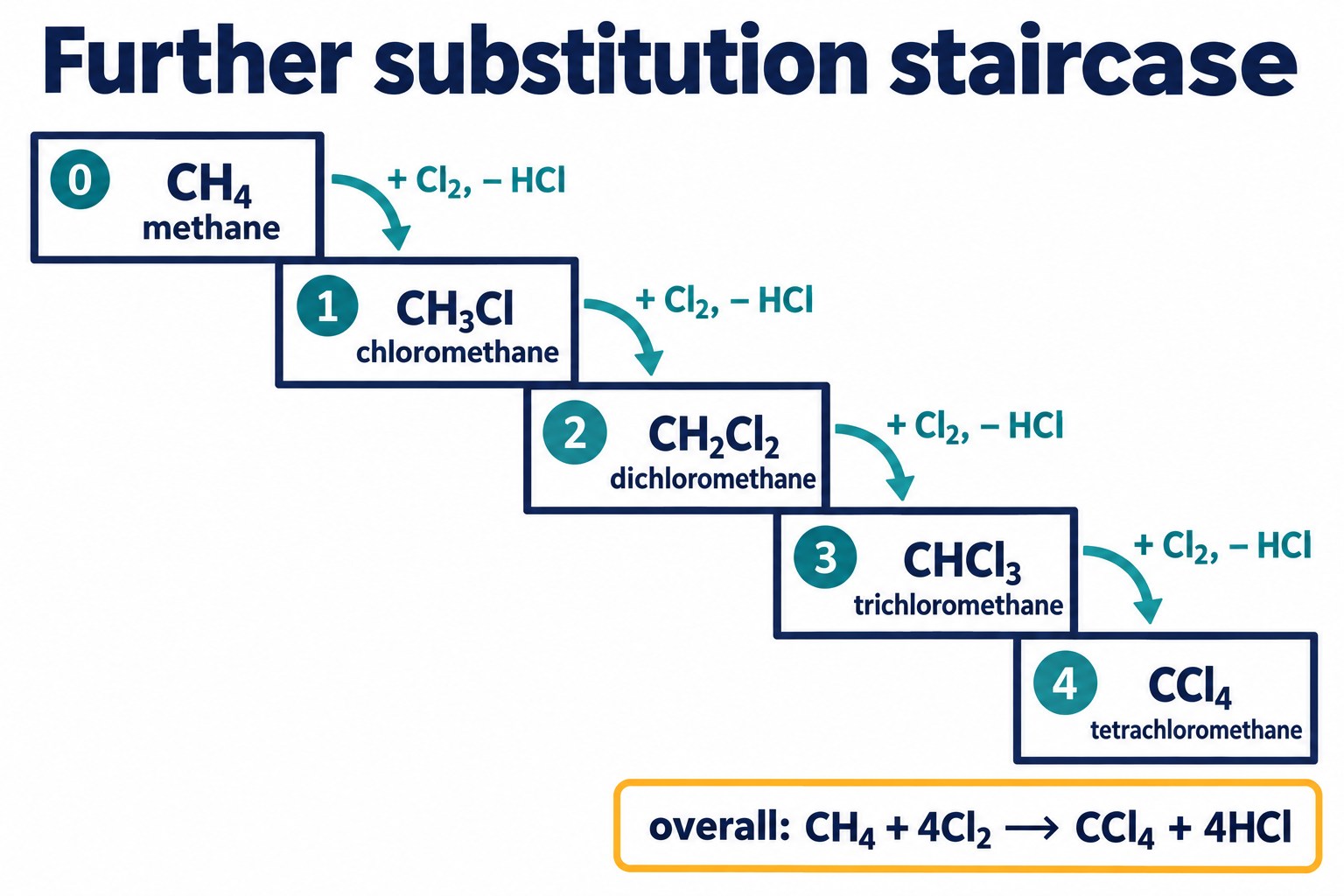
Each step down the ladder replaces one more H by Cl and forms one more HCl.
Quick Check: The Products from Ethane
Type the formulae of the products formed as ethane is chlorinated further.
Propagation Steps Leading to Further Substitution
Further substitution can be explained using the same propagation logic as the first chlorination step. A chlorine radical removes a hydrogen atom from chloromethane, producing a chloromethyl radical.
The chloromethyl radical then reacts with chlorine to form dichloromethane and regenerate a chlorine radical.
CH3Cl + Cl• → HCl + •CH2Cl
•CH2Cl + Cl2 → CH2Cl2 + Cl•
Why this is propagation: a chlorine radical is used in the first step and regenerated in the second step, so the chain reaction can continue.
Quick Check: The Steps That Substitute Again
Complete the two propagation steps that make the second substitution product.
Overall Equations for Further Substitution
Further substitution can be represented using overall equations. Each additional substitution uses one Cl2 molecule and forms one HCl molecule.
CH3Cl + Cl2 → CH2Cl2 + HCl
CH2Cl2 + Cl2 → CHCl3 + HCl
CHCl3 + Cl2 → CCl4 + HCl
If methane is fully chlorinated to tetrachloromethane, all four hydrogen atoms are replaced.
CH4 + 4Cl2 → CCl4 + 4HCl
Quick Check: Balance the Overall Equation
Balance each overall equation on paper, then flip the card to check.
Exam Clues and Common Mistakes
Exam questions often test whether you understand why free-radical substitution does not usually give one pure product when chlorine is in excess.
The key point is that chlorinated products still contain C-H bonds, so they can react further under the same free-radical conditions.
| Question clue | What it means | Best exam response |
|---|---|---|
| Chlorine is in excess | More than one substitution can occur. | State that further hydrogen atoms can be replaced by chlorine. |
| A mixture of products forms | Different numbers of H atoms have been substituted. | Name or write formulae such as CH2Cl2, CHCl3 and CCl4. |
| Asked for an overall equation | Show the net reaction, not the radical mechanism. | For full substitution, write CH4 + 4Cl2 → CCl4 + 4HCl. |
Common mistake: Do not stop at CH3Cl when chlorine is in excess. The question is asking you to consider continued substitution and the resulting product mixture.
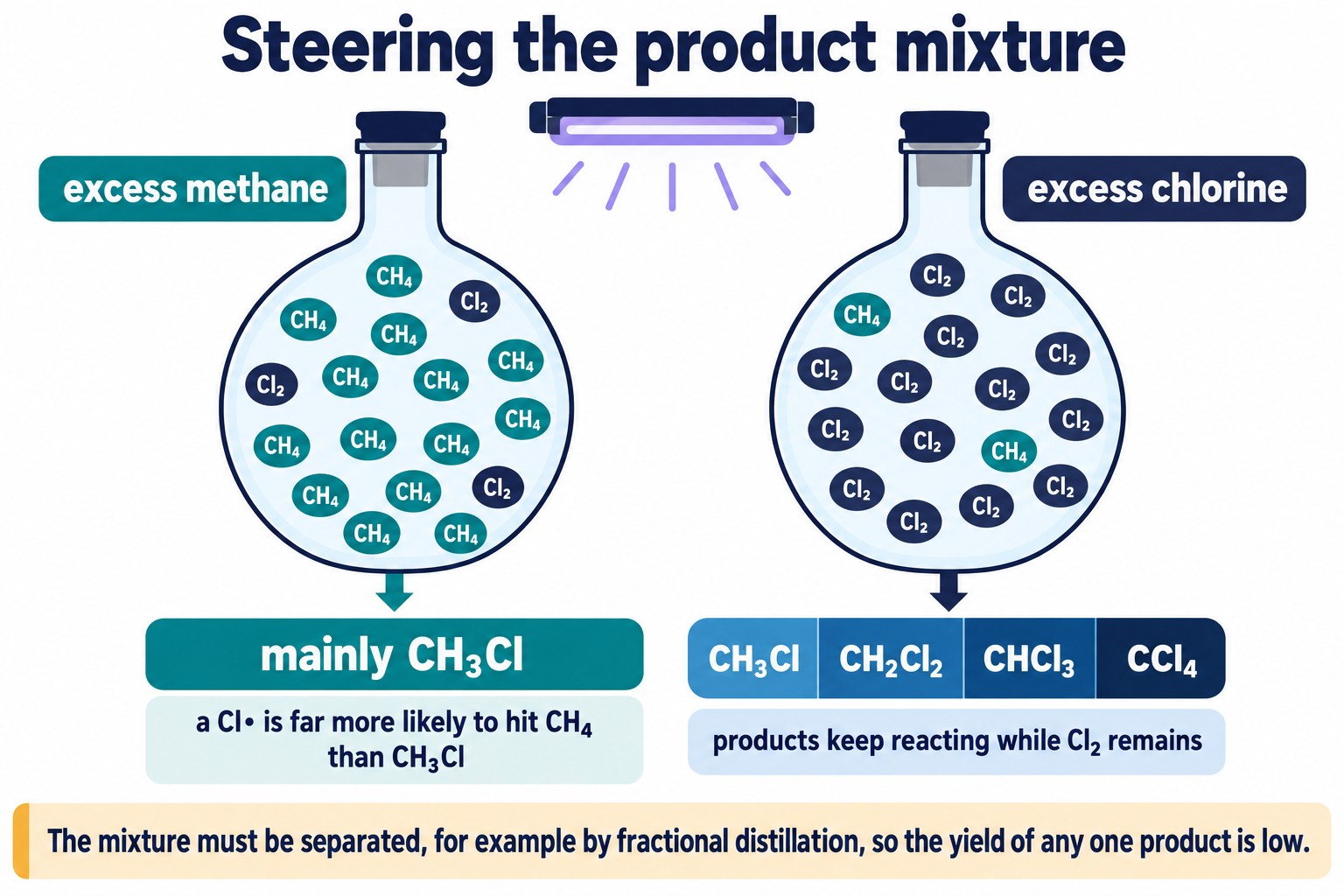
Further substitution, position isomers and termination by-products all lower the yield of one product.
Quick Check: Explain Why the Product Is Impure
Write a short explanation, then compare it with the mark points and the model answer.
Quick Check: Further Substitution Summary
Pull the whole page together by choosing the accurate statement in each round.
Further Substitution FAQs
Review the key points about continued substitution in free-radical chlorination.
What is further substitution?
Further substitution is the continued replacement of hydrogen atoms by chlorine atoms after the first substitution product has already formed.
Why does excess chlorine lead to further substitution?
Excess chlorine provides enough chlorine molecules and chlorine radicals for chlorinated products such as CH3Cl to react again, replacing more hydrogen atoms.
Which products can form when methane reacts with excess chlorine?
A mixture may form, including CH3Cl, CH2Cl2, CHCl3 and CCl4, depending on how many hydrogen atoms are replaced.
What is the overall equation for complete chlorination of methane?
The overall equation is CH4 + 4Cl2 → CCl4 + 4HCl.
Why is a mixture of products formed?
A mixture forms because partially chlorinated products still contain C-H bonds, so they can undergo further free-radical substitution.
Copyright notice: This OLS revision content, including the explanations, layout, diagrams, tables and embedded learning structure, is authored for Online Learning System by Dr. Mohammed Al-Fatah. It may not be copied, reproduced, redistributed or adapted without written permission.
Keep this note — free
Save your progress across every Edexcel topic. A free account remembers which topics you have covered, saves your question scores, and syncs across your phone and laptop.
- Track every topic you have finished
- Keep your practice-question scores
- No payment, no card, free forever
Already registered? Log in