Free Radical Substitution
A concise revision guide to why alkanes are usually unreactive, how they react with halogens under ultraviolet light, and how free-radical substitution is introduced through initiation, propagation and termination.
- 6B.15ii
- 6B.15i-a
- 6B.16ii-a
- 6C.23
What these spec points say
- 6B.15ii know that a radical: is formed by homolytic fission of a covalent bond and results in the formation of radicals
- 6B.15i-a know that a radical is a species with an unpaired electron
- 6B.16ii-a understand the reactions of alkanes with halogens
- 6C.23 understand that heterolytic bond fission of a covalent bond results in the formation of ions
Radical Chain Reaction: Methane and Chlorine
Choose a step to follow every electron: UV light makes the radicals, the chain repeats, and two radicals meeting end it.
© Dr. Mohammed Al-Fatah – onlinelearningsystem.net
GCSE Recap: Shared Pairs in an Alkane
Start with the GCSE ideas about shared electron pairs in alkanes.
Why Alkanes Are Usually Unreactive
Alkanes are saturated hydrocarbons. They contain only carbon and hydrogen atoms, with only single covalent bonds between atoms.
In most situations, alkanes do not react readily with other substances because they contain strong carbon-carbon, C-C, and carbon-hydrogen, C-H, bonds.
These strong covalent bonds require a large amount of energy to break. As a result, alkanes usually need high-energy conditions, such as ultraviolet light or high temperature, before they react.
Key idea: Alkane reactions are not easy to start because the C-C and C-H bonds are strong and non-polar or only weakly polar.
Quick Check: Why Nothing Happens to Hexane
Choose the best explanation of why an alkane does not react with common reagents.
Watch: making halogenoalkanes from alkanes
Why chemists want halogenoalkanes, and the reaction that makes them from alkanes. What takes the hydrogen's place?
Alkanes React with Halogens Under UV Light
Although alkanes are generally unreactive, they can react with halogens under specific conditions.
When exposed to ultraviolet, UV, light, alkanes react with chlorine in a substitution reaction. A hydrogen atom in the alkane is replaced by a chlorine atom.
For methane and chlorine, the overall equation can be written as:
Overall reaction: CH4 + Cl2 → CH3Cl + HCl
Important: This overall equation is a simplified summary. In practice, a more complex mixture of products can form because further substitution may occur.
Quick Check: Ethane and Bromine
Complete the passage about an alkane reacting with a halogen in UV light.
What Is Free-Radical Substitution?
Free-radical substitution is a mechanism in which highly reactive free radicals are produced and used to replace hydrogen atoms in an alkane with halogen atoms.
A free radical is a species that contains an unpaired electron. In equations, this unpaired electron is shown using a dot, such as Cl•.
The mechanism does not occur as one simple step. It takes place through a sequence of distinct stages:
| Stage | What happens | Why it matters |
|---|---|---|
| Initiation | UV light breaks a halogen-halogen bond to form free radicals. | This starts the chain reaction by producing reactive species. |
| Propagation | Free radicals react and generate new free radicals. | This repeating stage allows the chain reaction to continue. |
| Termination | Two free radicals combine together. | This removes radicals from the reaction mixture and stops that chain. |
Exam focus: Use the phrase free-radical substitution mechanism and link it to hydrogen atoms in alkanes being replaced by halogen atoms.
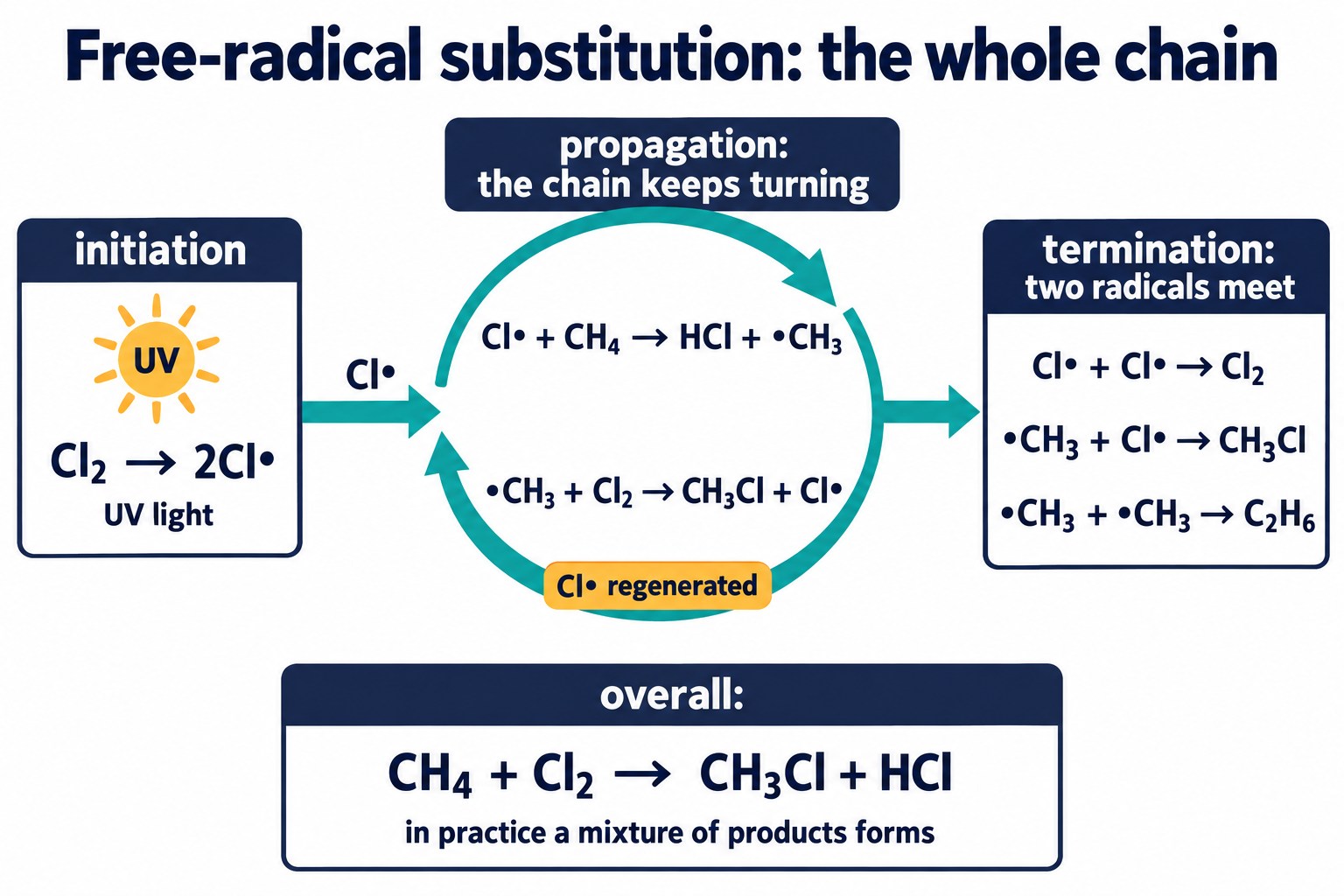
Initiation makes radicals, propagation keeps the chain going and termination removes radicals.
Quick Check: Name the Stage
Decide quickly which stage of the mechanism each equation shows.
Homolytic Fission and Free Radicals
The first key idea in free-radical substitution is homolytic fission. This occurs when a covalent bond breaks so that each atom takes one electron from the shared pair.
When chlorine molecules absorb UV light, the Cl-Cl bond breaks by homolytic fission. This forms two chlorine radicals:
Homolytic fission: Cl2 → 2Cl•
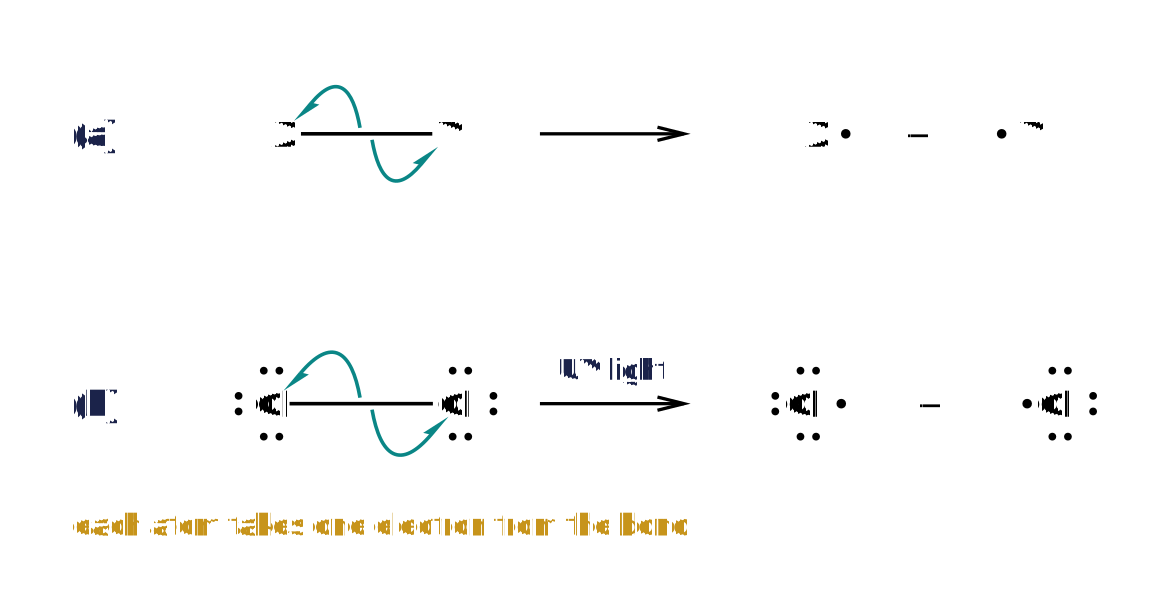
Each atom receives one electron from the shared pair, forming two species with unpaired electrons.
Quick Check: Spot the Radicals
Click every species that is a free radical.
Homolytic Fission Compared with Heterolytic Fission
Reaction mechanisms often involve bond breaking. The type of bond breaking depends on how the bonding electrons are divided.
In homolytic fission, each atom takes one electron and free radicals form. In heterolytic fission, one atom takes both electrons and ions form.
| Type of fission | Electron movement | Products formed | Arrow style |
|---|---|---|---|
| Homolytic fission | Each atom takes one electron from the shared pair. | Free radicals. | Single-headed curly arrows are used for movement of one electron. |
| Heterolytic fission | One atom takes both electrons from the shared pair. | Ions. | Double-headed curly arrows are used for movement of an electron pair. |
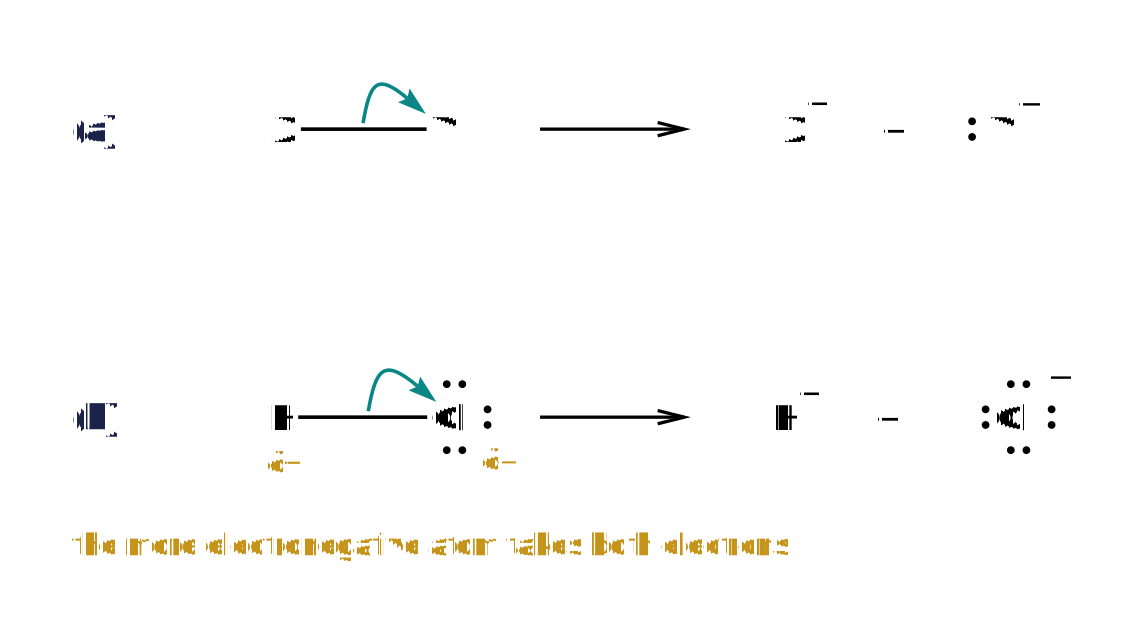
Heterolytic fission produces ions because both bonding electrons move to the same atom.
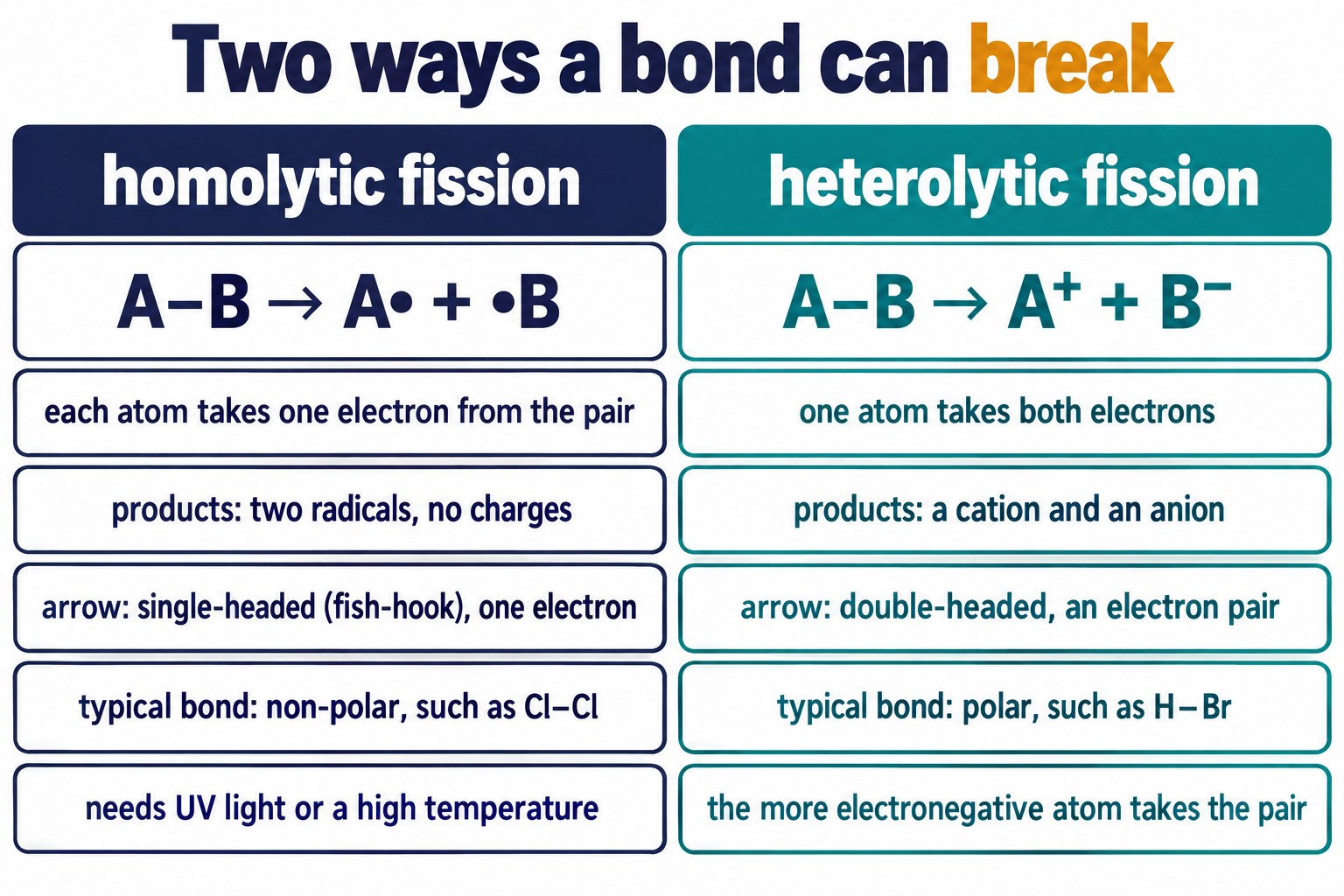
Homolytic fission gives radicals and uses single-headed arrows; heterolytic fission gives ions and uses double-headed arrows.
Breaking a Covalent Bond: Homolytic and Heterolytic Fission
Choose a step to watch where the two electrons of a bond go when it breaks: one each (free radicals), or both to one atom (ions).
© Dr. Mohammed Al-Fatah – onlinelearningsystem.net
Quick Check: Pick the Accurate Statement
Choose the accurate statement about how each bond breaks.
Mechanisms and Curly Arrows
A reaction mechanism is a step-by-step description of how a chemical reaction proceeds.
Curly arrows are used in mechanisms to show the movement of electrons. For electron-pair movement, a curly arrow must start from a lone pair of electrons or from the centre of a covalent bond.
Free-radical substitution uses radical chemistry, so the detailed arrow style differs from many ionic organic mechanisms. This page introduces the mechanism concept before the separate pages on initiation, propagation and termination.
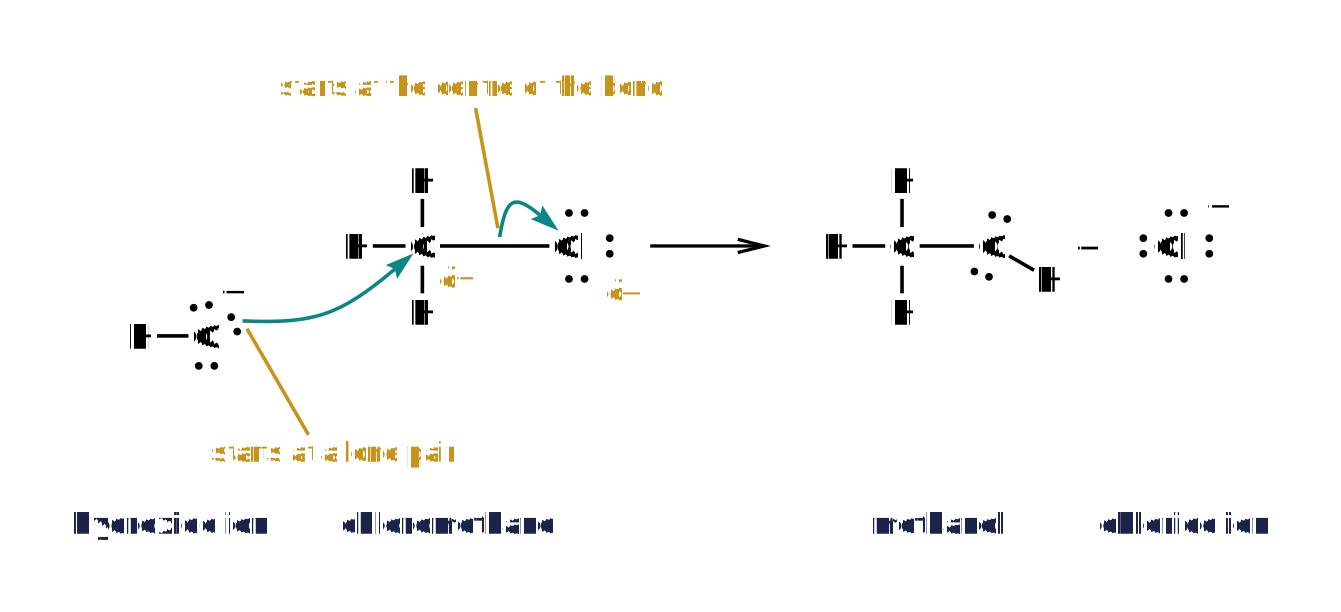
This ionic mechanism shows electron-pair movement. Radical mechanisms use single-electron movement and are treated separately in the following subtopic pages.
Do not mix up the arrow types: free-radical mechanisms involve single-electron movement, whereas many ionic mechanisms use electron-pair curly arrows.
Quick Check: Equation or Mechanism?
Decide whether an overall equation counts as a mechanism.
Quick Check: Free Radical Substitution Summary
Pull the whole page together by choosing the accurate statement in each round.
Free Radical Substitution Summary
1. Alkane reactivity
Alkanes are usually unreactive because their C-C and C-H bonds are strong and require a large amount of energy to break.
2. UV light starts the reaction
UV light provides enough energy for homolytic fission of the halogen molecule, forming reactive halogen radicals.
3. Chain mechanism
The reaction proceeds through initiation, propagation and termination, producing substitution products and possible further substitution products.
Free Radical Substitution FAQs
These questions summarise the core exam points on alkane substitution and free radicals.
Why are alkanes usually unreactive?
Alkanes are usually unreactive because they contain strong C-C and C-H bonds. These bonds require a large amount of energy to break.
What condition is needed for alkanes to react with chlorine?
Ultraviolet light is needed. UV light provides enough energy to break the Cl-Cl bond by homolytic fission, forming chlorine radicals.
What is a free radical?
A free radical is a species with an unpaired electron. The unpaired electron is usually represented using a dot, such as Cl•.
Why is the reaction called substitution?
It is called substitution because a hydrogen atom in the alkane is replaced by a halogen atom.
Why can a mixture of products form?
After the first substitution, the halogenoalkane product can undergo further substitution. This can replace more hydrogen atoms and produce a mixture of chlorinated products.
Copyright notice: This OLS revision content, including the explanations, layout, diagrams, tables and embedded learning structure, is authored for Online Learning System by Dr. Mohammed Al-Fatah. It may not be copied, reproduced, redistributed or adapted without written permission.
Keep this note — free
Save your progress across every Edexcel topic. A free account remembers which topics you have covered, saves your question scores, and syncs across your phone and laptop.
- Track every topic you have finished
- Keep your practice-question scores
- No payment, no card, free forever
Already registered? Log in