Reactions of Alkenes with Bromine Water
A concise revision guide to the reaction of alkenes with bromine water, including the orange to colourless observation, why the reaction is a test for the alkene functional group and how the C=C double bond reacts by addition.
- 6A.5-a
- 6C.22ii
- 6C.25-b
What these spec points say
- 6A.5-a be able to classify reactions as addition
- 6C.22ii understand the addition reactions of alkenes with: halogens to produce dihalogenoalkanes
- 6C.25-b know the qualitative test for a C=C double bond using bromine water
Before You Start
This page builds on the GCSE test for alkenes and on the reaction of alkenes with bromine.
- Bromine water is orange; alkenes turn it colourless and alkanes do not.
- Alkenes are unsaturated because they contain a C=C bond.
- In an addition reaction atoms add across the C=C bond.
- Water molecules have lone pairs on oxygen, so water can donate an electron pair.
GCSE Recap: Saturated or Unsaturated?
Four quick GCSE questions on alkenes, alkanes and cracking before you look at the test in detail.
Watch: the test for a C=C double bond
The standard test for a C=C double bond, step by step. What colour change would you see?
The Overall Reaction
Alkenes react with bromine water in an addition reaction. Bromine water is bromine dissolved in water, and the reaction takes place at room temperature.
The C=C double bond opens and atoms add across the double bond. This means the alkene becomes a saturated organic product.
The key observation is that the orange colour of bromine water decolourises to colourless.
Key idea: The colour change happens because bromine reacts with the C=C double bond, so bromine water is used as a chemical test for alkenes.
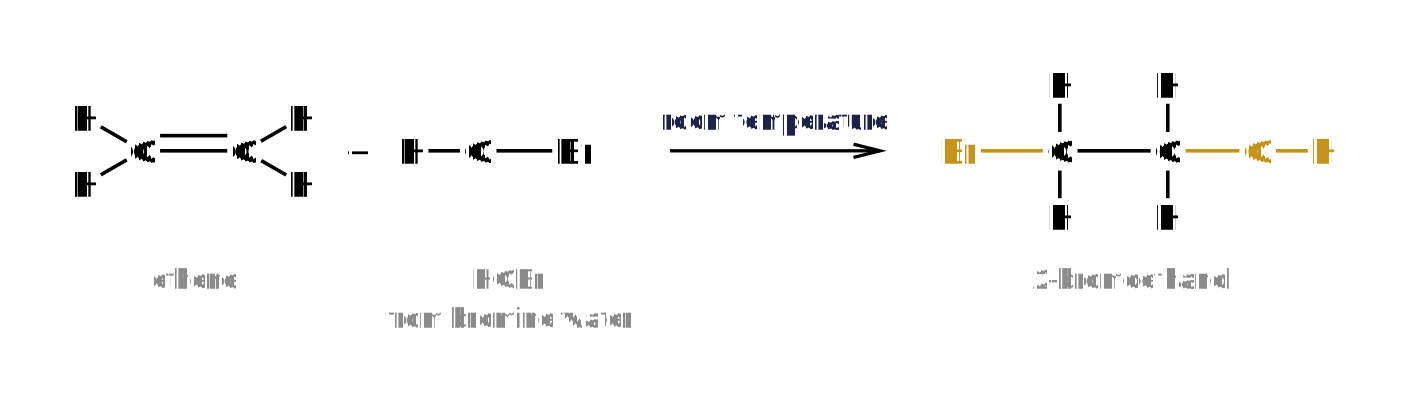
The C=C double bond reacts with bromine water, causing the orange colour to disappear.
Quick Check: Drop by Drop
Decide what it means when the orange colour stops disappearing.
Using Bromine Water to Test for Alkenes
Bromine water is commonly used to test whether an organic compound contains an alkene functional group.
If a C=C double bond is present, bromine water changes from orange to colourless. This positive test shows that the bromine has reacted with the alkene.
If there is no C=C double bond under these conditions, the orange colour is expected to remain.
Positive test
Bromine water decolourises from orange to colourless. This suggests the compound contains a C=C double bond.
Negative test
The orange colour remains. This suggests there is no alkene functional group reacting under the test conditions.
Exam focus: State both the reagent and the observation: bromine water changes from orange to colourless.
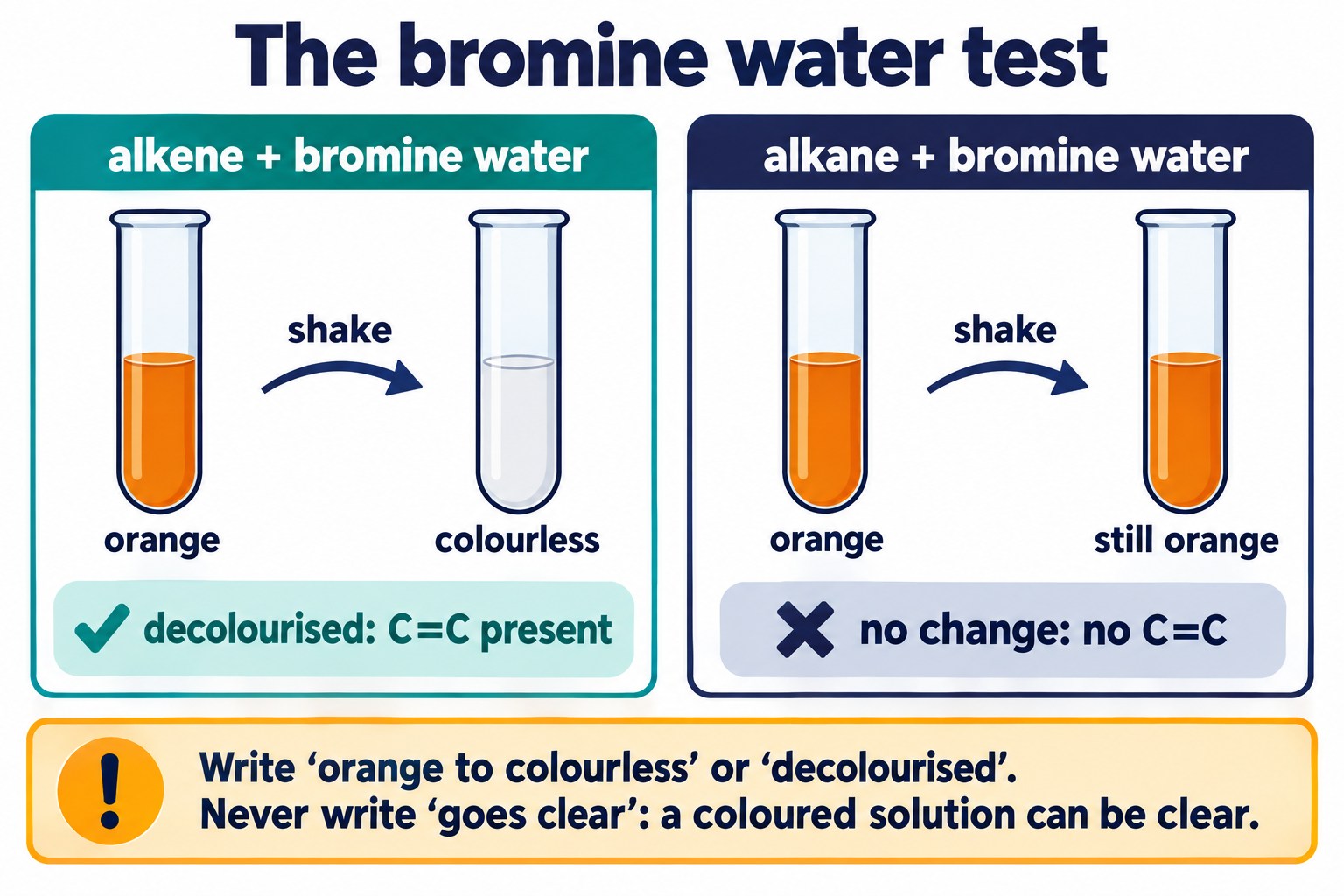
An alkene decolourises bromine water from orange to colourless; an alkane leaves it orange.
Quick Check: Which Ones React?
Click every substance in the list that turns bromine water from orange to colourless.
Why This Is an Addition Reaction
Alkenes are unsaturated because they contain a carbon-carbon double bond, C=C. The double bond contains an electron-rich π bond, which is the reactive part of the molecule.
During addition, the π bond is broken and new bonds form to the two carbon atoms from the original double bond.
The overall result is that the molecule becomes more saturated because atoms have been added across the C=C bond.
Addition reaction: A reaction in which atoms are added across a double bond, converting an unsaturated molecule into a more saturated product.
Remember: In alkene addition reactions, the C=C double bond is the reactive site. The π bond reacts first because it is electron-rich and more exposed than the σ bond.
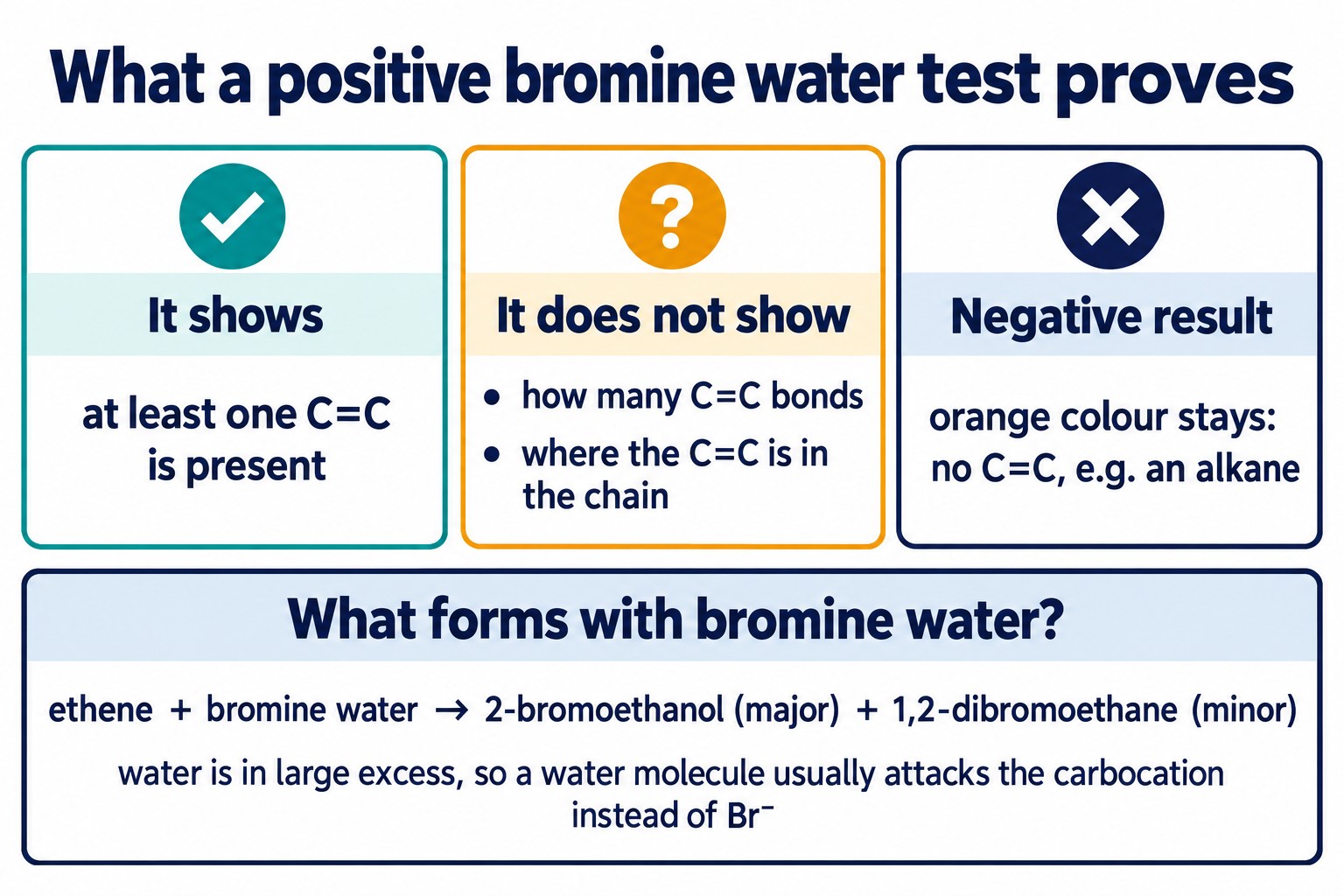
A positive test proves a C=C is present; with water in excess the main product is a bromoalcohol.
Quick Check: Pick the Accurate Statement
In each round, choose the one statement that is accurate.
The Reaction Mechanism
The reaction of an alkene with bromine water is linked to the same core idea as other alkene addition reactions: the electron-rich π bond reacts first.
The C=C double bond provides electron density, allowing the reaction to begin. The double bond then opens and new bonds form across the two carbon atoms.
This explains why the characteristic orange colour disappears. Bromine is consumed as it reacts with the alkene.
Step 1: The C=C bond reacts
The π bond in the alkene is electron-rich and begins the reaction with bromine water.
Step 2: The double bond opens
The alkene loses the C=C double bond as atoms add across the two carbon atoms.
Step 3: The colour change is observed
The orange colour of bromine water decolourises to colourless as bromine is used up in the reaction.
Quick Check: How Far Does the Result Go?
Write a short explanation, then compare it with the mark points and the model answer.
Common Exam Mistakes
Students often lose marks by saying only that bromine water “goes clear” without giving the full starting colour. The full observation is orange to colourless.
Another common error is to describe the reaction as substitution. This is incorrect for alkenes. The reaction is addition because atoms are added across the C=C double bond.
For a test question, the safest answer should include the reagent, condition and observation.
Exam focus: Link the observation to the alkene functional group. The colour change is evidence that a C=C double bond has reacted.
Quick Check: Bromine Water from Start to Finish
Each round covers one part of the page, from the observation to the mechanism. Choose the one accurate statement.
FAQs
These questions cover the bromine water points that cost marks.
What is the full observation for the alkene test?
Bromine water changes from orange to colourless. Writing that it goes clear is not enough, because clear only means transparent.
Why does bromine water give 2-bromoethanol, not 1,2-dibromoethane?
Water is in huge excess, so a water molecule usually attacks the carbocation before a bromide ion can. Some 1,2-dibromoethane still forms.
Do alkanes decolourise bromine water?
Not in the dark at room temperature. They have no π bond, so no addition can happen and the orange colour stays.
Is this test a substitution reaction?
No. Atoms add across the C=C bond, so it is electrophilic addition.
Why does the bromine still act as an electrophile in water?
The π electrons induce a dipole in Br2, just as in an organic solvent. The Brδ+ atom accepts the electron pair.
Copyright notice: This OLS revision content, including the explanations, layout, diagrams, tables and embedded learning structure, is authored for Online Learning System by Dr. Mohammed Al-Fatah. It may not be copied, reproduced, redistributed or adapted without written permission.
Keep this note — free
Save your progress across every Edexcel topic. A free account remembers which topics you have covered, saves your question scores, and syncs across your phone and laptop.
- Track every topic you have finished
- Keep your practice-question scores
- No payment, no card, free forever
Already registered? Log in