Alcohol
A concise revision guide to the alcohol functional group, the hydroxyl group, the -ol suffix, naming diols and triols, and the priority of the -OH group in organic nomenclature.
- 6A.4-a
What these spec points say
- 6A.4-a be able to name compounds relevant to this specification using the rules of IUPAC nomenclature
GCSE Recap: The Alcohols You Already Know
Start with the alcohols you met at GCSE before learning the A Level naming rules.
What Is an Alcohol?
An alcohol is an organic compound containing the hydroxyl functional group, written as -OH.
The oxygen atom in the -OH group is bonded to a carbon atom in the organic molecule. This functional group determines the characteristic chemistry of alcohols.
In naming, the -OH group is usually shown using the suffix -ol.
Key idea: The alcohol functional group is the hydroxyl group, -OH. Do not confuse this with the hydroxide ion, OH–.

The hydroxyl group is the identifying functional group of alcohols and is written as -OH in organic formulae.
Quick Check: Spot the Alcohol
Decide which of these compounds contains a hydroxyl group bonded to carbon.
Naming Alcohols Using the -ol Suffix
Alcohols are named using the suffix -ol.
If the position of the -OH group needs to be shown, the position number is placed between the name stem and the -ol suffix.
For example, propan-1-ol has a three-carbon chain and the -OH group is attached to carbon 1.
| Homologous series | Functional group | Prefix | Suffix | Example |
|---|---|---|---|---|
| Alcohols | -OH | hydroxy- | -ol | propan-1-ol |
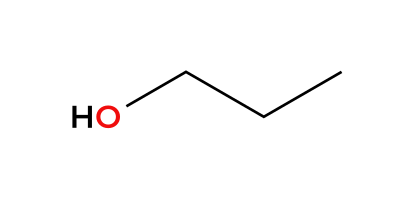
The number 1 shows that the -OH group is bonded to the first carbon atom in the propyl chain.
Quick Check: Name That Alcohol
Pick the correct name for each alcohol from its formula.
Alcohols with Two or More -OH Groups
If a molecule contains two or more -OH groups, prefixes such as di- and tri- are used.
In these cases, the final e in the alkane stem is retained before the suffix. For example, ethane becomes ethane-1,2-diol, not ethan-1,2-diol.
Two -OH groups
Use -diol, with numbers showing the positions of both -OH groups.
Three -OH groups
Use -triol, with numbers showing the positions of all three -OH groups.
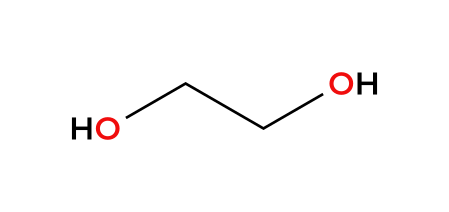
Ethane-1,2-diol contains two -OH groups, so the diol suffix is used and the e in ethane is retained.
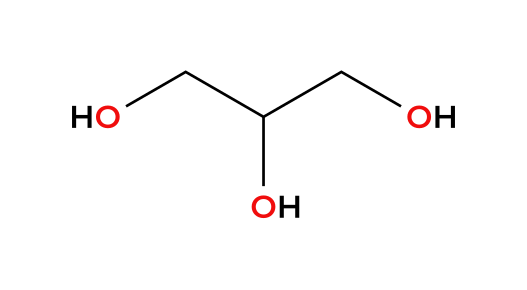
Propane-1,2,3-triol contains three -OH groups, so each position is included before the triol suffix.
Quick Check: Diols and Triols
Type the missing numbers to complete the names of these alcohols with more than one -OH group.
Watch: an -OH group and a branch on one chain
An alcohol group and a methyl branch sit on the same four-carbon chain. Which one decides the numbering?
Priority of the -OH Group
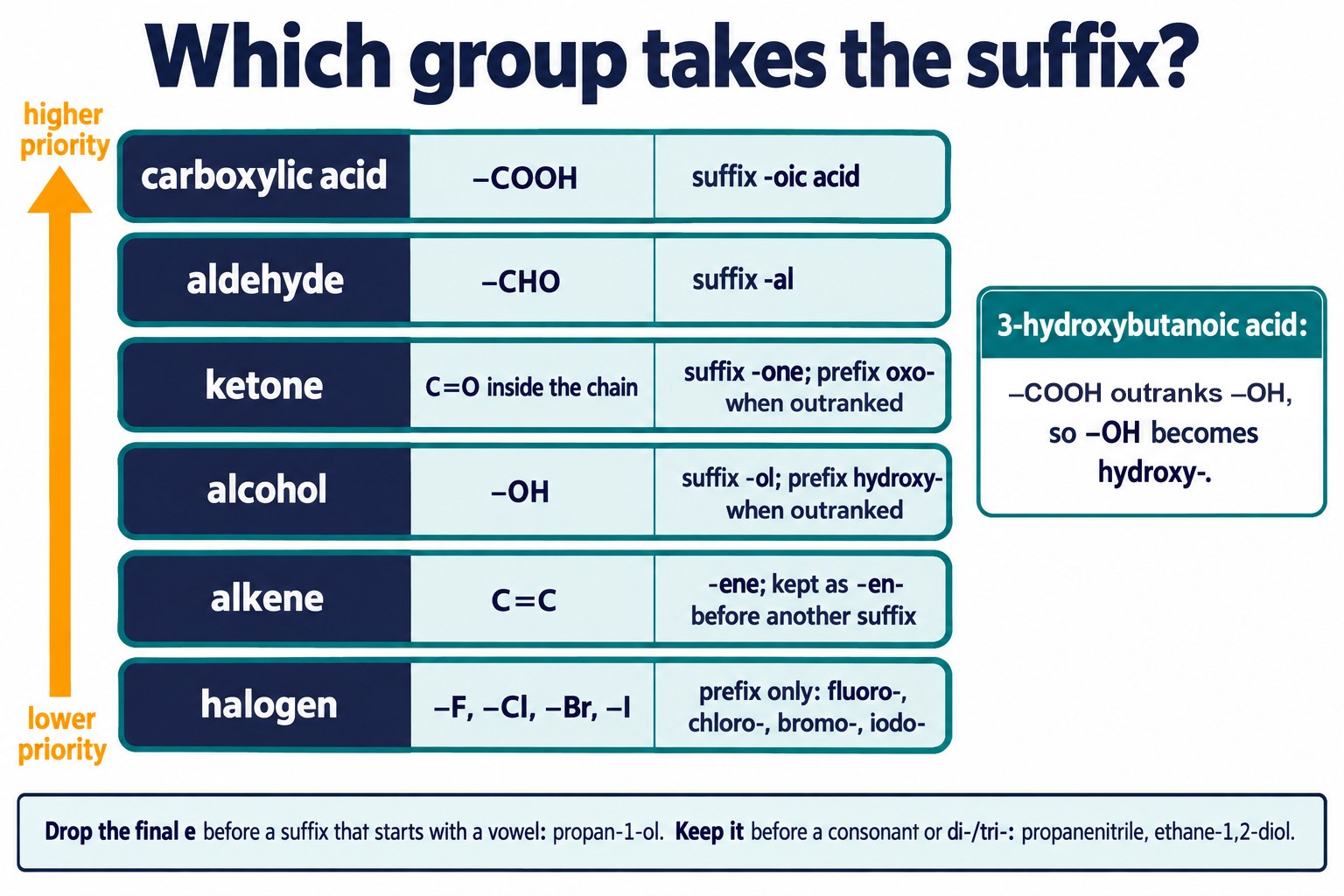
The -OH group has higher priority than both halogenoalkanes and alkenes when naming organic molecules.
This means the carbon chain is numbered so that the -OH group is on the lowest possible carbon, often carbon 1.
If a molecule also contains a C=C double bond or halogen substituents, these are still included in the name, but the -OH group controls the main suffix and the numbering direction.
Exam focus: When several groups are present, first identify the highest-priority group that will control the suffix and numbering.
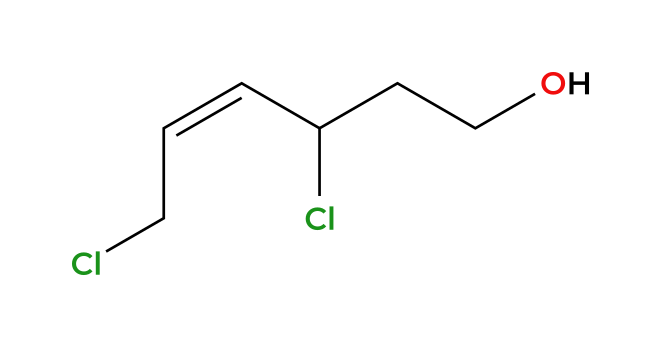
The -ol suffix and carbon 1 position are used because the -OH group has higher naming priority than the C=C bond and chloro substituents.
Quick Check: Explain the Numbering
Write a short explanation of how the -OH group controls the name of a halogen-containing alcohol.
When Alcohol Is Named as Hydroxy-
If a compound contains an -OH group and another functional group with higher priority, the higher-priority group takes the suffix form.
In that situation, the -OH group is named using the prefix hydroxy-.
This is why it is important to recognise whether -OH is acting as the main functional group or as a substituent in the name.
| Naming situation | How -OH appears in the name | Example naming logic |
|---|---|---|
| -OH is the main functional group | Use the suffix -ol | propan-1-ol |
| A higher-priority group controls the suffix | Use the prefix hydroxy- | The higher-priority group takes the suffix form |
Remember: The usual alcohol naming pattern is -ol, but hydroxy- is used when the -OH group is not the highest-priority group.
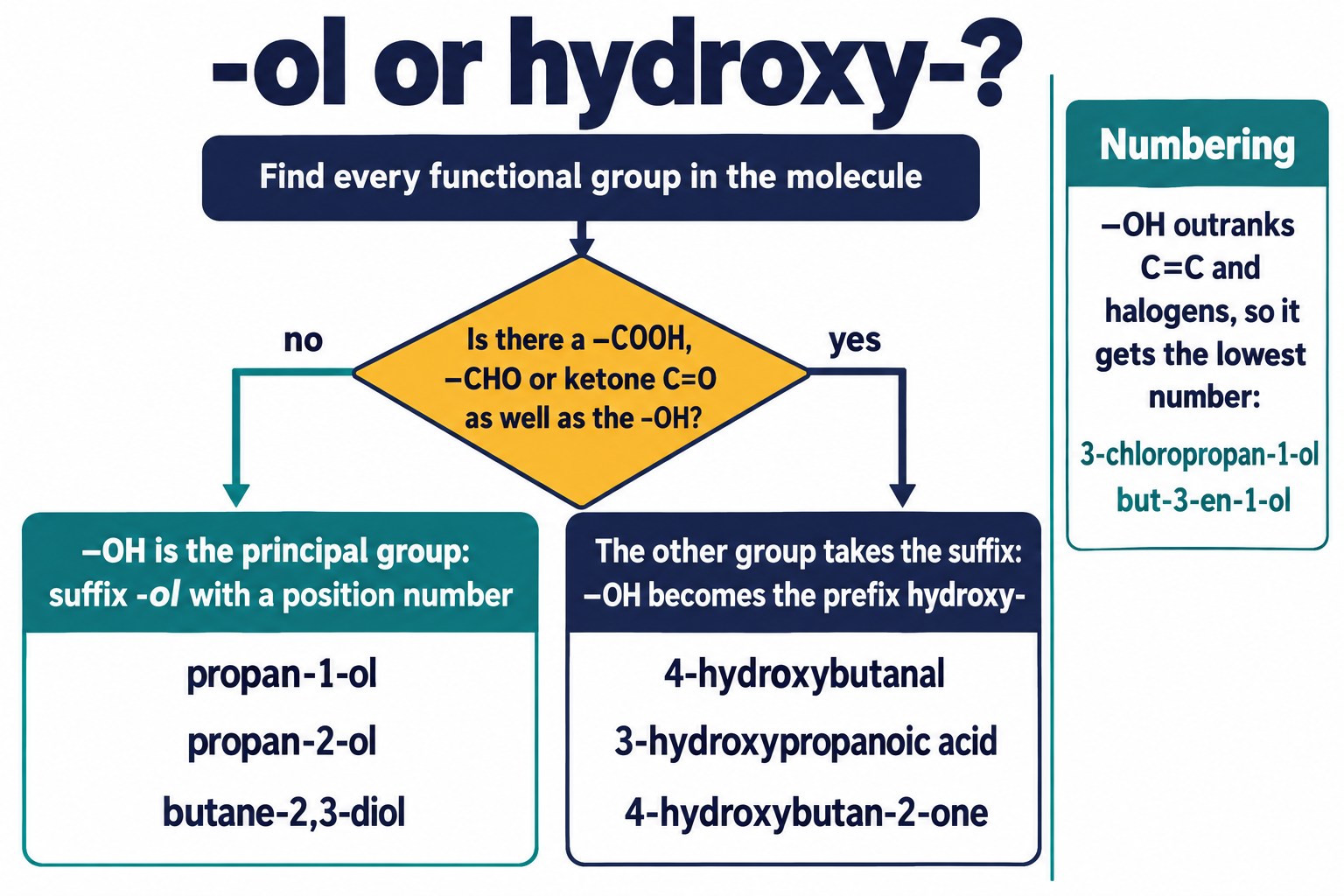
The OH group is a suffix, -ol, unless a higher-priority group is present; then it becomes the prefix hydroxy-.
Quick Check: When -OH Becomes Hydroxy-
Name a molecule in which the -OH group is not the highest-priority group.
Quick Check: Alcohol Naming Summary
Pull the whole page together by choosing the accurate statement about each new molecule.
FAQs
These questions cover the alcohol naming points that cost marks.
Is the -OH in an alcohol the same as a hydroxide ion?
No. The -OH group is covalently bonded to carbon and is not an ion. Hydroxide, OH⁻, is a negative ion found in ionic compounds such as sodium hydroxide.
Why is it ethane-1,2-diol and not ethan-1,2-diol?
The suffix -diol starts with d, a consonant, so the e of ethane is kept.
Where does the position number go in an alcohol name?
Between the stem and the suffix, as in propan-2-ol. It shows which carbon carries the -OH group.
When is the -OH group called hydroxy-?
When a higher-priority group, such as an aldehyde or carboxylic acid, takes the suffix. The -OH group then becomes the prefix hydroxy-, as in 2-hydroxypropanoic acid.
Do I number from the end nearer the -OH or nearer a halogen?
Nearer the -OH group. It has higher priority than halogens and C=C bonds, so it gets the lowest number.
Copyright notice: This OLS revision content, including the explanations, layout, diagrams, tables and embedded learning structure, is authored for Online Learning System by Dr. Mohammed Al-Fatah. It may not be copied, reproduced, redistributed or adapted without written permission.
Keep this note — free
Save your progress across every Edexcel topic. A free account remembers which topics you have covered, saves your question scores, and syncs across your phone and laptop.
- Track every topic you have finished
- Keep your practice-question scores
- No payment, no card, free forever
Already registered? Log in