Oxides of Sulfur
A concise revision guide to sulfur dioxide pollution from combustion, sulfur-containing impurities in fuels, coal as a sulfur dioxide source, acid rain and environmental effects.
- 6B.11-c
- 6B.12-c
What these spec points say
- 6B.11-c know oxides of sulfur are formed during combustion of alkane fuels
- 6B.12-c understand problems arising from acidity of oxides of sulfur
GCSE Recap: Acidic Oxides, pH and Carbonates
Before you start, check the GCSE ideas about acids that explain how acid rain forms and what it does.
Where Sulfur Dioxide Comes From
Some petroleum fractions contain sulfur-based impurities. When these fuels are burned, the sulfur impurities are oxidised and form sulfur dioxide, SO2.
This means combustion can release pollutants even when the hydrocarbon fuel itself mainly contains carbon and hydrogen. The pollution comes from impurities mixed with the fuel or from sulfur-containing organic molecules present in the fuel source.
Key idea: Sulfur dioxide is not produced from pure alkanes alone. It forms when sulfur-containing substances in the fuel are burned.
Quick Check: Which Fuels Give SO₂?
Click every substance that would give sulfur dioxide when it burns.
Watch: from sulfur in fuel to acid rain
Sulfur dioxide rises from burning fuel and meets the rain. Then come the equations.
Formation of Sulfur Dioxide
In fuels the sulfur is nearly always combined in compounds rather than present as the element. Whatever it is combined with, the sulfur is oxidised to sulfur dioxide when the fuel burns, so examiners accept this simplified equation:
S + O2 → SO2
Most often the sulfur sits inside an organic molecule. For example, methanethiol, CH3SH, burns to form sulfur dioxide alongside carbon dioxide and water.
CH3SH + 3O2 → SO2 + CO2 + 2H2O
Exam focus: When sulfur is present in the fuel, combustion produces sulfur dioxide. Do not confuse this with incomplete combustion, which produces carbon monoxide or soot.
Quick Check: Balance the Equations
Type the missing balancing numbers for three sulfur compounds the page does not show.
Sulfur Dioxide and Acid Rain
Sulfur dioxide is an acidic gas. Once released into the atmosphere, it can dissolve in rainwater and contribute to the formation of acid rain.
Sulfur dioxide dissolves in rainwater to give sulfurous acid, H2SO3:
SO2 + H2O → H2SO3
In the atmosphere some sulfur dioxide is oxidised to sulfur trioxide, SO3, the other oxide of sulfur, which dissolves to give the stronger sulfuric acid, H2SO4:
2SO2 + O2 → 2SO3
SO3 + H2O → H2SO4
Acid rain is a major environmental problem because it can damage buildings, harm aquatic life and affect soil chemistry.
Limestone and marble are calcium carbonate, so the acid reacts with the stone itself, giving a salt, water and carbon dioxide. The salt flakes or washes off, so carved surfaces are slowly eaten away. Acid rain also corrodes metal structures.
| Stage | Chemistry idea | Consequence |
|---|---|---|
| Combustion | Sulfur-containing substances burn in oxygen. | Sulfur dioxide, SO2, is released. |
| Atmosphere | SO2 is acidic and dissolves in rainwater. | Acid rain can form. |
| Environment | Acidic rainwater reacts with materials and ecosystems. | Buildings, aquatic life and soils can be damaged. |
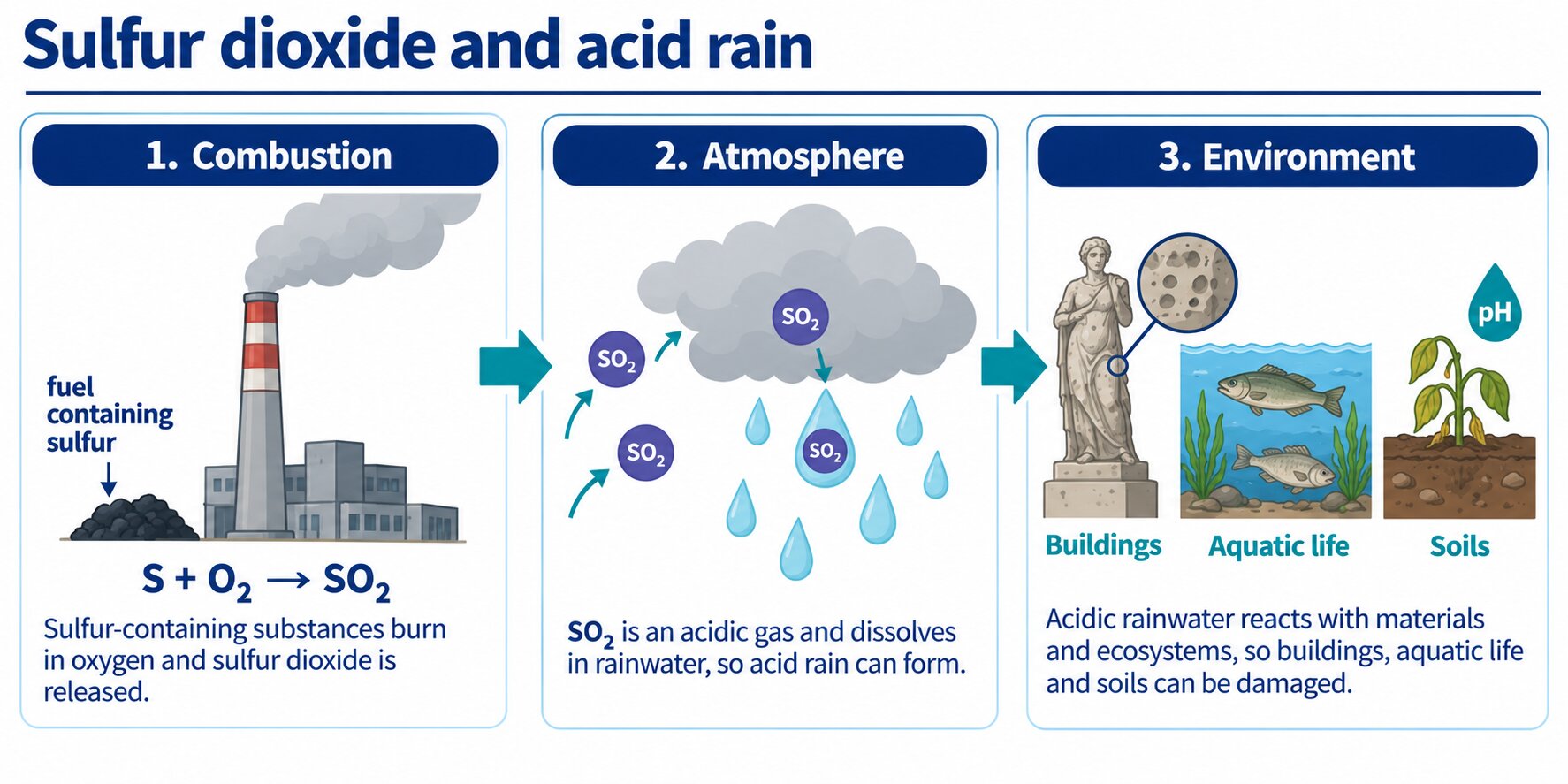
Sulfur dioxide released during combustion can dissolve in rainwater, contributing to acid rain and environmental damage.
Quick Check: Explain the Damaged Statue
Write a short explanation, then compare it with the mark points and the model answer.
Coal and Other Sources of Sulfur Dioxide
Coal often contains a relatively high sulfur content. When coal is burned in power stations, large quantities of sulfur oxides can be released.
This is why sulfur dioxide pollution is closely associated with the combustion of sulfur-containing fossil fuels, especially where fuel sulfur content is high and pollution control is limited.
Emissions are cut by flue gas desulfurisation. The waste gases are passed through a spray of calcium oxide, CaO, or a slurry of calcium carbonate, CaCO3.
Both are basic, so they neutralise the acidic sulfur dioxide and it is removed as solid calcium sulfite:
CaO + SO2 → CaSO3
Sulfur compounds are also taken out of fuels at the refinery before they are sold, which is why low-sulfur petrol and diesel give less SO2.
| Fuel or source | Reason SO2 may form | Pollution issue |
|---|---|---|
| Petroleum fractions | May contain sulfur-based impurities. | SO2 is released during combustion. |
| Sulfur-containing organic molecules | The sulfur atom is oxidised during burning. | SO2 forms alongside CO2 and H2O. |
| Coal | Often has relatively high sulfur content. | Large amounts of sulfur oxides can be emitted in power stations. |
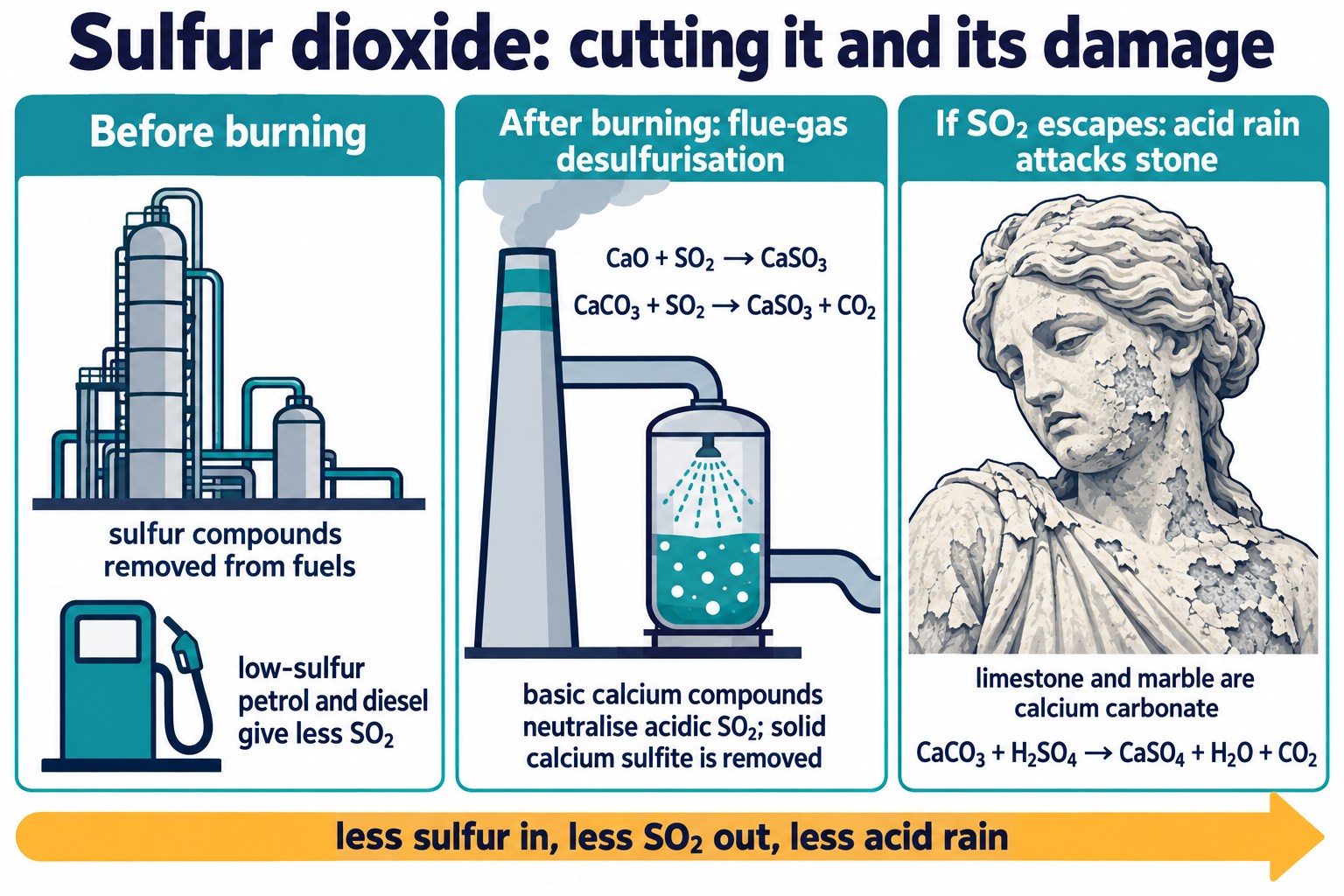
Sulfur is removed from fuels before burning, and SO₂ is removed from flue gases by calcium oxide or calcium carbonate.
Quick Check: How Much SO₂?
Work out the mass of sulfur dioxide on paper, then choose your answer.
Environmental Effects to Remember
Sulfur dioxide pollution is important because it links combustion chemistry to large-scale environmental damage. In exam answers, the strongest responses connect the source, the pollutant and the effect.
- Source: sulfur-containing impurities or sulfur-containing fuels are burned.
- Pollutant: sulfur dioxide, SO2, is released into the atmosphere.
- Effect: sulfur dioxide contributes to acid rain.
- Damage: acid rain damages buildings, harms aquatic life and affects soil chemistry.
Exam focus: A precise answer should name sulfur dioxide and link it to acid rain. Avoid vague phrases such as “bad gases” or “general pollution”.
Quick Check: Pick the Accurate Statement
In each round, choose the one statement that is accurate.
Oxides of Sulfur FAQs
Common questions about sulfur dioxide pollution from combustion.
Why does combustion produce sulfur dioxide?
Combustion produces sulfur dioxide when the fuel contains sulfur-based impurities or sulfur-containing organic molecules. The sulfur reacts with oxygen to form SO2.
What is the equation for sulfur burning in oxygen?
The balanced equation is S + O2 → SO2.
How does sulfur dioxide cause acid rain?
Sulfur dioxide is an acidic gas. Once released into the atmosphere, it dissolves in rainwater and contributes to the formation of acid rain.
Why is coal an important source of sulfur dioxide pollution?
Coal often contains a relatively high sulfur content, so burning coal in power stations can release large quantities of sulfur oxides.
What damage can acid rain cause?
Acid rain can damage buildings, harm aquatic life and affect soil chemistry.

Copyright notice: This OLS revision content, including the explanations, layout, diagrams, tables and embedded learning structure, is authored for Online Learning System by Dr. Mohammed Al-Fatah. It may not be copied, reproduced, redistributed or adapted without written permission.
Keep this note — free
Save your progress across every Edexcel topic. A free account remembers which topics you have covered, saves your question scores, and syncs across your phone and laptop.
- Track every topic you have finished
- Keep your practice-question scores
- No payment, no card, free forever
Already registered? Log in