Ketone
A concise revision guide to ketone functional groups, the carbonyl group, the -one suffix, position numbers, diones and common naming traps in organic chemistry.
- 6A.4-a
- 17B.6-b
What these spec points say
- 6A.4-a be able to name compounds relevant to this specification using the rules of IUPAC nomenclature
- 17B.6-b be able to identify the ketone functional group
Before You Start
This page builds on naming carbon chains and on the C=O group you met in carboxylic acids and esters at GCSE.
- Meth-, eth-, prop- and but- show 1, 2, 3 and 4 carbon atoms in the longest chain.
- Carbon forms four covalent bonds and oxygen forms two.
- A double bond is two shared pairs of electrons, drawn as C=O.
- A functional group decides the family a compound belongs to and how it reacts.
GCSE Recap: Double Bonds, Formulae and Isomers
Check the GCSE ideas about bonding and isomers that ketone naming relies on.
What Is a Ketone?
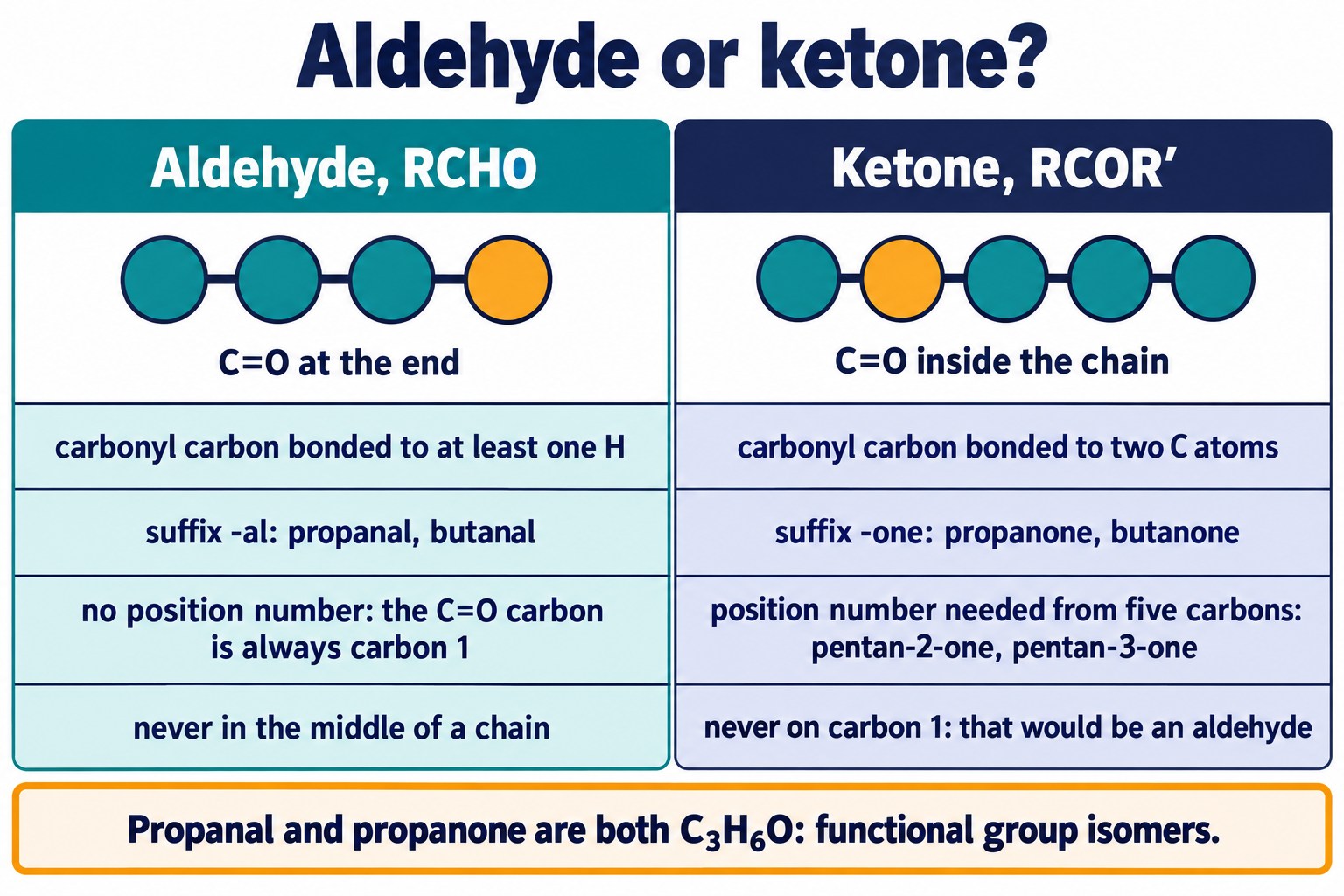
A ketone is an organic compound containing a carbonyl group, written as C=O, where the carbonyl carbon is bonded to two carbon atoms.
This means a ketone has the general structural pattern RCOR’, often written as R-C(=O)-R’. The R groups may be alkyl groups or parts of a ring.
The carbonyl group is the functional group of ketones. It controls the naming pattern and helps identify the homologous series.
Key idea: In a ketone, the C=O group is within the carbon chain, not at the end of the chain.
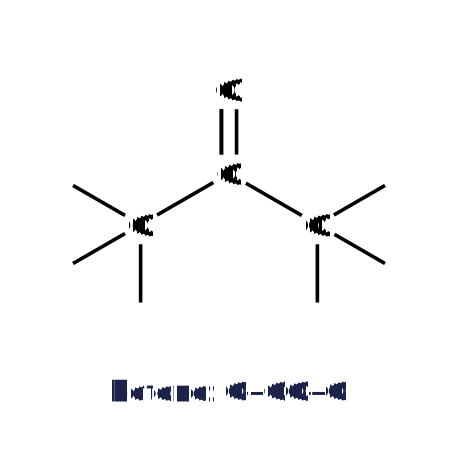
The carbonyl carbon is attached to two carbon atoms, which distinguishes ketones from aldehydes.
Quick Check: Ketone or Not?
Decide quickly whether each compound is a ketone.
Naming Ketones Using the -one Suffix
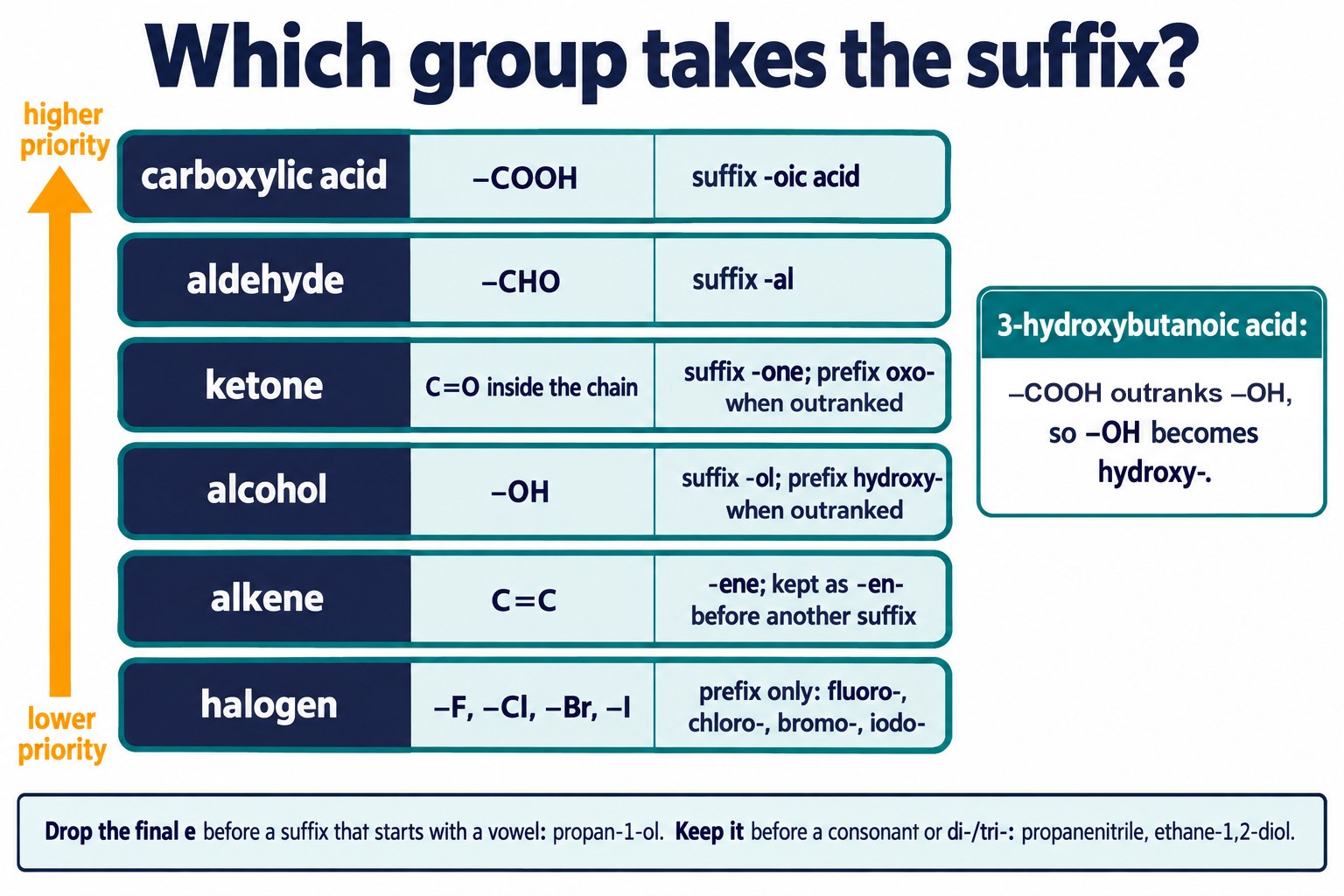
Ketones are usually named using the suffix -one. The parent chain is selected so that it includes the carbonyl carbon.
When a position number is needed, the carbon chain is numbered so that the carbonyl carbon receives the lowest possible number.
| Homologous series | Functional group | Prefix | Suffix |
|---|---|---|---|
| Ketones | C=O bonded to two carbon atoms | oxo- | -one |
Exam focus: The suffix -one identifies the compound as a ketone when the carbonyl group is the principal functional group.
Quick Check: Lowest Possible Number
Decide whether this ketone has been numbered correctly.
Watch: a ketone on carbon 3 from both ends
The C=O lands on carbon 3 whichever end you start from. So how do you decide the numbering?
Position Numbers in Ketone Names
Some ketone names need a position number to show where the C=O group is located in the carbon chain.
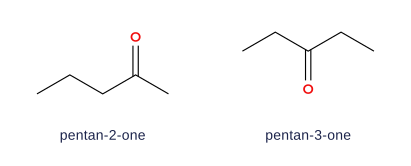
This becomes especially important when there is more than one possible position for the carbonyl group. For example, in a five-carbon chain, the names pentan-2-one and pentan-3-one describe different structures.
For simple cases where only one ketone position is possible, the position number may be omitted in common A Level usage.
Remember: A ketone carbonyl cannot be on carbon 1 in an open-chain molecule, because that would place the C=O group at the end of the chain.
Quick Check: Name the Ketone
Type the name of each ketone from its structural formula.
Quick Check: Counting Heptanones
Work out how many different unbranched ketones a seven-carbon chain can form.
Cyclic Ketones
Ketones can also be found in cyclic molecules. In a cyclic ketone, the carbonyl carbon is part of the ring and is bonded to two other carbon atoms in the ring.
Cyclohexanone is a common example. The name combines the cyclohexane ring framework with the ketone suffix -one.
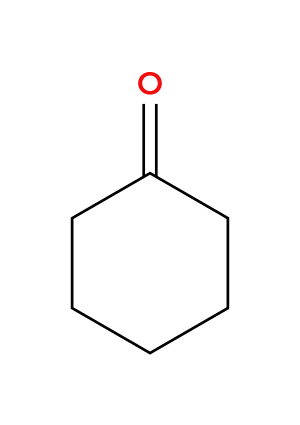
The carbonyl carbon is part of the ring, so the structure is named as a cyclic ketone.
Quick Check: Picture a Cyclic Ketone
Choose the correct description of a cyclic ketone molecule.
Diones and Common Naming Traps
If a molecule contains two ketone carbonyl groups, the suffix can become -dione. The parent alkane name keeps the final e before adding the suffix, as in butane-2,3-dione.
Take care with carbonyl groups at the end of a chain. A terminal C=O group is not a ketone carbonyl because the carbonyl carbon is not bonded to two carbon atoms.
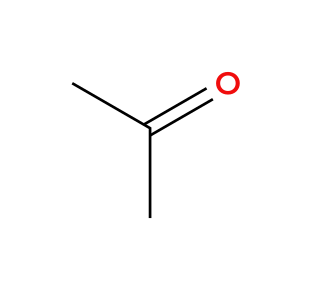
Propanone: the C=O group is on carbon 2 and bonded to two carbon atoms, so it is a ketone. A C=O group on carbon 1 would make the aldehyde propanal, so there is no propan-1-one.
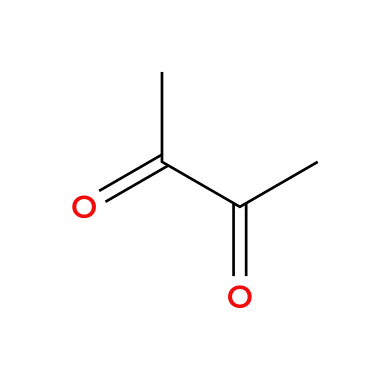
Butane-2,3-dione: both carbonyl carbons are bonded to two carbon atoms. With C=O groups on carbons 1 and 4 the molecule would be the dialdehyde butanedial, not butane-1,4-dione.
Exam focus: Do not identify a molecule as a ketone from the C=O group alone. Check what the carbonyl carbon is bonded to.
Quick Check: Explain the Naming Error
Explain what is wrong with a student's ketone name.
Quick Check: Diones and Traps
Finish the page by choosing the accurate statement about each molecule.
FAQs
These questions cover the ketone naming points that cost marks.
Can a ketone have its C=O on carbon 1?
No. A C=O on carbon 1 is bonded to a hydrogen atom, which makes the compound an aldehyde. In a chain the ketone carbonyl is never at the end.
Why is there no number in propanone or butanone?
Only one position is possible for the ketone group, so the number adds nothing. From pentanone onwards it is needed: pentan-2-one and pentan-3-one differ.
Is pentan-4-one a correct name?
No. Number from the end nearer the C=O group, so the same molecule is pentan-2-one.
How do I tell a ketone from an ester?
In a ketone the carbonyl carbon is bonded to two carbon atoms. In an ester it is bonded to a carbon and to an oxygen that links on to another carbon.
What does oxo- mean in a name?
It is the prefix for a ketone C=O, used when a higher-priority group, such as a carboxylic acid, takes the suffix.
Copyright notice: This OLS revision content, including the explanations, layout, diagrams, tables and embedded learning structure, is authored for Online Learning System by Dr. Mohammed Al-Fatah. It may not be copied, reproduced, redistributed or adapted without written permission.
Keep this note — free
Save your progress across every Edexcel topic. A free account remembers which topics you have covered, saves your question scores, and syncs across your phone and laptop.
- Track every topic you have finished
- Keep your practice-question scores
- No payment, no card, free forever
Already registered? Log in