Reactions of Alkenes with Hydrogen
A concise revision guide to the reaction of alkenes with hydrogen, including the change from alkene to alkane, the use of a nickel catalyst and why this reaction is both an addition reaction and a reduction reaction.
- 6A.5-e
- 6C.22i
What these spec points say
- 6A.5-e be able to classify reactions as reduction
- 6C.22i understand the addition reactions of alkenes with: hydrogen, in the presence of a nickel catalyst, to form an alkane Knowledge of the application of this reaction to the manufacture of margarine by catalytic hydrogenation of unsaturated vegetable oils is expected.
Hydrogenation on a Catalyst Surface
Choose a step to watch ethene and hydrogen meet on a nickel surface and leave as ethane.
© Dr. Mohammed Al-Fatah – onlinelearningsystem.net
GCSE Recap: Catalysts and Hardening Oils
Answer three quick GCSE questions before you start.
The Overall Reaction
Alkenes react with hydrogen, H2, in the presence of a nickel catalyst. The reaction converts an alkene into an alkane.
The C=C double bond opens and one hydrogen atom adds to each carbon atom from the original double bond. This removes the alkene functional group and produces a saturated hydrocarbon.
For example, ethene reacts with hydrogen to form ethane.
Key idea: Hydrogen adds across the C=C double bond, so the alkene becomes an alkane.
Ethene reacts with H2; the C=C double bond is converted into a C-C single bond as ethane forms.

Quick Check: How Much Hydrogen?
Apply the conditions to a molecule that has more than one double bond.
Watch: the bond most students forget in hydrogenation
An exam question on hydrogenating ethene: which bonds break? Most students miss one of them.
Why This Is an Addition Reaction
This reaction is an addition reaction because atoms are added across the carbon-carbon double bond.
The alkene starts with a C=C double bond, meaning it is unsaturated. During the reaction, the double bond opens and two new C-H bonds form.
The product is an alkane, which is saturated because it contains only single covalent bonds between carbon atoms.
Hydrogenation: The addition of hydrogen across a C=C double bond, converting an alkene into an alkane.
Remember: In alkene addition reactions, the C=C double bond is the reactive site. The double bond opens so new atoms can bond to the two carbon atoms.
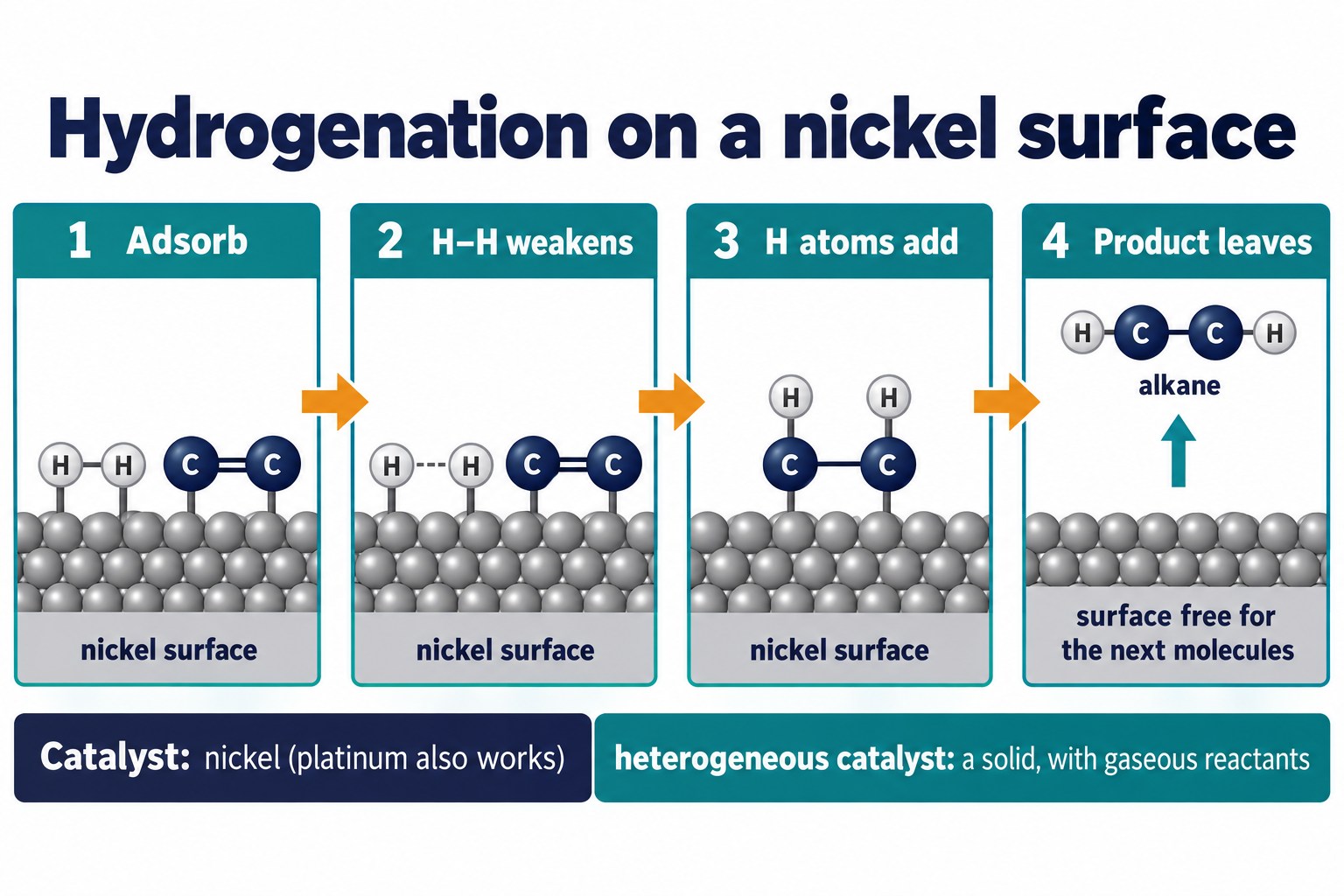
Hydrogen and the alkene are held on the nickel surface, the H–H bond breaks and one hydrogen atom adds to each carbon of the C=C.
Quick Check: Formulae, Names and Amounts
Answer as quickly as you can, using alkenes that are not on this page.
Why This Is Also a Reduction Reaction
The reaction with hydrogen can also be described as a reduction reaction.
In organic chemistry, reduction often means the addition of hydrogen to a molecule. Since the alkene gains hydrogen atoms, the reaction is described as reduction.
This is why the same reaction can be correctly described in two ways: addition, because atoms add across the double bond, and reduction, because hydrogen is added.
Step 1: Hydrogen is the reagent
The alkene reacts with H2 in the presence of a nickel catalyst.
Step 2: The double bond opens
The C=C bond is replaced by a C-C single bond as new C-H bonds form.
Step 3: An alkane forms
The product is saturated because it no longer contains the alkene C=C functional group.
Exam focus: If asked for the reaction type, addition is essential. Reduction is also valid because hydrogen is added.
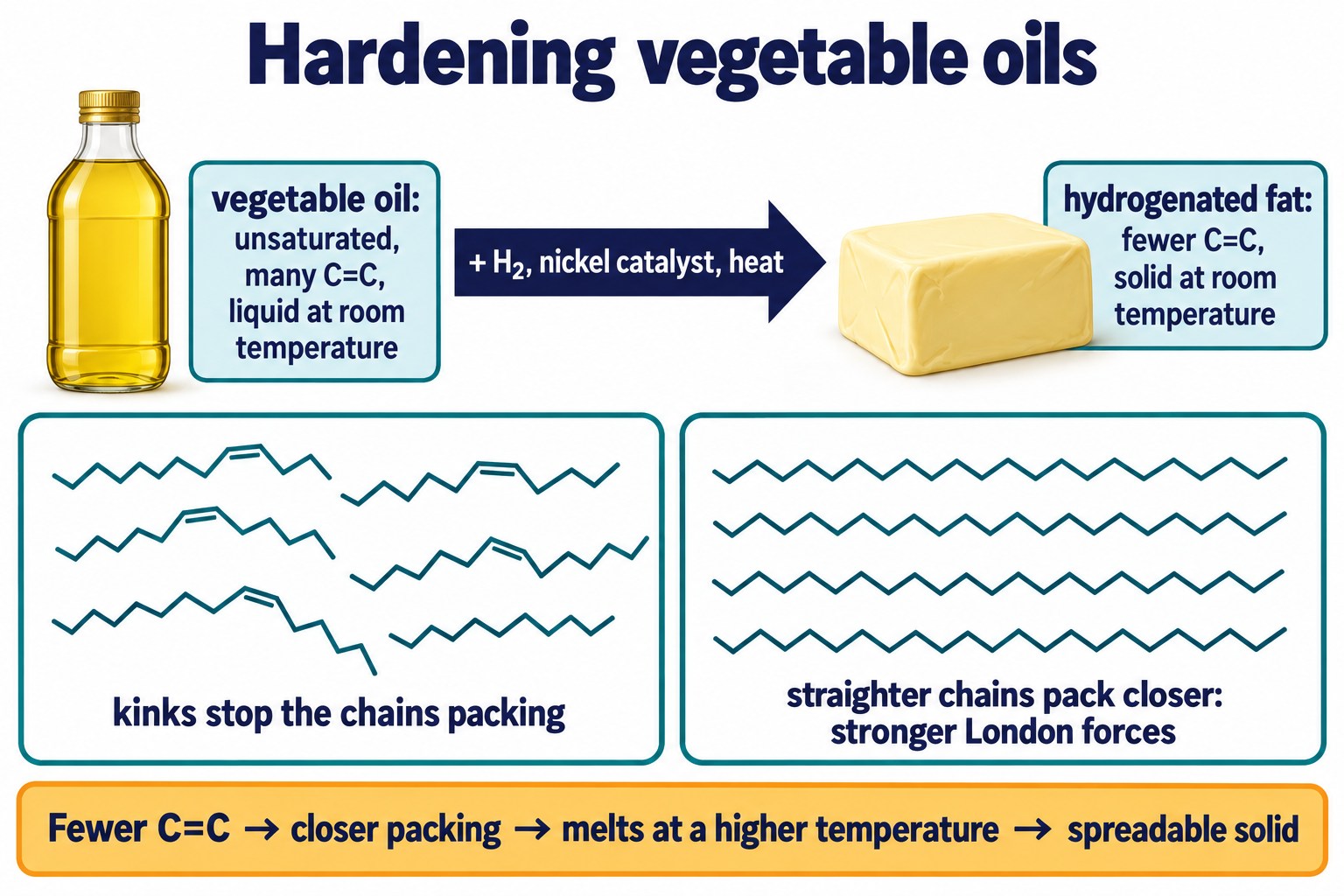
Adding hydrogen to C=C bonds in oils straightens the chains, so they pack closer and the fat is solid.
Quick Check: Two Names for One Reaction
Drag the words into place to describe the hydrogenation of a ring alkene that is not on this page.
Quick Check: Pick the Accurate Statement
In each round, choose the one statement that is accurate.
Common Exam Mistakes
Students often lose marks by forgetting the nickel catalyst, or by describing the reaction as substitution. This is not substitution because no atom is replaced.
Another common error is to leave the product as an alkene. The product must be an alkane, because the carbon-carbon double bond has been removed.
For a simple reaction question, the safest answer should include the reagent, condition, product type and reaction type.
Exam focus: Link the functional group change to the reaction type: alkene to alkane happens because hydrogen adds across the C=C double bond.
FAQs
These questions cover the hydrogenation points that cost marks.
What does the nickel catalyst do?
It adsorbs hydrogen and the alkene on its surface and weakens the H-H bond, so the reaction is fast at a moderate temperature.
Is hydrogenation addition or reduction?
Both. Hydrogen adds across the C=C bond, which is addition, and gaining hydrogen counts as reduction in organic chemistry.
What forms when propene reacts with hydrogen?
Propane, CH3CH2CH3. One hydrogen atom adds to each carbon of the double bond.
How many moles of H2 does a diene take?
Two. Each C=C bond takes one mole of H2, so counting moles of H2 absorbed tells you how many double bonds are present.
Where is hydrogenation used?
In making margarine. Some C=C bonds in vegetable oils are hydrogenated, which raises the melting temperature so the fat is solid at room temperature.
Copyright notice: This OLS revision content, including the explanations, layout, diagrams, tables and embedded learning structure, is authored for Online Learning System by Dr. Mohammed Al-Fatah. It may not be copied, reproduced, redistributed or adapted without written permission.
Keep this note — free
Save your progress across every Edexcel topic. A free account remembers which topics you have covered, saves your question scores, and syncs across your phone and laptop.
- Track every topic you have finished
- Keep your practice-question scores
- No payment, no card, free forever
Already registered? Log in