Carboxylic Acid
A concise revision guide to the carboxylic acid functional group, the -oic acid suffix, numbering from the carboxylic acid carbon, dicarboxylic acids and examples such as ethanoic acid, propanoic acid and ethanedioic acid.
- 6A.4-a
- 17C.9
What these spec points say
- 6A.4-a be able to name compounds relevant to this specification using the rules of IUPAC nomenclature
- 17C.9 be able to identify the carboxylic acid functional group
GCSE Recap: Carboxylic Acids
Three quick questions on the carboxylic acids you met at GCSE.
What Is a Carboxylic Acid?
A carboxylic acid is an organic compound containing the carboxyl functional group, written as -COOH.
The carboxyl group contains both a carbonyl bond, C=O, and a hydroxyl group, -OH, attached to the same carbon atom.
This functional group is found at the end of the carbon chain, so its carbon is included as part of the parent chain.
Key idea: The carboxylic acid group is written as -COOH and the carbon in this group is counted as carbon 1 in the parent chain.
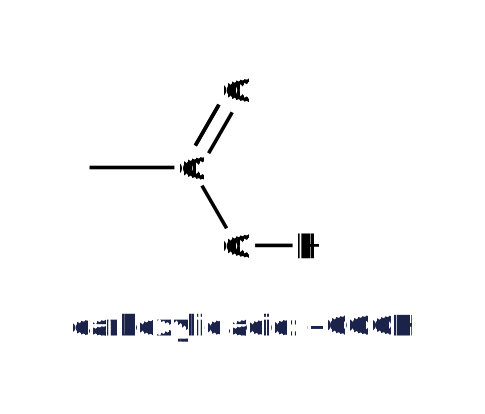
The carboxyl group combines C=O and -OH on the same carbon atom, giving the characteristic -COOH group.
Quick Check: Find the Carboxylic Acids
Click every formula that contains a genuine -COOH group.
Naming Carboxylic Acids Using the -oic Acid Suffix
Carboxylic acids are named using the suffix -oic acid. This suffix replaces the final -e from the corresponding alkane name.
No position number is needed for the carboxylic acid group because it is always found at the end of the carbon chain.
| Homologous series | Functional group | Suffix | Example |
|---|---|---|---|
| Carboxylic acids | -COOH | -oic acid | ethanoic acid |
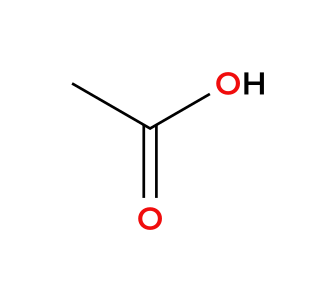
Ethanoic acid has a two-carbon chain and a terminal -COOH group.
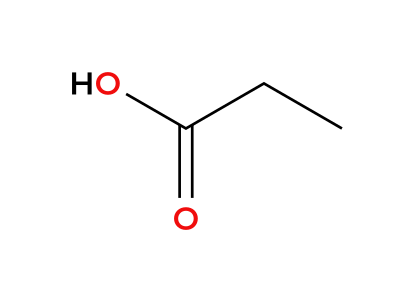
Propanoic acid has a three-carbon chain, with the carboxyl carbon counted in the chain length.
Quick Check: Name That Acid
Type the name of each new carboxylic acid.
Watch: name it, then draw it
2-ethyl-3,3-dimethylbutanoic acid. Which carbon is carbon 1, and where do the side chains go?
Numbering Starts from the Carboxylic Acid Carbon
When naming a carboxylic acid, numbering of the carbon chain always starts from the carboxylic acid carbon.
This means the carbon in the -COOH group is carbon 1. Any other functional groups or side chains are numbered relative to this carbon.
For example, 3-hydroxy-4-methylpentanoic acid has the carboxylic acid carbon as carbon 1, the -OH group on carbon 3 and a methyl group on carbon 4.
Exam focus: Do not number from the end closest to a side chain if the molecule contains -COOH. The carboxylic acid carbon controls the numbering direction.
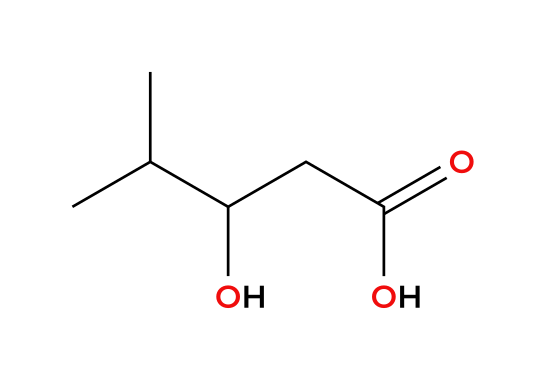
The substituent numbers are assigned after carbon 1 is fixed as the carboxylic acid carbon.
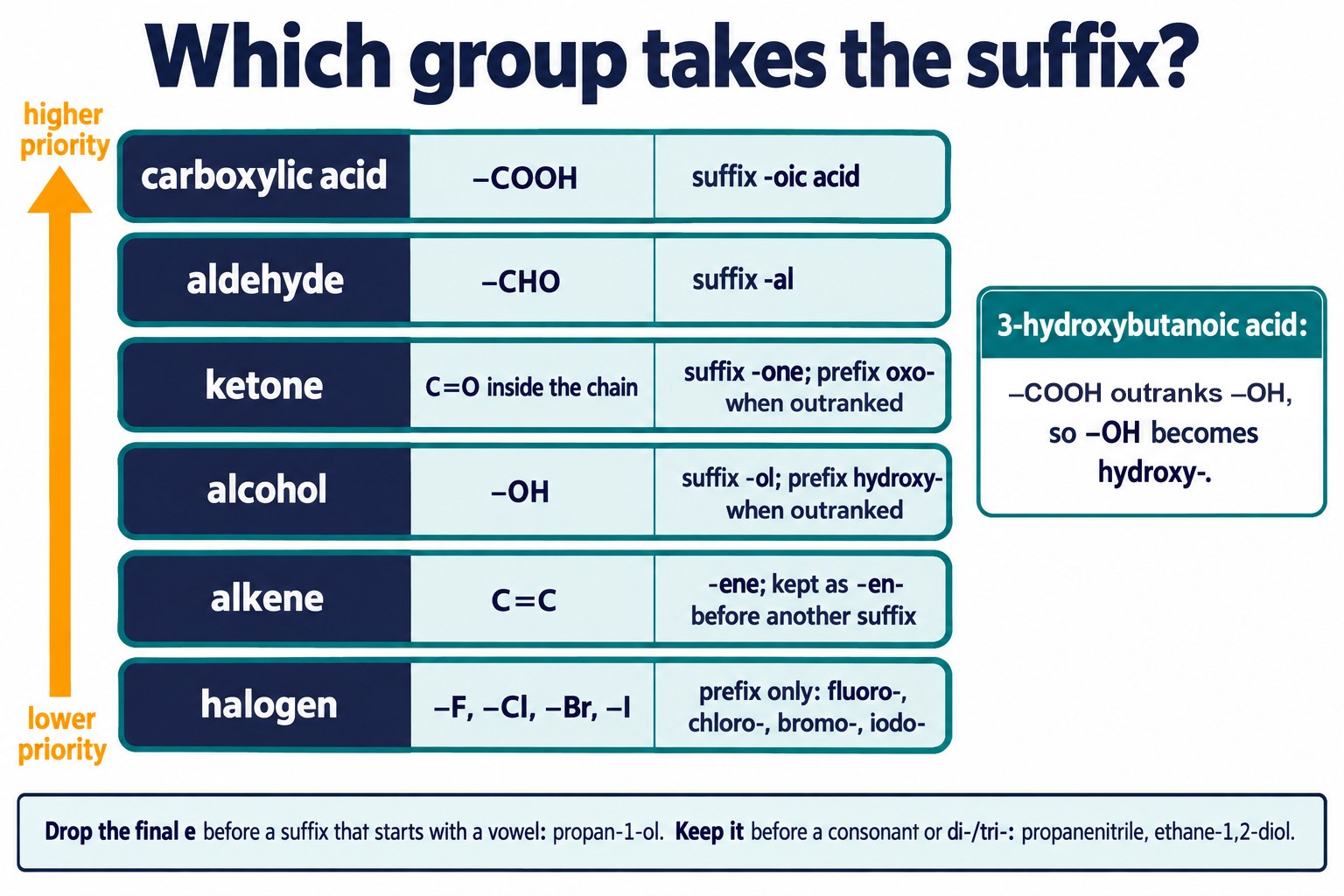
Quick Check: Numbering from the Carboxyl Carbon
Drag the words and numbers into place to name three substituted acids.
Carboxylic Acid Groups at Both Ends
If a molecule has carboxylic acid groups at both ends of the carbon chain, it is named as a dioic acid.
The suffix becomes -dioic acid to show that two -COOH groups are present.
One -COOH group
Use -oic acid, such as ethanoic acid or propanoic acid.
Two -COOH groups
Use -dioic acid, such as ethanedioic acid.
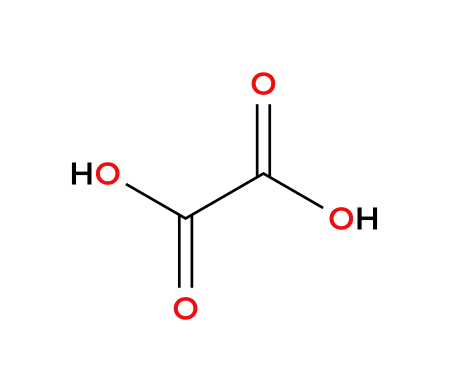
The name ethanedioic acid shows a two-carbon parent chain with a carboxylic acid group at each end.
Quick Check: A Dioic Acid
Pick the structure that matches the name hexanedioic acid.
Common Naming Points to Remember
Carboxylic acid names are usually straightforward once the -COOH group has been identified. The most important step is to include the carboxyl carbon in the main chain and then number from that carbon.
The position of the carboxylic acid group is not written in the name because the -COOH group must be terminal. However, positions are still needed for other groups such as hydroxy or methyl groups.
| Naming point | Correct approach | Example |
|---|---|---|
| Position of -COOH | Do not include a position number for the carboxylic acid group. | propanoic acid |
| Numbering direction | Start numbering from the carboxylic acid carbon. | 3-hydroxy-4-methylpentanoic acid |
| Two -COOH groups | Use the suffix -dioic acid. | ethanedioic acid |
Remember: The carboxylic acid carbon is part of the parent chain, not a side group.
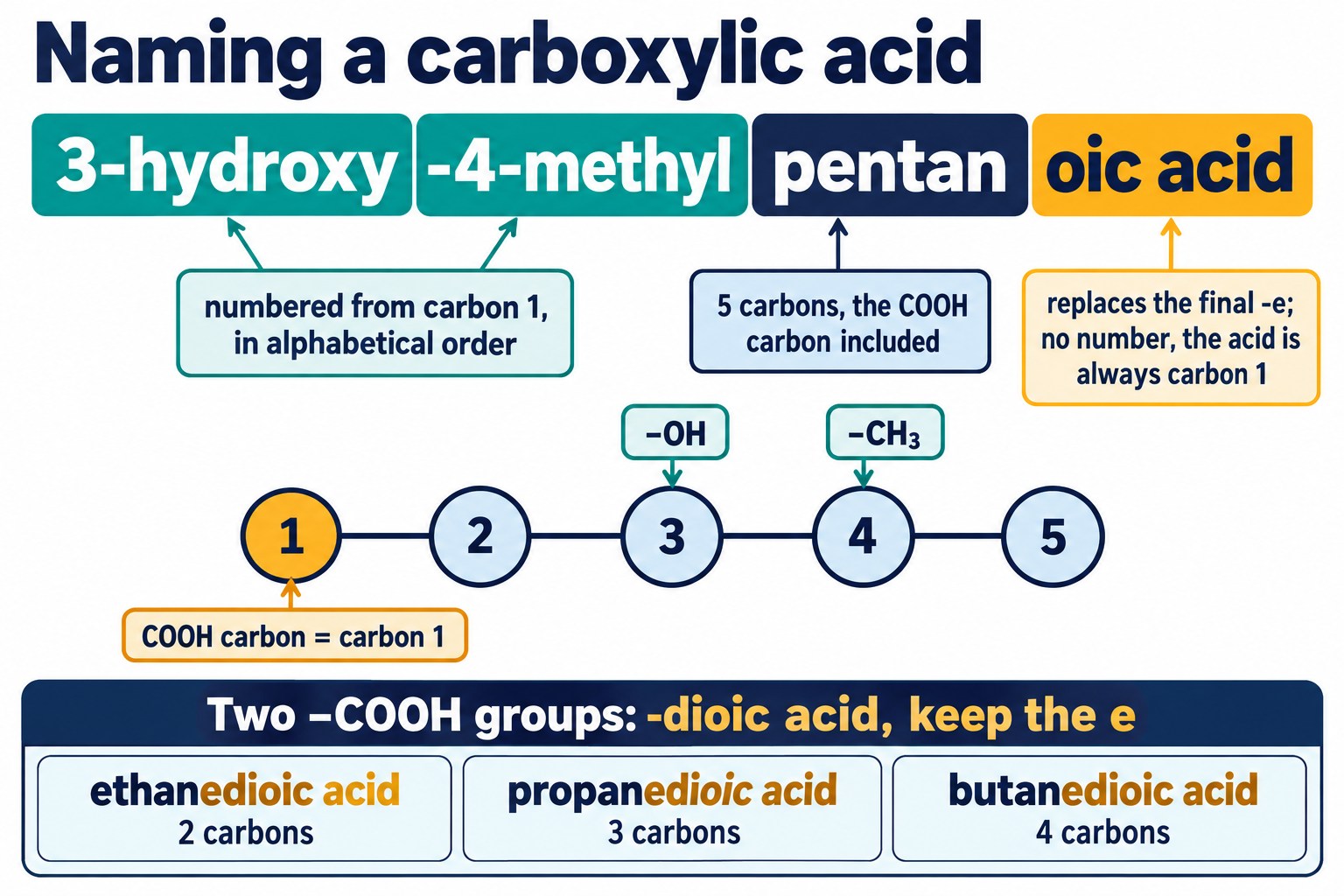
The COOH carbon is carbon 1 and counts in the stem, so substituents are numbered from it.
Quick Check: Spot the Naming Error
Choose the accurate statement in each round.
FAQs
These questions cover the carboxylic acid naming points that cost marks.
Is the COOH carbon counted in the chain length?
Yes. Ethanoic acid, CH₃COOH, has two carbons, and one of them is the COOH carbon.
Why is there no number for the acid group?
The COOH group is always at the end of the chain, on carbon 1, so the number adds nothing.
Which end do I number from in a substituted acid?
Always from the COOH carbon, which is carbon 1. A side chain nearer the other end does not change this.
How is a molecule with COOH at both ends named?
With the suffix -dioic acid and the e of the alkane kept: HOOCCOOH is ethanedioic acid.
Is the C=O in a carboxylic acid a ketone group?
No. The C=O and the -OH on the same carbon form one carboxyl group, and it is named only as the acid.
Copyright notice: This OLS revision content, including the explanations, layout, diagrams, tables and embedded learning structure, is authored for Online Learning System by Dr. Mohammed Al-Fatah. It may not be copied, reproduced, redistributed or adapted without written permission.
Keep this note — free
Save your progress across every Edexcel topic. A free account remembers which topics you have covered, saves your question scores, and syncs across your phone and laptop.
- Track every topic you have finished
- Keep your practice-question scores
- No payment, no card, free forever
Already registered? Log in