Carboxylic Acid
A concise revision guide to the carboxylic acid functional group, the -oic acid suffix, numbering from the carboxylic acid carbon, dicarboxylic acids and examples such as ethanoic acid, propanoic acid and ethanedioic acid.
What Is a Carboxylic Acid?
A carboxylic acid is an organic compound containing the carboxyl functional group, written as -COOH.
The carboxyl group contains both a carbonyl bond, C=O, and a hydroxyl group, -OH, attached to the same carbon atom.
This functional group is found at the end of the carbon chain, so its carbon is included as part of the parent chain.
Key idea: The carboxylic acid group is written as -COOH and the carbon in this group is counted as carbon 1 in the parent chain.
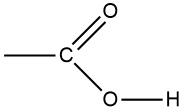
The carboxyl group combines C=O and -OH on the same carbon atom, giving the characteristic -COOH group.
Naming Carboxylic Acids Using the -oic Acid Suffix
Carboxylic acids are named using the suffix -oic acid. This suffix replaces the final -e from the corresponding alkane name.
No position number is needed for the carboxylic acid group because it is always found at the end of the carbon chain.
| Homologous series | Functional group | Suffix | Example |
|---|---|---|---|
| Carboxylic acids | -COOH | -oic acid | ethanoic acid |
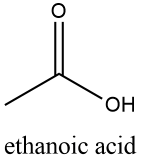
Ethanoic acid has a two-carbon chain and a terminal -COOH group.
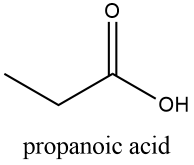
Propanoic acid has a three-carbon chain, with the carboxyl carbon counted in the chain length.
Numbering Starts from the Carboxylic Acid Carbon
When naming a carboxylic acid, numbering of the carbon chain always starts from the carboxylic acid carbon.
This means the carbon in the -COOH group is carbon 1. Any other functional groups or side chains are numbered relative to this carbon.
For example, 3-hydroxy-4-methylpentanoic acid has the carboxylic acid carbon as carbon 1, the -OH group on carbon 3 and a methyl group on carbon 4.
Exam focus: Do not number from the end closest to a side chain if the molecule contains -COOH. The carboxylic acid carbon controls the numbering direction.
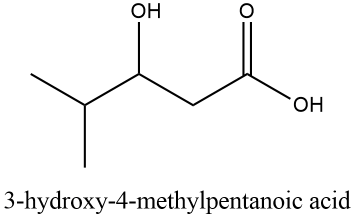
The substituent numbers are assigned after carbon 1 is fixed as the carboxylic acid carbon.
Carboxylic Acid Groups at Both Ends
If a molecule has carboxylic acid groups at both ends of the carbon chain, it is named as a dioic acid.
The suffix becomes -dioic acid to show that two -COOH groups are present.
One -COOH group
Use -oic acid, such as ethanoic acid or propanoic acid.
Two -COOH groups
Use -dioic acid, such as ethanedioic acid.
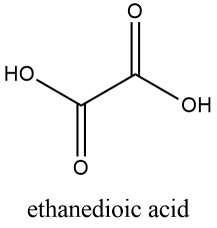
The name ethanedioic acid shows a two-carbon parent chain with a carboxylic acid group at each end.
Common Naming Points to Remember
Carboxylic acid names are usually straightforward once the -COOH group has been identified. The most important step is to include the carboxyl carbon in the main chain and then number from that carbon.
The position of the carboxylic acid group is not written in the name because the -COOH group must be terminal. However, positions are still needed for other groups such as hydroxy or methyl groups.
| Naming point | Correct approach | Example |
|---|---|---|
| Position of -COOH | Do not include a position number for the carboxylic acid group. | propanoic acid |
| Numbering direction | Start numbering from the carboxylic acid carbon. | 3-hydroxy-4-methylpentanoic acid |
| Two -COOH groups | Use the suffix -dioic acid. | ethanedioic acid |
Remember: The carboxylic acid carbon is part of the parent chain, not a side group.
Check Your Understanding
Use these short activities to check the carboxylic acid functional group, the -oic acid suffix, numbering rules and dicarboxylic acid naming.
Master Topic 6A/6B Organic Chemistry and Alkanes for Edexcel A Level Chemistry
Continue from these free revision notes into the full Topic 6A/6B Organic Chemistry and Alkanes course for Edexcel A Level Chemistry Paper 2 (9CH0/02), with guided video teaching, diagnostic MCQ practice, teacher-marked short-answer questions and a specification assignment with a personalised progress report.
Guided video teaching
Learn the chemistry and exam technique through structured video lessons with worked examples and walkthroughs.
Instant MCQ feedback
Auto-marked MCQ quizzes provide immediate diagnostic feedback for every answer choice.
Teacher-marked SAQs
Submit written exam responses and receive chemistry specialist feedback with improvement guidance.
Progress tracking
Identify strengths and weaknesses across the full Topic 6A/6B specification with targeted reporting.
See how the course works
Click play to start the course preview animation.
Some ionic radii are shown.
| Ion | Ionic radius / nm |
|---|---|
| Na+ | 0.102 |
| K+ | 0.138 |
| F− | 0.133 |
| Cl− | 0.180 |
Which compound has the strongest ionic bonding?
Explain why the metallic bonding in magnesium is much stronger than that in sodium.