Alkanes from Crude Oil
Use this landing page to move quickly between the main crude oil revision pages for Edexcel A Level Chemistry Topic 6. These pages cover how crude oil is separated, how long-chain hydrocarbons are converted into more useful molecules and how reforming changes hydrocarbon structure for industrial use.
Choose an Alkanes from Crude Oil Page
Crude oil is a complex mixture of hydrocarbons. This section breaks the topic into the three key industrial processes students need to recognise: fractional distillation, cracking and reforming.
Key idea: Fractional distillation separates crude oil into fractions by boiling range, while cracking and reforming change hydrocarbon molecules into more useful products.
Fractional Distillation
Revise how crude oil is separated into fractions using differences in boiling point and chain length.
Cracking
Learn how long-chain hydrocarbons are broken into shorter alkanes and alkenes that are more useful as fuels and feedstocks.
Reforming
Review how straight-chain hydrocarbons are rearranged into branched or cyclic molecules to improve fuel quality.
How to Use These Pages
Start with fractional distillation to understand how crude oil is separated. Then move to cracking to see how supply and demand are adjusted by changing long-chain hydrocarbons into shorter products. Finish with reforming to connect molecular structure with fuel performance.
Exam focus: Be able to explain separation by boiling point, describe cracking conditions and products, and understand why reforming produces hydrocarbons with improved fuel properties.
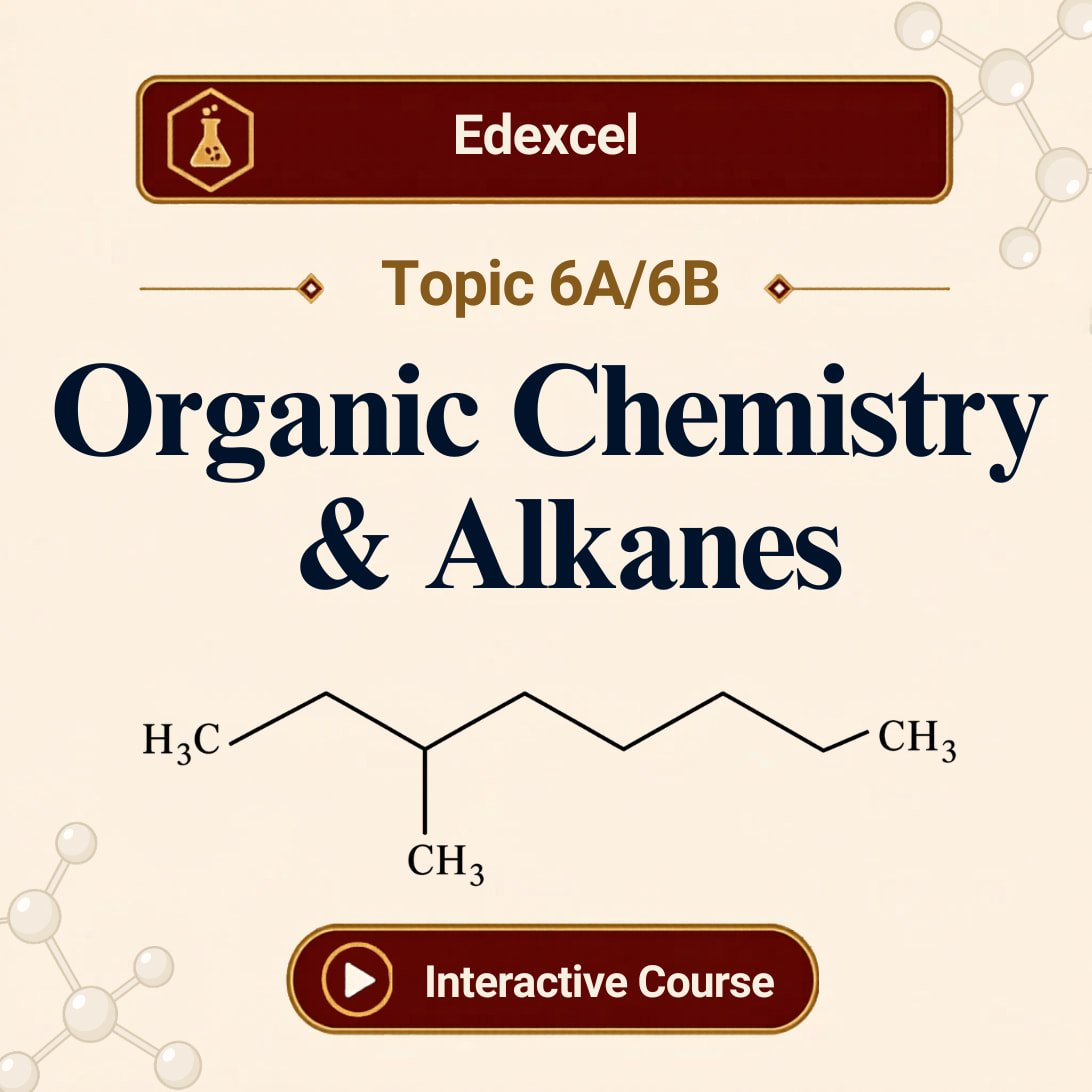
Master Topic 6A/6B Organic Chemistry and Alkanes for Edexcel A Level Chemistry
Continue from these free revision notes into the full Topic 6A/6B Organic Chemistry and Alkanes course for Edexcel A Level Chemistry Paper 2 (9CH0/02), with guided video teaching, diagnostic MCQ practice, teacher-marked short-answer questions and a specification assignment with a personalised progress report.
Guided video teaching
Learn the chemistry and exam technique through structured video lessons with worked examples and walkthroughs.
Instant MCQ feedback
Auto-marked MCQ quizzes provide immediate diagnostic feedback for every answer choice.
Teacher-marked SAQs
Submit written exam responses and receive chemistry specialist feedback with improvement guidance.
Progress tracking
Identify strengths and weaknesses across the full Topic 6A/6B specification with targeted reporting.
See how the course works
Click play to start the course preview animation.
Some ionic radii are shown.
| Ion | Ionic radius / nm |
|---|---|
| Na+ | 0.102 |
| K+ | 0.138 |
| F− | 0.133 |
| Cl− | 0.180 |
Which compound has the strongest ionic bonding?
Explain why the metallic bonding in magnesium is much stronger than that in sodium.
Copyright notice: This revision page, including its written explanations, layout and teaching sequence, is produced for Online Learning System by Dr. Mohammed Al-Fatah. It is intended for student revision and may not be copied, redistributed or republished without permission.