Alternative Fuel
A concise revision guide to pollutants from fuel combustion, biofuels, alcohol fuels, biodiesel and the advantages and disadvantages of replacing fossil fuels with renewable plant-based fuels.

Why Alternative Fuels Are Needed
Most fossil fuels are obtained from crude oil. Crude oil is a non-renewable resource, so it will eventually be depleted if it continues to be used faster than it forms.
Alternative fuels have been developed to reduce reliance on finite fuel reserves. Important examples include alcohols such as ethanol and biodiesel, both of which can be produced from plant material.
Definition: A renewable fuel is a fuel made from resources that can be replaced or regrown on a short timescale compared with fossil fuels.
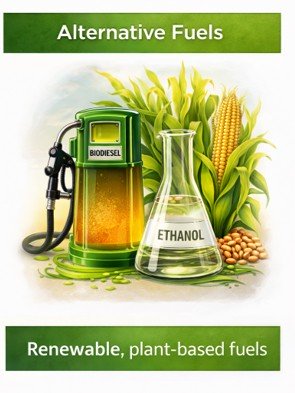
Biofuels are produced from recently living plant material, whereas fossil fuels are made from ancient biological material over very long timescales.
Pollutants from Fuel Combustion
Burning fuels in engines can release several pollutants. The exact products depend on the conditions inside the engine, including oxygen supply, temperature and whether the fuel burns completely.
| Pollutant source | Pollutant | Environmental consequence |
|---|---|---|
 |
Nitrogen oxides Formed when N2 in the air reacts at the high temperatures and spark in the engine. |
NO is toxic and can form smog. NO2 is toxic and acidic and forms acid rain. |
 |
Carbon monoxide | Toxic gas formed during incomplete combustion. |
 |
Carbon dioxide | Contributes towards global warming. |
 |
Unburnt hydrocarbons Formed because not all fuel burns in the engine. |
Contribute towards global smog. |
 |
Soot and particulates | Cause global dimming and respiratory problems. |
Exam focus: Link each pollutant to both its origin and its consequence. For example, nitrogen oxides form at high engine temperatures and contribute to acid rain and smog.
Biofuels from Renewable Resources
Biofuels are fuels produced from biological material, especially plant material. They are described as renewable because the raw materials can be regrown.
Biofuels are often considered more carbon neutral than fossil fuels because the carbon dioxide released during combustion can be partially offset by the carbon dioxide absorbed during plant growth.
Key idea: Biofuels are not automatically zero-carbon. The carbon dioxide released when they burn may be partly balanced by photosynthesis during plant growth, but growing, processing and transporting the fuel can still involve emissions.
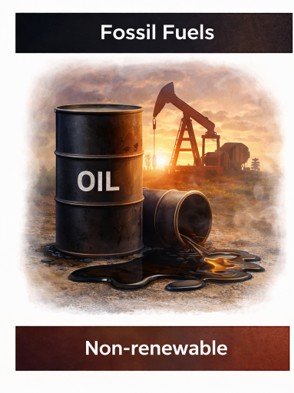
Fossil fuels
Crude-oil based fuels are non-renewable because the reserves are finite.

Alternative fuels
Plant-based fuels can be renewable if the crops or raw materials are regrown sustainably.
Alcohol Fuels and Biodiesel
Alcohol fuels such as ethanol can be produced by the fermentation of sugars obtained from plants. Because the raw materials can be regrown, ethanol is considered a renewable fuel source.
Biodiesel is produced by reacting vegetable oils with methanol in the presence of an alkali catalyst. This converts the oils into a fuel suitable for use in diesel engines, providing an alternative to fossil-based diesel.

Alcohol fuels
Ethanol can be made by fermentation of sugars from plants.

Biodiesel
Vegetable oils react with methanol using an alkali catalyst to make biodiesel.
Common mistake: Do not describe biodiesel as crude-oil based. It is made from vegetable oils and methanol, so it is an alternative to fossil-based diesel.
Advantages and Disadvantages of Biofuels
Biofuels can reduce dependence on fossil fuels, but their production can also compete with food production and land use.
| Advantages | Disadvantages |
|---|---|
| Reduction in use of fossil fuels Biofuels reduce reliance on finite fossil fuel resources. |
Less food crops may be grown Land and crops may be diverted from food production to fuel production. |
| Biofuels are renewable Plant material can be regrown if managed sustainably. |
Land not used to grow food crops Using agricultural land for fuel crops can reduce food availability. |
| Biodiesel is more carbon neutral CO2 released during combustion may be partly offset by CO2 absorbed during plant growth. |
Rainforests may be cut down to provide land Deforestation damages habitats and can increase net carbon emissions. |
| Fossil fuels can be used as feedstock Reducing their use as fuels can preserve crude oil for making organic compounds. |
Shortage of fertile soils Large-scale fuel crop production can increase pressure on fertile land. |
| Lower risk of large-scale fossil fuel pollution Less extraction and transport of fossil fuels can reduce the risk of major pollution events. |
Environmental pressure Intensive farming can cause water stress, habitat loss and soil degradation. |
Reduced fossil fuel use
Using biofuels can decrease dependence on finite crude-oil resources.

Food crop competition
Growing fuel crops can reduce the land available for food crops.

Deforestation risk
Rainforests may be cleared to provide land for biofuel crop production.
Land and water pressure
Large-scale crop growth can put pressure on fertile soils and water supplies.
Common Exam Mistakes
- Do not say biofuels are completely carbon neutral. It is more precise to say they may be more carbon neutral because plant growth can offset some CO2 released during combustion.
- Do not confuse carbon monoxide with carbon dioxide. Carbon monoxide is toxic, while carbon dioxide contributes towards global warming.
- Do not forget that nitrogen oxides form from nitrogen in the air at high engine temperatures, not from nitrogen inside the fuel.
- Do not list only advantages of biofuels. Examiners often expect a balanced evaluation including food crop competition, land use and deforestation.
Check Your Understanding
Use these short activities to check pollutants from fuel combustion, the meaning of renewable fuels and the advantages and disadvantages of biofuels.
Alternative Fuel Summary
Fossil fuels
Crude-oil fuels are non-renewable and will eventually be depleted.
Biofuels
Alcohols and biodiesel can be made from plant-based renewable resources.
Pollutants
Combustion can produce CO, CO2, nitrogen oxides, unburnt hydrocarbons and particulates.

Trade-offs
Biofuels reduce fossil fuel use but may increase pressure on food crops, forests and fertile soils.

Master Topic 6A/6B Organic Chemistry and Alkanes for Edexcel A Level Chemistry
Continue from these free revision notes into the full Topic 6A/6B Organic Chemistry and Alkanes course for Edexcel A Level Chemistry Paper 2 (9CH0/02), with guided video teaching, diagnostic MCQ practice, teacher-marked short-answer questions and a specification assignment with a personalised progress report.
Guided video teaching
Learn the chemistry and exam technique through structured video lessons with worked examples and walkthroughs.
Instant MCQ feedback
Auto-marked MCQ quizzes provide immediate diagnostic feedback for every answer choice.
Teacher-marked SAQs
Submit written exam responses and receive chemistry specialist feedback with improvement guidance.
Progress tracking
Identify strengths and weaknesses across the full Topic 6A/6B specification with targeted reporting.
See how the course works
Click play to start the course preview animation.
Some ionic radii are shown.
| Ion | Ionic radius / nm |
|---|---|
| Na+ | 0.102 |
| K+ | 0.138 |
| F− | 0.133 |
| Cl− | 0.180 |
Which compound has the strongest ionic bonding?
Explain why the metallic bonding in magnesium is much stronger than that in sodium.
Alternative Fuel FAQ
Use these questions to check the main exam ideas about pollutants and plant-based fuels.
Why are fossil fuels described as non-renewable?
Fossil fuels are non-renewable because they are formed over very long timescales and are being used faster than they can be replaced.
Why are biofuels described as renewable?
Biofuels are described as renewable because their raw materials, such as plant crops, can be regrown.
Why can biofuels be more carbon neutral than fossil fuels?
The carbon dioxide released during biofuel combustion can be partly offset by carbon dioxide absorbed during plant growth.
How is biodiesel made?
Biodiesel is produced by reacting vegetable oils with methanol in the presence of an alkali catalyst.
What are the main disadvantages of growing crops for biofuels?
Less land may be available for food crops, rainforests may be cut down and there may be greater pressure on fertile soils and water supplies.
Copyright notice: This OLS revision content, including the explanations, layout, diagrams, tables and embedded learning structure, is authored for Online Learning System by Dr. Mohammed Al-Fatah. It may not be copied, reproduced, redistributed or adapted without written permission.