Initiation
A concise revision guide to the initiation step in free-radical substitution, including UV light, homolytic fission, halogen radicals and how unpaired electrons are represented.
What Happens During Initiation?
Initiation is the first step in the free-radical substitution mechanism. It produces the free radicals needed to start the chain reaction.
In this step, a halogen molecule absorbs energy from ultraviolet, UV, light. The energy breaks the halogen-halogen bond by homolytic fission.
For chlorine, the initiation equation is:
Initiation equation: Cl2 → 2Cl•
Key idea: Initiation does not directly make the haloalkane product. It produces the reactive halogen radicals that allow the next stage, propagation, to begin.
Why UV Light Breaks the Halogen Bond
UV light provides enough energy to break the Cl-Cl bond in chlorine or the Br-Br bond in bromine.
In chlorination, the Cl-Cl bond is broken in preference to other bonds because it is the weakest bond present in the starting mixture. UV light does not have sufficient energy to break the much stronger C-H bond in the alkane under these conditions.
| Bond considered | What UV light does | Importance in initiation |
|---|---|---|
| Cl-Cl or Br-Br | Breaks the halogen-halogen bond by homolytic fission. | Forms halogen free radicals, such as Cl• or Br•. |
| C-H | Does not break this bond during initiation. | The C-H bond is stronger, so it is not the bond selected by UV light at this stage. |
Exam focus: Do not write that UV light breaks a C-H bond in the initiation step. The initiation step breaks the halogen-halogen bond.
Homolytic Fission
The halogen-halogen bond breaks by homolytic fission. This means that each atom takes one electron from the shared covalent bond.
Because each atom receives one electron, the products are not ions. Instead, the products are free radicals with unpaired electrons.
Homolytic fission: bond breaking in which each atom takes one electron from the shared covalent bond.
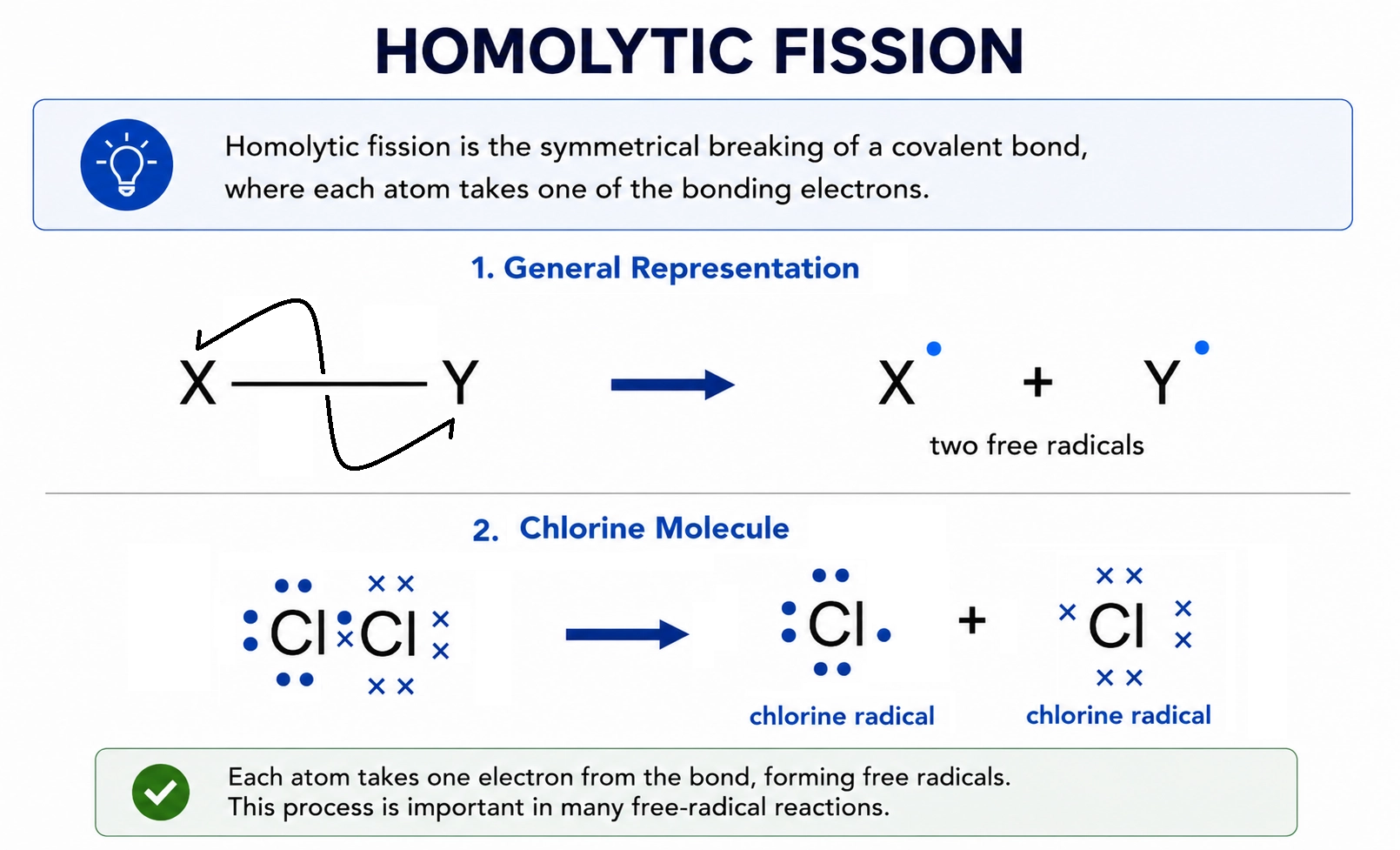
Each atom receives one electron from the shared pair, producing two free radicals rather than ions.
Free Radicals Formed in Initiation
A free radical is a reactive species with an unpaired electron. This unpaired electron is represented using a dot, such as Cl• or Br•.
Free radicals have no overall charge. The dot shows the unpaired electron, not a positive or negative charge.
| Halogen molecule | Initiation equation | Radical formed |
|---|---|---|
| Chlorine, Cl2 | Cl2 → 2Cl• | Chlorine radicals, Cl• |
| Bromine, Br2 | Br2 → 2Br• | Bromine radicals, Br• |
Remember: The dot must stay with the radical symbol. It represents the unpaired electron that makes the species highly reactive.
Writing the Initiation Step Correctly
When writing initiation, keep the equation simple and specific. The reactant is the halogen molecule, and the products are two halogen radicals.
For chlorination, the correct initiation step is:
Cl2 → 2Cl•
For bromination, the equivalent initiation step is:
Br2 → 2Br•
Common mistake: Do not add charges to the radicals. Cl• and Br• are neutral radicals, not Cl– or Br– ions.
Check Your Understanding
Use these short activities to check UV light, homolytic fission, radical formation and the correct initiation equations.
Master Topic 6A/6B Organic Chemistry and Alkanes for Edexcel A Level Chemistry
Continue from these free revision notes into the full Topic 6A/6B Organic Chemistry and Alkanes course for Edexcel A Level Chemistry Paper 2 (9CH0/02), with guided video teaching, diagnostic MCQ practice, teacher-marked short-answer questions and a specification assignment with a personalised progress report.
Guided video teaching
Learn the chemistry and exam technique through structured video lessons with worked examples and walkthroughs.
Instant MCQ feedback
Auto-marked MCQ quizzes provide immediate diagnostic feedback for every answer choice.
Teacher-marked SAQs
Submit written exam responses and receive chemistry specialist feedback with improvement guidance.
Progress tracking
Identify strengths and weaknesses across the full Topic 6A/6B specification with targeted reporting.
See how the course works
Click play to start the course preview animation.
Some ionic radii are shown.
| Ion | Ionic radius / nm |
|---|---|
| Na+ | 0.102 |
| K+ | 0.138 |
| F− | 0.133 |
| Cl− | 0.180 |
Which compound has the strongest ionic bonding?
Explain why the metallic bonding in magnesium is much stronger than that in sodium.
Initiation FAQs
These questions target the main points students often confuse when first learning the initiation step.
What is initiation in free radical substitution?
Initiation is the first stage of the mechanism. UV light breaks a halogen-halogen bond by homolytic fission, forming halogen free radicals.
What condition is needed for initiation?
Ultraviolet light is needed. It provides enough energy to break the Cl-Cl or Br-Br bond and produce radicals.
What is homolytic fission?
Homolytic fission is bond breaking where each atom takes one electron from the shared covalent bond. This forms free radicals.
Why does UV light break Cl-Cl rather than C-H?
The Cl-Cl bond is weaker than the C-H bond, so UV light breaks the chlorine-chlorine bond preferentially during initiation.
How are free radicals shown in equations?
Free radicals are shown using a dot to represent an unpaired electron, for example Cl• or Br•.
Copyright notice: This OLS revision content, including the explanations, layout, diagrams, tables and embedded learning structure, is authored for Online Learning System by Dr. Mohammed Al-Fatah. It may not be copied, reproduced, redistributed or adapted without written permission.