Electrophilic Addition Mechanism
A concise revision guide to addition reactions of alkenes, electrophiles, electron-rich π bonds and why the carbon-carbon double bond is the reactive centre in alkene chemistry.
Addition Reactions of Alkenes
An addition reaction is a reaction in which two reactant molecules combine to form a single product molecule.
Alkenes commonly undergo addition reactions because their carbon-carbon double bond can be broken and replaced by new single bonds.
This is why the C=C bond is the functional group that controls the characteristic reactions of alkenes.
Key idea: In an alkene addition reaction, atoms add across the C=C double bond and only one organic product molecule is formed.
Addition across a double bond
The double bond opens up, allowing new atoms or groups to attach to the two carbon atoms from the original C=C bond.
Why the π Bond Reacts
In an alkene, the π bond is weaker than the σ bond, so it requires less energy to break during a reaction.
The π bond also contains a region of high electron density. This exposed electron density is especially attractive to electron-seeking species.
Because the π bond is both weaker and more exposed than a σ bond, it is particularly susceptible to attack by electrophiles.
Exam focus: Link alkene reactivity to the exposed, electron-rich π bond rather than simply saying that alkenes have a double bond.
Electron-rich π bond
The π bond forms exposed electron density above and below the molecular plane, making the alkene attractive to electrophiles.
Electrophiles
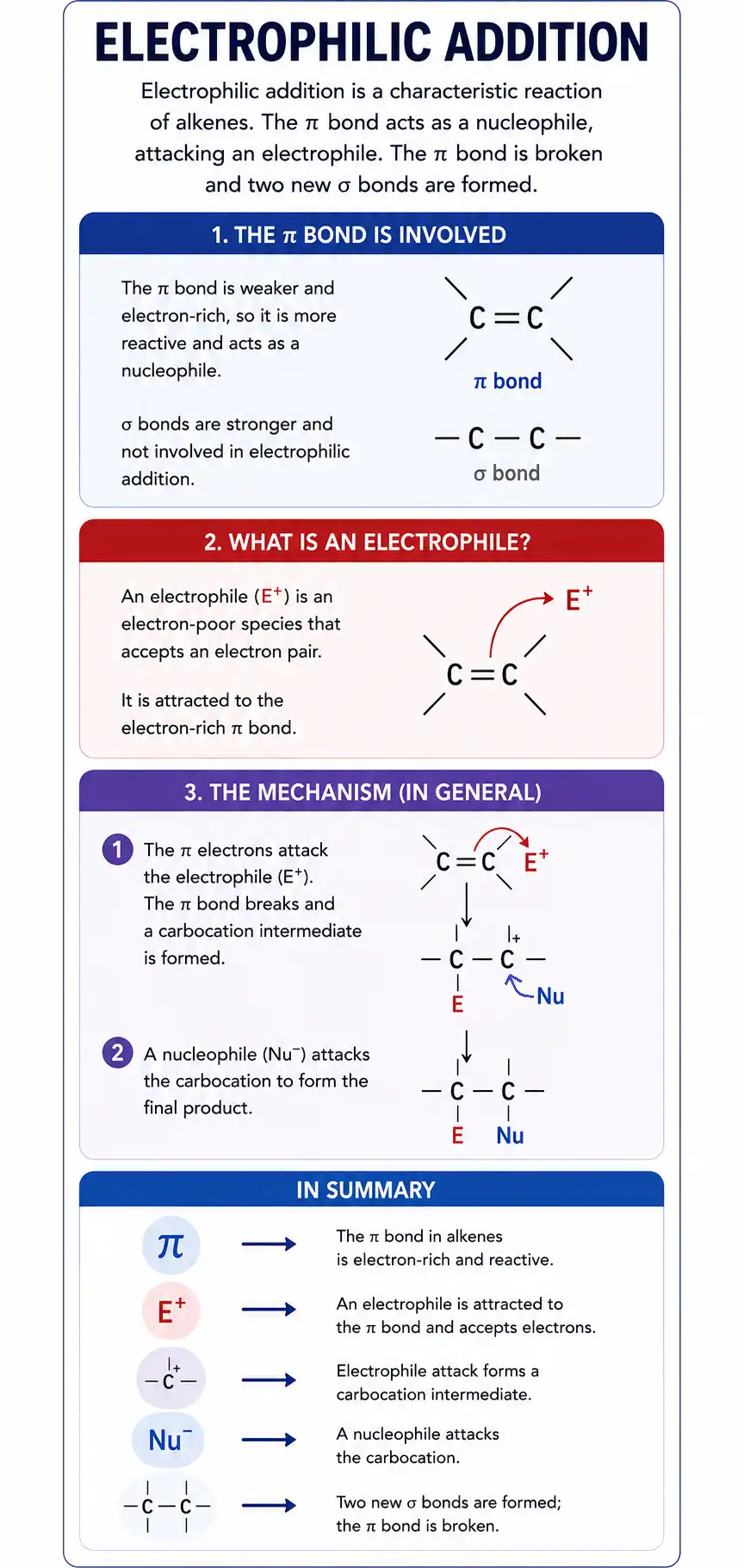
An electrophile is an electron pair acceptor.
Electrophiles are attracted to regions of high electron density. In alkenes, this means the electrophile is drawn towards the electron-rich π bond.
This attraction begins the electrophilic addition mechanism.
Electrophile: A species that accepts an electron pair from an electron-rich region during a chemical reaction.
The Electrophilic Addition Mechanism
In electrophilic addition, the π bond breaks and new single bonds are formed. The electrophile accepts an electron pair from the alkene.
At this stage, students must be careful with curly arrows. A curly arrow shows the movement of an electron pair, so the arrow should start from a bond or lone pair, not from a positive charge.
1. Attraction
The electrophile is attracted to the high electron density in the π bond.
2. Bond breaking
The π bond breaks because it is weaker than the σ bond.
3. New bonds form
New single bonds form to give an addition product.
Remember: Electrophilic addition happens because the π bond is electron-rich, exposed and relatively easy to break.
Exam Link: Why Alkenes React This Way
Exam answers should connect three ideas: the alkene contains a C=C bond, the π bond has high electron density, and electrophiles are attracted to this electron-rich region.
It is not enough to write that alkenes are reactive because they have a double bond. The explanation needs to identify the role of the π bond and the electrophile.
| Exam phrase | Why it matters | Common mistake to avoid |
|---|---|---|
| π bond has high electron density | Explains why an electrophile is attracted to the alkene. | Only saying that the double bond is reactive. |
| Electrophile accepts an electron pair | Links the definition of electrophile to the mechanism. | Calling the electrophile an electron donor. |
| π bond breaks and new single bonds form | Explains why the reaction is an addition reaction. | Describing substitution instead of addition. |
Check Your Understanding
Use these short activities to check the key ideas before moving on to reactions of alkenes.
Master Alkenes for Edexcel A Level Chemistry
Continue from these free revision notes into the full Topic 6C Alkenes course, with guided video teaching, diagnostic MCQ practice, teacher-marked short-answer questions and a specification assignment with a personalised progress report.
Guided video teaching
Learn the chemistry and exam technique through structured video lessons with worked examples and walkthroughs.
Instant MCQ feedback
Auto-marked MCQ quizzes provide immediate diagnostic feedback for every answer choice.
Teacher-marked SAQs
Submit written exam responses and receive chemistry specialist feedback with improvement guidance.
Progress tracking
Identify strengths and weaknesses across the full Topic 6C specification with targeted reporting.
See how the course works
Click play to start the course preview animation.
Some ionic radii are shown.
| Ion | Ionic radius / nm |
|---|---|
| Na+ | 0.102 |
| K+ | 0.138 |
| F− | 0.133 |
| Cl− | 0.180 |
Which compound has the strongest ionic bonding?
Explain why the metallic bonding in magnesium is much stronger than that in sodium.
Copyright notice: This OLS revision content, including the explanations, layout, diagrams, tables and embedded learning structure, is authored for Online Learning System by Dr. Mohammed Al-Fatah. It may not be copied, reproduced, redistributed or adapted without written permission.