Reactions of Alkenes with KMnO4
A concise revision guide to the oxidation of alkenes using potassium manganate(VII), including the formation of diols, the purple to colourless observation and how this reaction can be used as a test for the alkene functional group.
The Overall Reaction
Alkenes react with KMnO4, potassium manganate(VII), in acidified solution to form diols.
A diol is an organic compound containing two alcohol, -OH, groups. In this reaction, the C=C double bond opens and an -OH group is added to each carbon atom from the original double bond.
For example, propene is oxidised to form propane-1,2-diol.
Key idea: KMnO4 oxidises the alkene functional group, converting the C=C double bond into a diol.
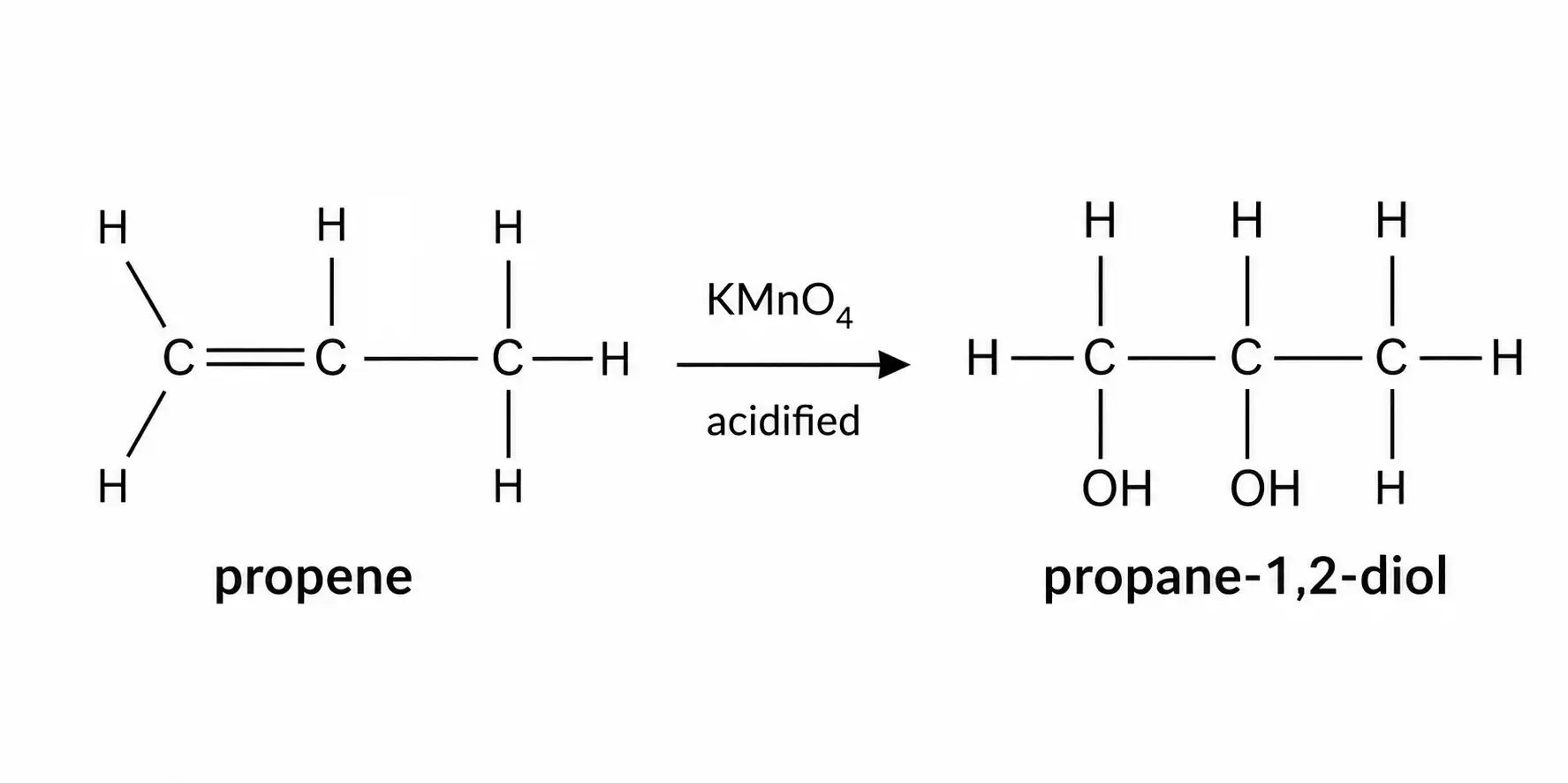
The displayed reaction shows the alkene functional group in propene changing into a diol after oxidation with KMnO4.
Conditions and Observation
This reaction is carried out using acidified KMnO4 at room temperature.
The important observation is that the purple colour of the MnO4– ion decolourises to colourless.
This colour change is useful because it provides a simple chemical test for the presence of the alkene functional group.
Exam focus: State the full observation as purple to colourless. Do not write only “goes clear”.
Why It Tests for Alkenes
The reaction can be used as a test for alkenes because alkenes contain a C=C double bond that can be oxidised under these conditions.
Alkanes do not contain a carbon-carbon double bond. They are saturated hydrocarbons, so they do not react in the same way with acidified KMnO4 at room temperature.
Therefore, an alkene gives the purple to colourless change, but an alkane would show no colour change.
Diol: An organic compound containing two alcohol, -OH, groups. In this alkene oxidation reaction, the two -OH groups form on the two carbon atoms from the original C=C double bond.
Remember: The test depends on oxidation of the alkene double bond, not substitution or hydrogenation.
Common Exam Mistakes
Students often lose marks by forgetting that the product is a diol, not a single alcohol.
Another common error is to describe the reaction as addition only. The expected reaction type here is oxidation.
For observation questions, the safest answer should include both the starting colour and the final colour.
Exam focus: Link the colour change to the reaction of MnO4– with the alkene C=C double bond.
Check Your Understanding
Use these short activities to check the key ideas before moving on to the next alkene topic.
Master Alkenes for Edexcel A Level Chemistry
Continue from these free revision notes into the full Topic 6C Alkenes course, with guided video teaching, diagnostic MCQ practice, teacher-marked short-answer questions and a specification assignment with a personalised progress report.
Guided video teaching
Learn the chemistry and exam technique through structured video lessons with worked examples and walkthroughs.
Instant MCQ feedback
Auto-marked MCQ quizzes provide immediate diagnostic feedback for every answer choice.
Teacher-marked SAQs
Submit written exam responses and receive chemistry specialist feedback with improvement guidance.
Progress tracking
Identify strengths and weaknesses across the full Topic 6C specification with targeted reporting.
See how the course works
Click play to start the course preview animation.
Some ionic radii are shown.
| Ion | Ionic radius / nm |
|---|---|
| Na+ | 0.102 |
| K+ | 0.138 |
| F− | 0.133 |
| Cl− | 0.180 |
Which compound has the strongest ionic bonding?
Explain why the metallic bonding in magnesium is much stronger than that in sodium.
Copyright notice: This OLS revision content, including the explanations, layout, diagrams, tables and embedded learning structure, is authored for Online Learning System by Dr. Mohammed Al-Fatah. It may not be copied, reproduced, redistributed or adapted without written permission.